


Baby Food Maker vs Steamer vs Blender: What Parents Actually Need
Three ways to make a carrot purée, and they cost wildly different amounts. The one worth buying isn’t the fanciest — it’s the one whose cleanup you’ll still tolerate in week three.
You’ve decided to make your own baby food. Good — it’s cheaper than pouches and you get to pick every ingredient. Then you open a shopping tab and the question turns into something else entirely: do you buy a dedicated baby food maker, dust off a steamer and blender, or just use the blender already on your counter?
Here’s the thing nobody tells you when you’re comparing feature lists. All three of these actually work. A maker, a steamer-plus-blender, and a plain blender will all turn a steamed carrot into something your six-month-old can eat. The real question isn’t which one cooks best — it’s which one you’ll still be reaching for after the novelty wears off and you’re doing this at 6 p.m. with a hungry baby on your hip.

The honest verdict, before the table
Let me save you the suspense. For most parents starting solids, an all-in-one baby food maker is the easiest one to keep up with — not because it cooks better, but because it removes the steps where homemade food usually dies: the hot transfer, the second appliance, the pile of parts in the sink. If you already own a good steamer and a blender that handles small amounts, you genuinely don’t need to buy anything. And a plain blender is fine too, as long as you remember it doesn’t cook. (If you’re also weighing it against the jars on the shelf, we compared homemade versus store-bought purées separately.)
That’s The quick version. The longer version is that each option is the right one for a different kind of household, so here’s who each is actually for.
The all-in-one baby food maker
This is the one to pick if homemade purées are going to be a regular weekday thing and you want the lowest-friction version of it. A dedicated maker steams and then blends in the same cup, so you skip scraping hot vegetables from a basket into a separate jar. Its strength is the workflow and the small mess; the honest trade-off is that it’s another appliance to buy and store, and it’s built for baby-sized portions, not Sunday batch-cooking for the whole family.
A steamer plus a blender
This is the smart pick if you already own both, or if you cook in bigger batches. Steam a tray of sweet potato for the family’s dinner, set aside a baby-safe portion before you season it, then blend just what your baby needs. It’s flexible, it’s familiar, and it costs you nothing new. The trade-off is real, though: two appliances means more hot transfers between containers and more surfaces to wash — the basket, the pot or tray, the jar, the lid, the spatula. For some parents that’s nothing; for others it’s exactly what ends the homemade-food experiment.
Your existing kitchen blender
This is the cheapest route, and it’s a perfectly good one with a single catch: a blender blends, it doesn’t cook. You still have to steam, roast, or boil the food soft first. It works best when you’re already making family meals and just adapt a baby portion before adding salt, sugar, honey, or seasoning. The one frustration is volume — many full-size blenders can’t pull a tiny portion down into the blades without a splash of water or breast milk to get things moving.
The best tool for the job is the one whose cleanup you’ll actually keep up with.
The three side by side
If you only skim one thing: the maker wins on cleanup and workflow, the steamer-plus-blender wins on big batches and using what you own, and a plain blender is cheapest but doesn’t cook.
| Baby food maker | Steamer + blender | Kitchen blender | |
|---|---|---|---|
| Steams? | Yes | Yes (steamer) | No |
| Blends? | Yes | Yes (blender) | Yes |
| All-in-one? | Yes | No, two devices | No, blends only |
| Best portion size | Small, baby-sized | Large batches | Larger; small can stall |
| Parts to wash | Fewest | Most | Jar + cookware |
Just the facts, side by side — the verdict’s in the paragraphs above; this is the quick scan.
Whichever you pick, the food-safety rules are the same
The appliance doesn’t make food safe — how you handle it does. The American Academy of Pediatrics describes around 6 months as the usual time to introduce foods beyond breast milk or formula, while noting every child is different. Readiness looks like sitting with support, steady head and neck control, opening the mouth for the spoon, and moving food to the back of the mouth instead of pushing it out. Once you’re there, the handling is the same no matter what cooked the food:
- No honey before 12 months. It carries a risk of infant botulism in babies under one — keep it out of homemade purées entirely at this age.
- No added salt or sugar. Babies don’t need them, and added salt is hard on developing kidneys. Set aside a baby portion before you season family food.
- Store it promptly. Cool fresh purées quickly; refrigerate and use within about 24–48 hours, or freeze for longer. Don’t leave perishable baby food at room temperature for more than two hours, don’t save a container a spoon has gone back into from the baby’s mouth, and don’t refreeze thawed food. Label every portion with the date.
- Match texture to your baby’s stage. Early foods should be soft, puréed, or mashed. A blender making something perfectly smooth doesn’t mean it’s right for every baby — texture follows feeding skills, not appliance power.
For the practical side — which ingredients to start with and how — our guide to cooking vegetables, fruit, meat, and grains in a baby food maker walks through it stage by stage.
Where Quook fits
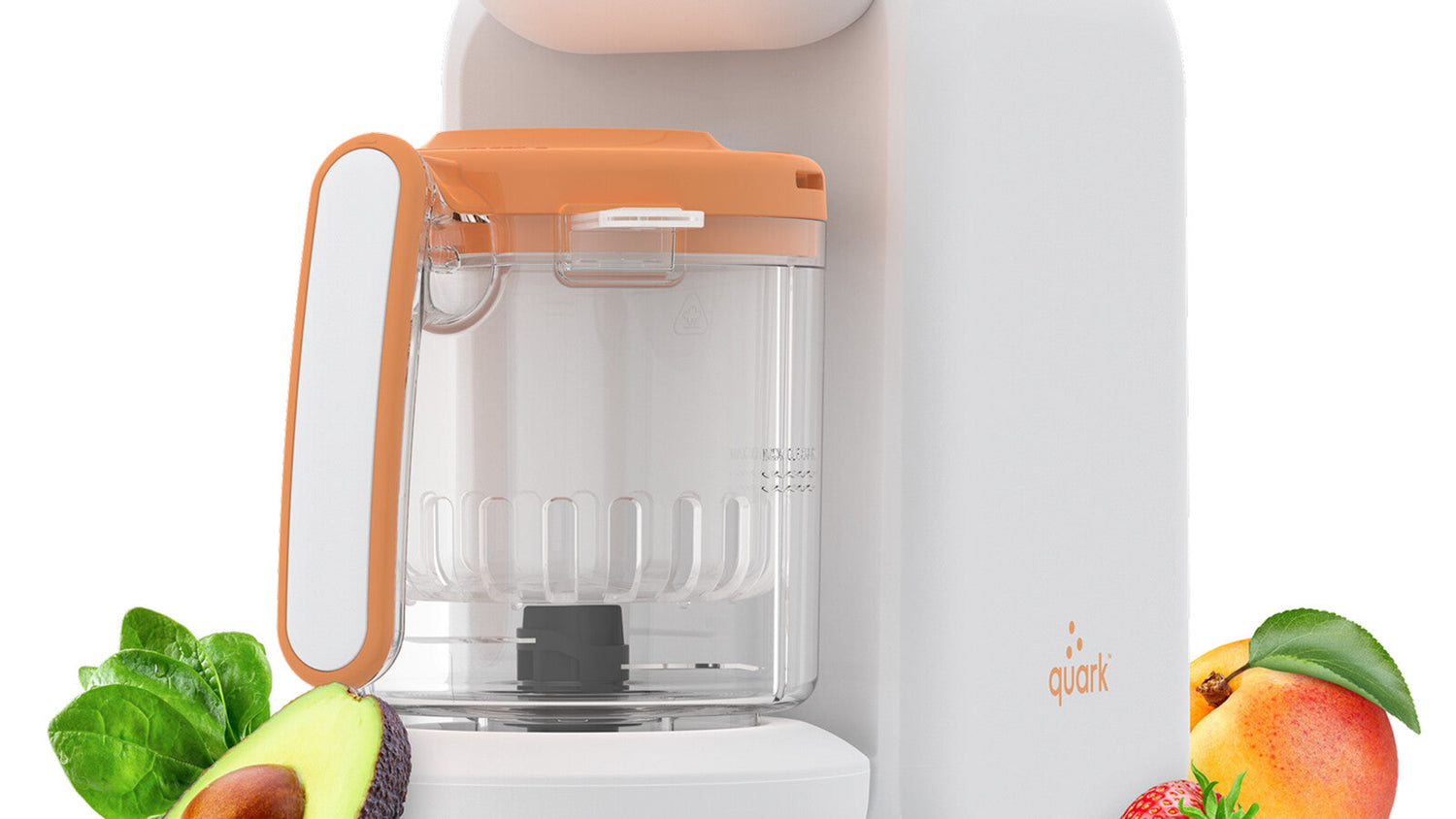
This is the part we make, so weigh it accordingly. Quook is built for the parent who wants homemade purées without assembling a mini appliance collection. It steams and blends in one cup, and because it’s a 5-in-1, it also warms bottles and steam-sterilizes small parts — so the comparison isn’t really one device versus one device. It’s one compact station versus a separate steamer, blender, bottle warmer, and sterilizer that each take up space and each need cleaning.
The build is a Tritan blending cup with a 316 stainless-steel blade and reservoir and platinum-cured silicone seals, run from a digital touch panel with auto and manual blending — the materials, capacity, and cleaning details are worth a look if that’s your deciding factor. If counter space and cleanup are the things that’ll decide whether you keep cooking, that consolidation is the whole argument for it. If they’re not — if you batch-cook and already own good gear — the steamer-plus-blender route is honestly just as valid. And when it’s time to clean, the step-by-step on the blades, basket, and cup keeps it quick.
Don’t overthink the appliance. Pick the one that matches how your kitchen actually runs — a maker if you want the simplest routine, a steamer-plus-blender if you batch-cook or already own it, your blender if you just want to cook soft and purée. The best one is whichever keeps you making the food, week after week, long after the new-parent enthusiasm has worn off.
Common questions
The questions parents ask us most when they’re choosing.
Is a baby food maker worth it instead of a steamer and blender?
It’s worth it when the simpler routine is what keeps you cooking. A maker steams and blends small portions in one cup with fewer parts to wash. A steamer plus blender is just as capable and better for big batches — but the extra dishes stop a lot of parents after the first week.
Can I just use my regular kitchen blender for baby food?
Yes, but it only blends — you still cook the food soft first, then blend a baby-safe portion before adding salt, sugar, honey, or seasoning. Small amounts often need a splash of water or breast milk to reach the blades.
Is a baby food maker safer than a steamer and blender?
No appliance is inherently safer. Safety comes from clean surfaces, cooking soft enough for your baby’s stage, age-appropriate texture, fast cooling, and correct storage — not the device.
When should I start making homemade baby food?
Most babies are ready for solids around 6 months, when they can sit with support, hold their head steady, and move food to the back of the mouth. Follow your baby’s cues and your pediatrician, not the calendar.
How long can I store homemade baby food?
Refrigerate fresh purées promptly and use within about 24–48 hours, or freeze for longer and label with the date. Don’t leave it out over two hours, don’t reuse a spoon-dipped container, and don’t refreeze thawed food.
Sources
Reviewed for accuracy by Dr. Yang · Last updated June 2026 · General guidance, not a substitute for advice from your own healthcare provider. Always follow current food-handling and feeding guidance.


Leave a comment
All comments are moderated before being published.
This site is protected by hCaptcha and the hCaptcha Privacy Policy and Terms of Service apply.