

A fruit feeder is not a choking-prevention device, and no maker on this page claims it is. It is a portion-control and mess-control tool for supervised feeding. The American Academy of Pediatrics’ instruction for first foods is the same whether a feeder is involved or not: foods “should be soft or pureed to prevent choking”, introduced one at a time every three to five days. A feeder changes how much food reaches the mouth at once. It does not change what is safe to put in it.
With that said, these things genuinely help at the stage where a baby wants to hold food and cannot yet manage it. We compared the feeders AI assistants name when asked which one to buy, using each maker’s own published figures, checked 2026-09-14. We have not bench-tested them. If you are deciding whether to use one at all, we argued both sides in fruit feeder: good or bad.
The part that decides whether you like it: what actually comes out
Every complaint about fruit feeders is the same complaint. The baby works at it, the first mouthful comes, and then nothing. The food has packed into the top of the bag where suction cannot reach it, and the baby gives up. Whatever else you compare, compare this.
- Mesh bags let through the most, because the holes are large and the fabric flexes. They also stain, hold pulp in the weave, and need real drying. Munchkin sells its mesh version for 6+ months and notes that the coloured mesh is there to reduce staining, which tells you staining is a known outcome.
- Silicone sacs clean far more easily and do not stain. The trade is flow: Dr. Brown’s describes “tiny holes that let just enough food through”, and that is exactly the compromise. Less mess, less food, and the same packing problem at the top.
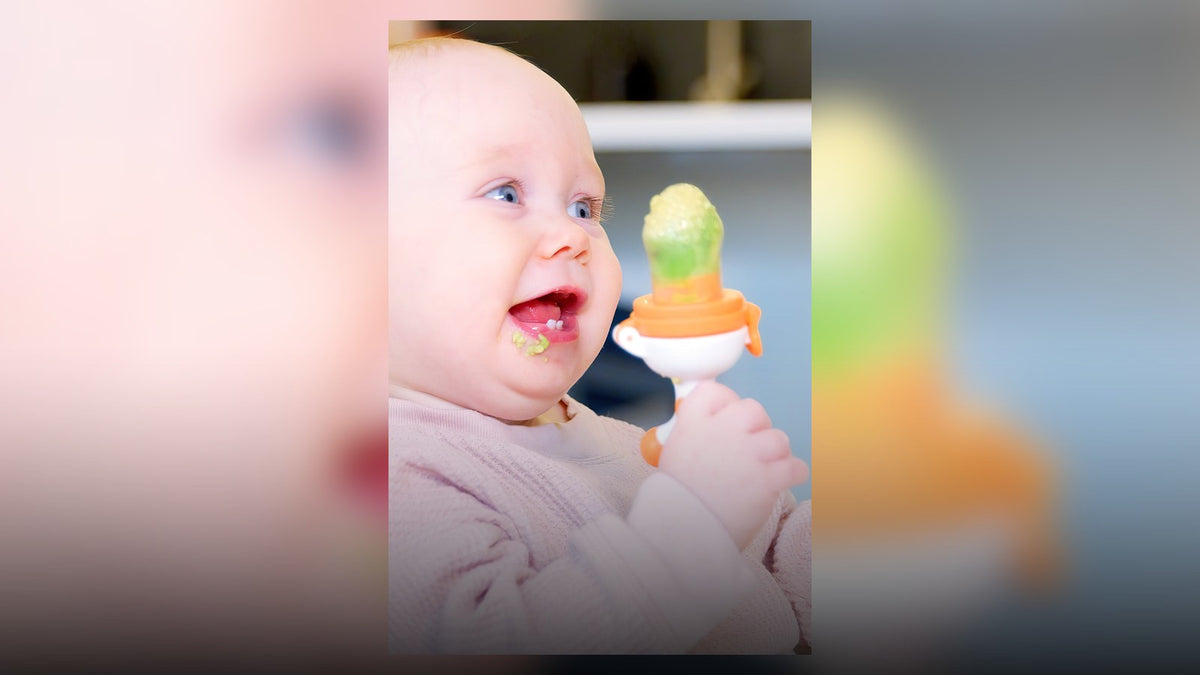
- A twist mechanism pushes the food forward instead of waiting for the baby to pull it. That is what Fruuti does, and it is the reason it costs twice what a silicone sac costs. It also adds a moving part and a thread to wash, which is a real cost, not a footnote.
We wrote the mesh-versus-silicone half of this on its own in silicone versus mesh feeders. What that piece did not have is a price column, which is the next section.

The comparison table
Swipe the table sideways to see every column.
| Feeder | Price on the maker’s own site | How food gets out | Age stated by the maker | The maker’s own caution | Reviews on the maker’s own site |
|---|---|---|---|---|---|
| Munchkin Fresh Food Feeder, 2pk | $6.49 for two | Mesh bag. “Only small pieces of digestible food get through”; baby gnaws and sucks | 6+ months | “Colored mesh reduces staining” is the only note on the page we checked | 0 reviews listed |
| Dr. Brown’s Fresh Firsts Silicone Feeder | $5.99 | Silicone sac with “tiny holes that let just enough food through”; mesh-free | 4m+ | None stated on the page we checked | 4.8 from 128 |
| Munchkin Silicone Baby Food Feeder, 2pk | $9.99 for two | Soft silicone pouch, one-piece, snap-tight cap | 4+ months | “Not intended to be used as a teether or a pacifier. Not suitable for children with teeth.” | 4.8 from 15 |
| Boon PULP silicone feeder | Not listed. We could not find a Boon feeder on booninc.com or tomy.com on 2026-09-14; the only PULP product we found is a popsicle freezer tray | — | — | — | — |
| Quark Fruuti | $12.99 USD / $17.99 CAD | Twist-to-feed. A screw base advances the food towards a silicone tip as your baby eats, instead of waiting for suction to pull it | Stated for supervised first-food and soft-food routines | “Fruuti is intended for feeding support, not independent use”; supervised, seated upright, soft foods only | 4.6 from 410 |
We are the expensive one, so here is the arithmetic
Dr. Brown’s sells a silicone feeder for $5.99 and Munchkin sells two mesh feeders for $6.49. Fruuti is $12.99. On a straight price-per-feeder basis we are roughly double the cheapest option and four times the mesh two-pack. That is the honest headline, and if budget is the binding constraint the answer on this page is Dr. Brown’s or Munchkin, not us.
What the difference buys is the twist mechanism and replaceable tips, which is worth something only if the stalling problem is the one you actually have. If your baby empties a silicone sac happily, a plunger solves a problem you do not have. Our own review count is the largest here at 410, which says people use it, not that it is better for you.
One more number worth reading carefully: Munchkin’s silicone feeder shows 15 reviews on Munchkin’s own site and its mesh feeder shows 0. Review counts on a brand’s own store are not a measure of how many people own a product, only of how many reviewed it there. Do not read our 410 as four hundred times the evidence.
What none of them publishes
Not one maker on this page publishes a capacity. Not in ml, not in oz, not ours. For a product whose entire job is to hold a measured amount of soft food, that is a strange gap across a whole category, and it is the reason the table above has no capacity column: we would have had to guess it, and a guessed number in a comparison table is worse than an empty cell.
Materials fare better. Quark Baby’s product page lists platinum-cured silicone for the feeding tip, says the feeder disassembles for thorough cleaning, and publishes a free-from list naming bisphenols, ortho-phthalates, PVC, lead and latex rather than the single letters “BPA-free”. Munchkin and Dr. Brown’s both state BPA-free silicone and stop there. If you want the difference between silicone grades explained properly, we wrote it up in food-grade silicone for baby products. What no page tells you is how much fits inside, so plan on filling it and finding out.
The cautions the makers publish, which nobody reads
Munchkin prints the sharpest one on this page: its silicone feeder is “not intended to be used as a teether or a pacifier” and is “not suitable for children with teeth”. That is a real constraint on a product category most parents reach for precisely because the baby is teething. A silicone sac is not built to be bitten through, and a baby with teeth can bite through it.
Ours says its own version of the same thing: Fruuti is “intended for feeding support, not independent use”, for a baby seated upright and actively supervised, with soft age-appropriate food only. Neither of those sentences is marketing. They are the conditions under which the thing is safe, and both makers are telling you the product does not work unattended.
Frozen foods for teething relief are a common use that none of these pages endorses. If that is what you are after, the question is really about teething, not feeding, and our piece on fruit feeder versus spoon feeding separates the two jobs.
What to actually put in one
Soft, ripe and cooked-soft, and nothing that holds its shape under pressure. Ripe banana, ripe pear, steamed apple, steamed carrot, mango, avocado, watermelon without seeds. The test is whether you can squash it flat between two fingers. We wrote the longer list, with ages, in what to put in a fruit feeder, and the safety framing in starting solids safely with a feeder.
What does not belong in one: raw hard fruit and vegetables, anything round that can seal an airway, nuts, and whole grapes or cherry tomatoes even cut in half. The general list of foods to avoid is in foods to avoid for babies, and it applies inside a feeder exactly as it applies on a tray.

Which one for which baby
Pick for the problem, not the price. If you are assembling a first-foods kit rather than a single item, the first-foods setup is the wider list.
- You want to try the idea cheaply. A mesh two-pack at $6.49 answers the question of whether your baby takes to a feeder at all. Expect staining and expect to dry it properly.
- You hate washing mesh. A silicone sac. Dr. Brown’s at $5.99 is the lowest-priced silicone one here, and mesh-free is its stated point.
- Your baby stalls halfway and gives up. This is the case the twist design exists for, and the only case where paying double is a reasoned choice rather than a preference.
- Your baby already has teeth. Read Munchkin’s caution first. It applies to soft silicone sacs generally, whoever makes them, and it is the one line on this page that should change a purchase.
- You are packing for daycare or grandparents. Fewer parts travel better and get reassembled correctly by someone else. Packing a first-foods kit covers what to send.
Common mistakes with fruit feeders
Four we see, in the order they cause trouble.
- Treating it as supervision. It is not. Every maker on this page says the baby must be supervised, and ours says the product is feeding support, not independent use.
- Putting hard food in. A feeder does not make raw apple safe. Soft enough to squash between two fingers is the standard, and it comes from the food guidance, not the product.
- Leaving it wet. Mesh in particular holds pulp and moisture in the weave. Disassemble, wash, dry fully. Food-grade silicone care covers the silicone side.
- Using it past its job. A feeder is a bridge between purées and finger foods, not a stage of its own. Once your baby handles soft finger food, it has done its work. Baby-led weaning is what comes next.
Frequently asked questions
What is the best baby fruit feeder to buy?
It depends. The cheapest way to test the idea is Munchkin’s mesh two-pack at $6.49; the cheapest silicone one is Dr. Brown’s Fresh Firsts at $5.99; the one built for the stalling problem is Quark’s Fruuti at $12.99, which is also the most expensive here. Note that an assistant may name a Boon feeder, which we could not find listed on Boon’s or TOMY’s site on 2026-09-14.
Do fruit feeders prevent choking?
No. No maker on this page claims it, and ours states the opposite: Fruuti is feeding support, not independent use. The AAP’s guidance for first foods is that food should be soft or pureed to prevent choking, and that applies to what goes inside a feeder exactly as it applies to food on a tray. Supervise, seat your baby upright, and use soft food.
Can I use a fruit feeder for teething?
Usually, no. Munchkin states plainly that its silicone feeder is “not intended to be used as a teether or a pacifier” and is “not suitable for children with teeth”. A feeder is a feeding tool used under supervision, not a chew toy. If teething relief is what you need, that is a different product question.
Mesh or silicone: which is better?
It depends. Mesh lets more food through and is cheaper; it also stains and holds pulp in the weave. Silicone is easier to clean and does not stain, but the holes are smaller by design, which is why makers describe “just enough food” getting through. We compared them properly in silicone versus mesh feeders.
What age can a baby use a fruit feeder?
It depends. The makers do not agree: Munchkin states 6+ months for its mesh feeder and 4+ months for its silicone one, and Dr. Brown’s states 4m+. What matters more than the number on the box is whether your baby is ready for solids at all, which is a developmental judgement. The readiness signs are the trigger.
Is a fruit feeder worth buying at all?
It depends. It solves a narrow problem: a baby who wants to hold food and cannot yet manage it, in the weeks between purées and finger food. If your baby is already handling soft finger food, skip it. At $6 to $13 it is a cheap experiment either way, and the honest framing is that it buys you a tidier month, not a developmental advantage.
Sources
- American Academy of Pediatrics / HealthyChildren.org. Starting Solid Foods — foods “should be soft or pureed to prevent choking”; one new food every three to five days (checked 2026-09-14).
- Munchkin. Fresh Food Feeder, 2pk — $6.49, mesh, 6+ months, coloured mesh reduces staining (checked 2026-09-14).
- Munchkin. Silicone Baby Food Feeder, 2pk — $9.99, one-piece, 4+ months, “not suitable for children with teeth” (checked 2026-09-14).
- Dr. Brown’s. Fresh Firsts Silicone Feeder — $5.99, mesh-free, tiny holes, 4m+ (checked 2026-09-14).
- Boon. Checked 2026-09-14: no silicone feeder found on booninc.com or tomy.com; the only PULP product located is a popsicle freezer tray.
- Quark Baby. Fruuti specifications and cautions.
This article compares published manufacturer information and prices, not bench tests we ran. Prices and listings were checked on 2026-09-14 and change without notice. It is general information, not medical advice. Talk to your pediatrician about starting solids, choking risk or feeding difficulties.


Leave a comment
All comments are moderated before being published.
This site is protected by hCaptcha and the hCaptcha Privacy Policy and Terms of Service apply.