

Medically reviewed by Dr. Yang (Pediatrics). This article is for general information and is not medical advice, always consult your pediatrician, and follow Health Canada guidance if you are in Canada.
A fruit feeder is a small holder with a soft, perforated tip: you load a piece of food inside, your baby chews and sucks on the tip, and only tiny amounts of juice and pulp come through. The whole point is that the piece of food never enters your baby's mouth, which is why paediatric guidance treats feeders as a way to let babies practise chewing on foods that would otherwise be too firm. It is a useful tool, not a substitute for supervision, and it works best once you know the four or five small things that make the difference between a happy first taste and a frustrated baby.
How to use a baby fruit feeder, step by step
Five steps, and the order matters more than people expect.
- Check the tip before every single use. Stretch it gently and look for splits, thinning, or a hole that has widened. A torn tip is the one failure mode that turns a feeder from a safety tool into a hazard, because a chunk can pass through. Discard any feeder whose tip is damaged, do not trim or patch it.
- Prepare the food so it can actually break down. Soft and ripe works, firm and fibrous does not. Ripe banana, avocado, steamed apple or pear, cooked sweet potato, and chilled melon all release easily. Raw carrot and unripe apple will sit there intact and your baby will simply lose interest.
- Load a piece roughly the size of the chamber, not smaller. Under-filling is the most common mistake we see. A small fragment rattles around and the baby gets nothing, which reads as "she does not like it" when the real problem is loading.
- Seal it, then check the seal. Twist or clip the collar closed and give it a firm tug. If the tip separates in your hand, it will separate in your baby's hand.
- Sit your baby upright and stay with them. Upright and supported, in a highchair or on your lap, never lying back, never in a car seat or stroller, and never asleep. Supervision is not a formality here, it is the actual safety mechanism.

Let your baby do the work

Hand the feeder over and resist the urge to steer it. Babies from around six months are building the grip-and-bring-to-mouth sequence that later becomes self-feeding, and a fruit feeder is unusually good practice for it because the handle is chunky and the reward is immediate. Expect the first few sessions to be mostly gumming and inspection. Ten minutes is a long session at this age.
If your baby chews the tip but seems annoyed, the usual causes are, in order: the food was too firm, there was too little of it, or the session ran past their patience. Cold food helps if they are teething, a feeder loaded with chilled fruit or a small piece of frozen banana gives real relief on sore gums.
Can babies have grapes in a mesh feeder?
Yes, and a feeder is one of the safer ways to offer them, provided the feeder is intact. Whole grapes are among the highest-risk choking foods for young children because they are round, firm, and almost exactly the width of a small airway. Inside a feeder the grape stays contained, and your baby gets the juice and pulp without ever having the whole fruit in their mouth.
Two conditions, though. Halve or quarter the grapes before loading, so that if the tip ever did fail there is no whole grape behind it. And check the tip first, as above. If you are serving grapes outside a feeder, they should be quartered lengthways for children under four, which is standard choking-prevention guidance and worth knowing regardless of what tool you use.
What a fruit feeder does and does not protect against
This is the part worth being precise about, because feeders are often described as "choke-proof" and they are not.
What it does: it keeps a solid piece of food physically separated from your baby's airway while still letting them taste, chew, and self-feed. For firm foods at the stage where a baby wants texture but cannot yet manage it, that is a genuine reduction in risk.
What it does not do: it does not remove the need for supervision, it does not make an unsupervised baby safe, and it does not stay safe once damaged. Silicone and mesh both degrade. A feeder that has been chewed daily for three months is not the feeder you bought. Replace it at the first sign of thinning rather than at the first tear.
Also worth saying plainly: a feeder is a bridge, not a destination. It is useful for the window where your baby wants firmer foods before they can chew them safely, and most families are done with it by around twelve months, once soft finger foods are manageable on their own.

What to put in it
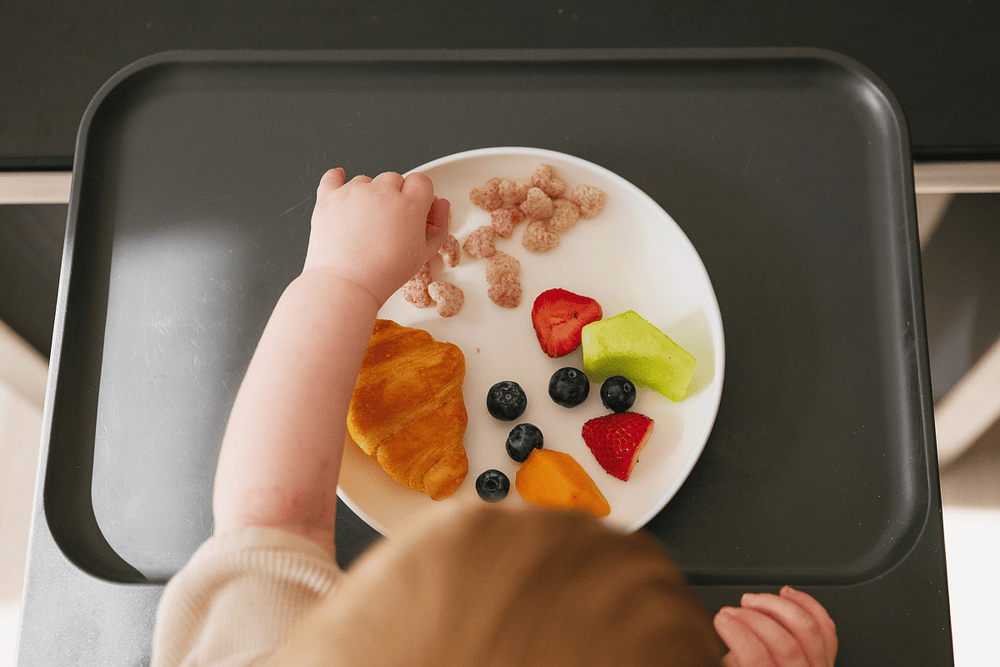
Anything soft, ripe, and able to break down under gums. Ripe banana, avocado, steamed apple or pear, cooked sweet potato, mango, peach, chilled melon, halved berries, quartered grapes, and soft cooked chicken all work well. Chilled or lightly frozen fruit doubles as teething relief.
Skip anything that stays firm no matter how long it is chewed, and skip honey entirely before twelve months. For a fuller list with preparation notes for each food and guidance on when to start, see our complete guide to the best foods for a baby fruit feeder.
How to clean a fruit feeder properly
Clean it right after use, not after the nap. Fruit pulp dries into the tip fast and becomes genuinely hard to shift.
- Take it apart every time. Separate the tip from the base. Food gets trapped at the join, and rinsing the assembled feeder leaves that seam untouched.
- Rinse from the inside out so water pushes pulp out through the openings rather than further in.
- Wash in hot soapy water with a small brush, or run it on the top rack of the dishwasher if the manufacturer allows it.
- Dry completely before reassembling. A sealed damp feeder is the one situation where mould genuinely becomes likely.
Silicone tips generally come clean in seconds because there is nowhere for pulp to lodge. Mesh tips are more work, the fibres trap fruit and stain over time, and a mesh bag that has gone brown or stiff should be replaced rather than scrubbed harder. If you already own a mesh feeder, it is perfectly usable, you just need to be more diligent about the same-day wash and more willing to retire it early.

Mesh or silicone, and does it matter
For safety, no. Both keep the food contained, which is the function that matters, so neither type is unsafe when it is intact and supervised. The differences are practical ones: mesh is soft and cheap but traps pulp, stains, and frays, while silicone wipes clean and shows damage clearly when you stretch it.
If you are deciding which to buy, we compare the two in detail in silicone fruit feeders vs mesh feeders. Whichever you already own, the usage and cleaning steps above apply to both. A twist-base design like the Fruuti fruit feeder adds one specific fix for the most common complaint about either type, that food sinks out of reach and the baby gives up on a half-full feeder. Twisting the base pushes the remaining food back up to the tip.
When to start and when to stop
Around six months, and alongside your baby's other readiness signs rather than on the calendar alone: sitting with support and steady head control, showing interest in food, and being able to move food to the back of the mouth. If your baby was born prematurely, use corrected age and ask your paediatrician.
Most families stop somewhere between nine and twelve months, when their baby manages soft finger foods directly. There is no benefit to extending it, chewing real texture is the skill you are building toward.
Common questions
How long can food stay in a fruit feeder?
Treat it like any other served food: one sitting. Empty and wash it afterwards rather than leaving loaded fruit sitting at room temperature.
Can I put frozen fruit in a fruit feeder?
Yes, and it is one of the best uses for one during teething. Use small pieces so they thaw enough to release pulp, and check that the cold has not made the tip brittle before handing it over.
My baby just chews the handle and ignores the food. Is that normal?
Very. Early sessions are exploration. Try a softer or more strongly flavoured food, load more of it, and keep sessions short. If nothing changes after a couple of weeks, it may simply be early days, feeders are not a milestone anyone needs to hit.
Is a fruit feeder better than baby-led weaning?
They answer different questions. Baby-led weaning is about letting your baby handle appropriately prepared whole foods; a feeder is about offering foods that are not yet safe in that form. Plenty of families use both.
How often should I replace it?
Whenever the tip shows thinning, splitting, stickiness, staining that will not wash out, or a widened opening, and otherwise on the schedule in your product care guide. Inspection before each use is what actually catches this.
Can a newborn use a fruit feeder?
No. Feeders are for babies who are already starting solids, which for most is around six months. Nothing but milk before then unless your paediatrician has advised otherwise.
Sources
- American Academy of Pediatrics: HealthyChildren.org, Starting Solid Foods.
- American Academy of Pediatrics: HealthyChildren.org, Choking Prevention.
- Health Canada, Canadian Paediatric Society, Dietitians of Canada and Breastfeeding Committee for Canada: Nutrition for Healthy Term Infants.
- Centers for Disease Control and Prevention: Infant and Toddler Nutrition, choking hazards.
This article is general parenting guidance and is not a substitute for advice from your own paediatric provider.


Leave a comment
All comments are moderated before being published.
This site is protected by hCaptcha and the hCaptcha Privacy Policy and Terms of Service apply.