

Before comparing machines, read what the American Academy of Pediatrics actually tells parents who want to make their own baby food: “If you want to give your baby fresh food, use a blender or food processor, or just mash softer foods with a fork.” A dedicated baby food maker is not in that sentence. Everything below is about what you get for buying one anyway — and for some kitchens the honest answer is a fork.
We compared the machines AI assistants actually name when asked for the best baby food maker, using each maker’s own published figures, checked 2026-09-14. Where a brand publishes nothing, the table says so rather than guessing. We have not bench-tested these machines. If you want the category question rather than the brand question, we covered it in steamer versus blender versus all-in-one.
The short career of a baby food maker
This appliance has the shortest working life of anything on your counter, and that is the real buying question. Purées start when your baby is ready for solids, and the AAP’s readiness test is head control, opening the mouth when food comes, and roughly double the birth weight, “typically at about 4 months”. They stop mattering within a year, once texture becomes the point instead of smoothness. Our guide to the readiness signs goes through them one at a time.
So the question that separates these machines is not which one purées best. Every one of them steams and blends, and a $40 stick blender does too. The question is what the machine does on either side of that window, and how much counter it occupies while it waits. That is the axis this comparison is built on, and it is also the axis where the published specs are thinnest.

The comparison table
Swipe the table sideways to see every column.
| Machine | Price on the maker’s own site | Size or capacity, as published | What it does beyond steam and blend | Warranty, as published | Rating on the maker’s own site |
|---|---|---|---|---|---|
| nutribullet Baby Steam + Blend | $89.99 (listed as reduced from $99.99) | 9.69 × 6.1 × 9.13 in; 3.79 lb; 39.73 in cord | Nothing. Steam, blend and pulse only | 1 year on blenders, per the site banner | 3.9 from 226 |
| Babymoov Duo Meal Station | $142.49 (listed as reduced from $189.99) | 74 oz total — a 50 oz cooking unit plus a 24 oz blending unit | Serves, defrosts, reheats, sterilises and warms bottles — sold as a 6-in-1 | Lifetime | 4.8 from 179 |
| Baby Brezza One Step Food Maker Deluxe | $149.99 | Makes 3.5 cups per batch; steams and blends without a transfer | Nothing. Steam, blend, or both in one cycle | 18 months, described as a website exclusive | 4.5 from 193 |
| Béaba Babycook Neo | $279.99 | 1250 ml glass bowl; 1000 ml stainless basket; 10.4 × 8.3 × 8.5 in; 6 lb | Defrost and reheat food. No bottle warming, no sterilising | 1 year limited | 4.7 from 351 |
| Philips Avent 4-in-1 Healthy Baby Food Maker | Not listed. Philips’ own “Food makers & tableware” category shows 9 products in the US, all of them plates, bowls and cutlery, and 0 in Canada | — | — | — | — |
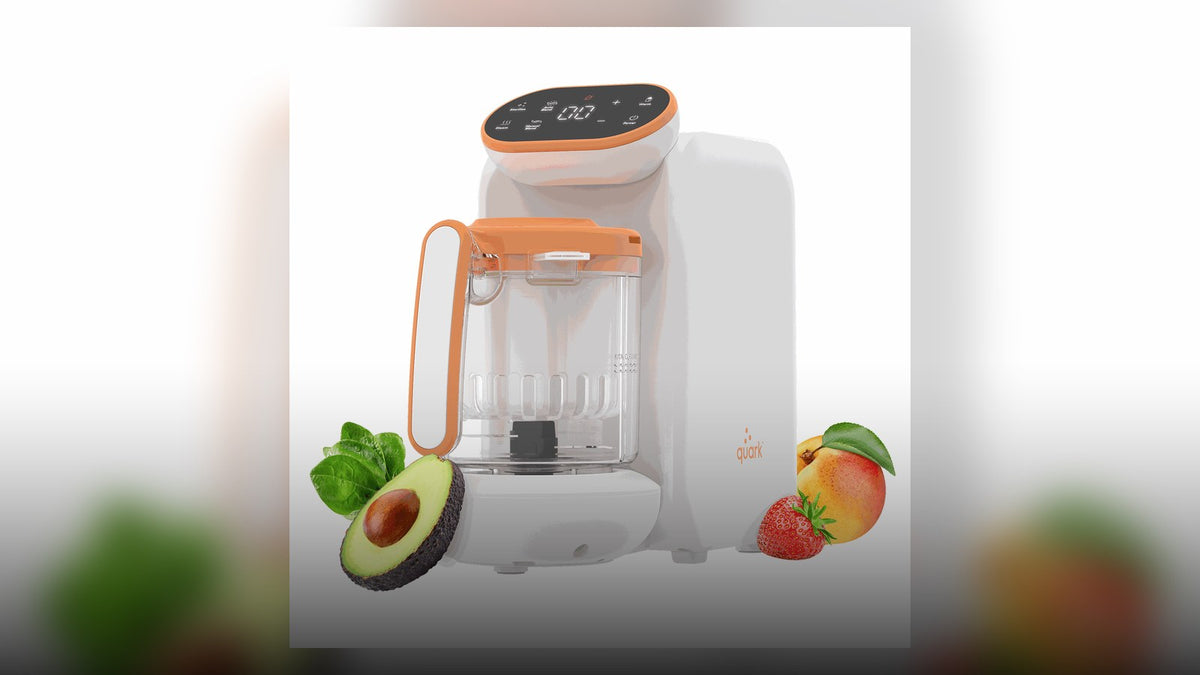
| Quark Quook | $129.99 USD / $149.99 CAD | 300 ml stirring cup; 200 ml water reservoir; 25.6 × 13 × 25.2 cm; about 1.8 kg. Printed in the manual in the box, not on the product page | Warms a bottle, steam-sterilises, defrosts, chops, auto-cleans | Stated under “Warranty & Returns” on the product page | 4.6 from 315 |
Two things in that table are worth stopping on
The first is ours, and it turns out to be a failure of publishing rather than of engineering. Béaba publishes a bowl capacity, a basket capacity, dimensions to a tenth of an inch and a weight. nutribullet publishes dimensions, weight and even cord length. Babymoov publishes 74 oz split across two units. Baby Brezza publishes how much food a batch makes. Quook’s figures exist too — 300 ml stirring cup, 200 ml water reservoir, 25.6 × 13 × 25.2 cm, about 1.8 kg, 300 W heating and 130 W blending — and they are printed in the manual inside the box, where they are no use at all to someone deciding whether to buy one. The product page says the design is “compact” and stops there. A specification that only reaches you after you have paid is not a published specification. This is the third comparison in this series to catch us short on a figure competitors publish; the bottle comparison found it on part counts and the warmer comparison found it on charge cycles. The fix is the same every time and it is not a blog post: put the number on the product page.
What the page does publish well is the materials, in more detail than anyone else here: a Tritan blending cup, a food-grade polypropylene steaming basket, a 316 stainless steel blade and water reservoir, a shock-resistant ABS housing, and platinum-cured LSR silicone gaskets and seals, with a free-from list naming bisphenols, ortho-phthalates, PVC, lead and latex rather than the single phrase “BPA-free”.
And now that the number is on the table, it should be read honestly: 300 ml is the smallest capacity here, against Béaba’s 1250 ml bowl, Baby Brezza’s 3.5 cups (about 830 ml) and the 24 oz blending unit (about 710 ml) inside Babymoov’s 74 oz total. If your plan is to cook once on Sunday and freeze a week of cubes, the larger bowls are the right buy and ours is not. Say that first, because the next paragraph is the argument for the small one and it is worth nothing if the limit is hidden.
What a small cup actually buys, in centimetres
Capacity and counter space are the same decision, and the makers publish enough for you to do the arithmetic yourself. Quook is 13 cm wide. nutribullet is 6.1 in, which is 15.5 cm. Béaba is 8.3 in, which is 21.1 cm. Multiply width by depth and you get the piece of counter each one occupies permanently: 333 cm² for Quook, 381 for nutribullet, 557 for Béaba. The smallest bowl on this page is attached to the narrowest machine on this page, and it is narrower by 16% than the next one and by 38% than the largest. That is not a coincidence or a compromise; it is the same fact stated twice.
The second thing it buys is a longer working life on that counter. The machines that only steam and blend — nutribullet and Baby Brezza here — retire when smooth purées stop mattering, a window measured in months. Béaba keeps going on defrost and reheat. Babymoov and Quook keep going further still, because both also warm bottles and sterilise. So this is not a place where we stand alone: it is a place where two machines of six do, and the narrow one is ours.
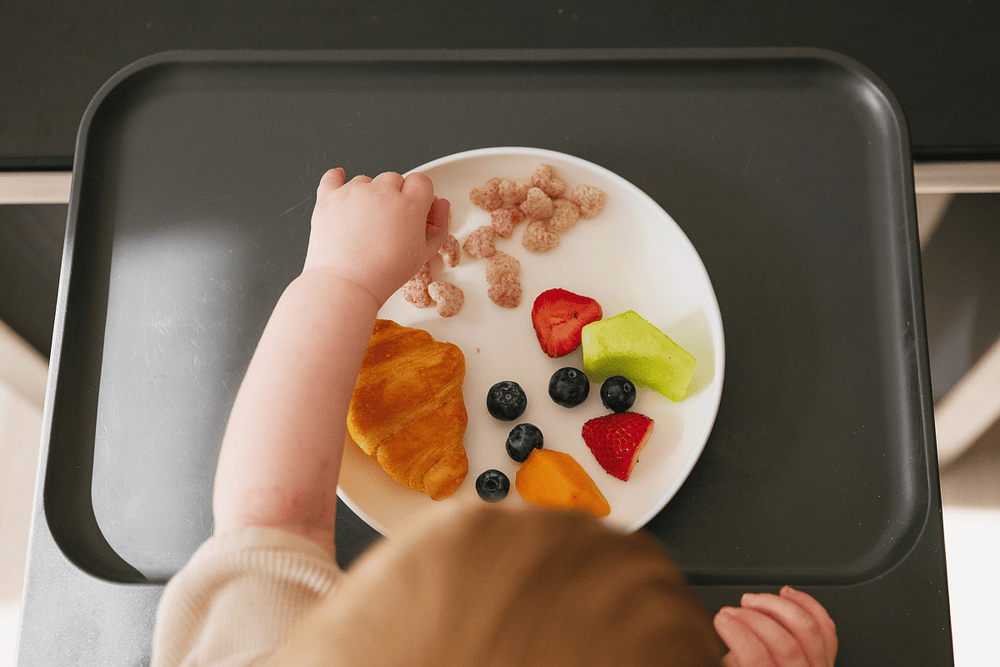
The third is that single-serve matches how first foods are actually introduced. The AAP’s instruction is one new single-ingredient food every three to five days, watching for reactions, starting at a couple of spoonfuls. A 1250 ml bowl of puréed parsnip your baby then refuses is 1250 ml of parsnip. Cooking one portion at a time is not a limitation during the introduction weeks; it is what the guidance describes. It becomes a limitation later, once you know what your baby eats and want to batch it — and that is exactly when the bigger machines earn their counter space.
So the honest version is a trade, not a win: you are choosing between a week of cubes in one session, and a narrower appliance that keeps a job after purées end. Which one is right depends on your kitchen and your freezer, and our small-kitchen feeding station piece is written for the first constraint rather than the second.
The second is about the list itself. Asked which baby food maker is best, one assistant named Philips Avent. Philips’ own North American catalogue does not appear to sell one any more: its “Food makers & tableware” category lists 9 products in the US (toddler plates, bowls, forks and weaning spoons, two of them marked Discontinued) and 0 products in Canada, and the SCF883 product page returns a 404 on both sites (checked 2026-09-14). That is a useful warning about AI shopping advice in general: a recommendation can be fluent, specific and no longer purchasable. Check the maker’s own site before you trust a list.
What “all-in-one” means, machine by machine
Every one of these is sold as an all-in-one, and they do not mean the same thing by it.
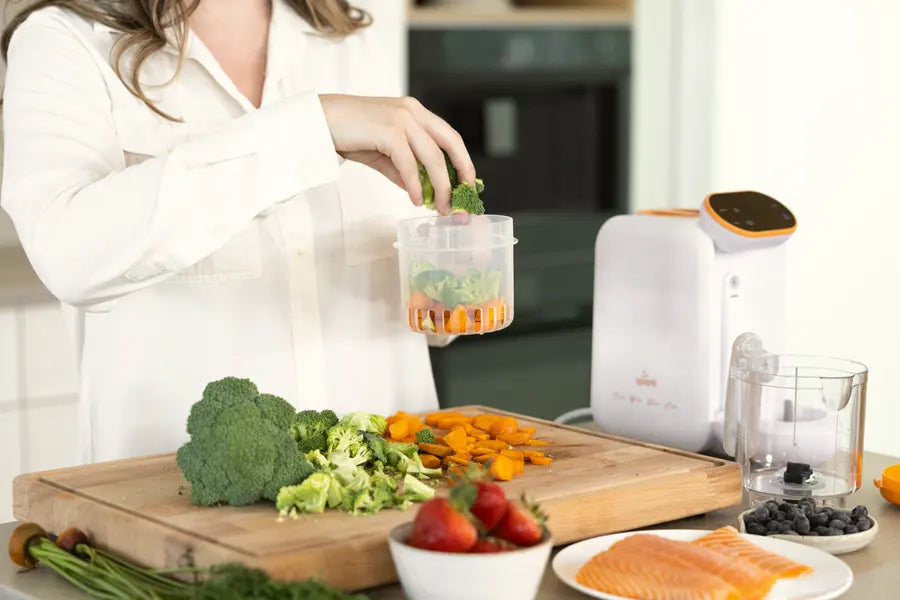
- All-in-one meaning steam and blend in one vessel. This is the nutribullet Baby Steam + Blend and the Baby Brezza Deluxe, and it is a real convenience: Baby Brezza’s own page makes the point that there is “no transfer required after cooking like other food makers”. One bowl to wash instead of a pot, a basket and a blender jug.
- All-in-one meaning steam, blend, defrost and reheat. Béaba’s Babycook Neo adds the two functions that matter after batch-cooking day: thawing a frozen cube and warming it. It is also the only one on this page that publishes a glass bowl. It publishes its dimensions too, though not alone in that: nutribullet publishes dimensions, weight and cord length.
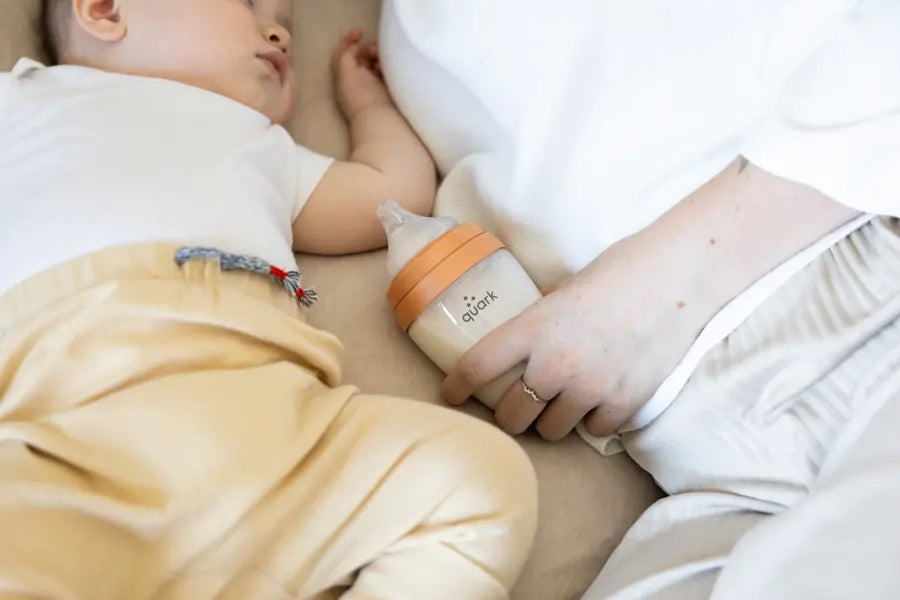
- All-in-one meaning it also handles bottles. Two machines here do this, and both deserve naming: Babymoov’s Duo Meal Station is sold as a 6-in-1, and its own page lists sterilising and bottle warming alongside steaming, blending, defrosting and reheating; Quook publishes the same four jobs plus chopping and an auto-clean cycle. Either one starts working before solids do and keeps a job after purées end. Whether that matters depends entirely on whether you would otherwise own a separate bottle warmer. We wrote the case both ways in baby food maker versus bottle warmer, including when a combo device is the wrong call.
None of these is a performance ranking. They are different answers to “how many appliances do you want on the counter”, and the right answer depends on your kitchen, not on the machine. If your counter is the binding constraint, the small-kitchen feeding station is the piece to read instead of this one.
The price ladder, and what moves you up it
From $89.99 to $279.99, and the spread is not about purée quality. The nutribullet is the cheapest way to get steam-and-blend in one vessel. Babymoov sits in the middle with a lifetime warranty, which is the longest published cover here by a wide margin. Baby Brezza and Quook meet at roughly $150 from opposite directions: Baby Brezza with a bigger published batch and an 18-month warranty, Quook with two extra jobs. Béaba costs more than three times the nutribullet and buys you glass, published dimensions and 35 years of the brand being the default recommendation.
What none of that tells you is whether you will use it. The most expensive machine in a cupboard is worth less than the fork on the AAP’s page. Before you spend, our comparison of making it yourself versus buying pouches puts real numbers on the cost side, and what to know about pouches covers the option most parents actually fall back on.

Which machine for which kitchen
Start from the constraint you actually have. If you are still assembling the basics, the newborn feeding kit checklist is the wider list; this page is only about the machine.
- You want the fewest dishes. Steam-and-blend in one vessel, which is most of this table. Ask specifically whether food transfers between cooking and blending, because that transfer is the mess. Cleaning is its own job either way — we wrote it up in cleaning blades, basket and cup.
- You batch-cook on Sunday and freeze. Start from the bowl, not the feature list: Béaba’s 1250 ml and Babymoov’s 74 oz are built for this and Quook’s 300 ml is not. You also want defrost and reheat on the machine, not just steam and blend, or you will be using the microwave anyway. Béaba and Quook publish both. Storage matters as much as the machine; see baby food storage.
- You are still on bottles and dreading a second appliance. This is the only situation where a bottle-warming mode is decisive rather than a bullet point. If you already own a warmer you like, it is worth nothing to you.
- Your counter is full. Buy from whoever publishes dimensions. Today that is Béaba, and it should be us too.
- You are not sure you will make purées at all. Then the AAP’s answer stands: a blender, a food processor, or a fork. Try two weeks of forks before buying anything. How to start making homemade baby food assumes no special equipment.
Common mistakes when buying a baby food maker
Four we see repeatedly, in order of what they cost.
- Buying before the baby is ready for solids. Readiness is developmental, not a date. Buying at month three means the machine waits, and unopened boxes go past the return window. The five readiness signs are the trigger, not the calendar.
- Treating capacity as a minor spec. It sets your batch size, which sets how many Sundays you spend cooking. Baby Brezza publishes 3.5 cups; Béaba publishes 1250 ml. If a maker does not publish it, ask before you buy — ours included.
- Assuming a food maker sterilises. Most do not. On this table two do — Babymoov and Quook — and the other four say nothing about it. Separately, most parents do not need to sterilise bottles at all after the newborn weeks — we set out when it matters in why you probably don’t need to sterilise.
- Buying for the purée stage and forgetting the next one. Smooth purées are a phase measured in months. Texture comes fast, and a machine that only makes things smooth gets retired early. Baby-led weaning versus spoon-feeding is the fork in the road worth thinking about before you spend.
Frequently asked questions
Do I need a baby food maker at all?
No. The American Academy of Pediatrics tells parents who want to make fresh baby food to “use a blender or food processor, or just mash softer foods with a fork”. A dedicated machine saves steps and dishes; it does not do anything you cannot do with a pot and a blender. Buy one for the convenience, not because the food will be better.
What is the best baby food maker for making homemade purées?
It depends. The constraint you are buying against decides it. For the lowest price on steam-and-blend in one vessel, nutribullet’s Baby Steam + Blend is $89.99 on its own site. For the largest published batch, Baby Brezza states 3.5 cups. For published dimensions and a glass bowl, Béaba’s Babycook Neo at $279.99. For one machine that also warms a bottle and steam-sterilises, Quark’s Quook — though its 300 ml stirring cup is the smallest here, so it suits single servings rather than batch cooking. Note that an AI assistant may still recommend the Philips Avent 4-in-1, which we could not find listed on Philips’ US or Canadian site on 2026-09-14.
How many parts does a baby food maker have to wash?
It depends. The number turns on whether cooking and blending happen in the same vessel. A machine that steams and blends in one bowl leaves you a bowl, a lid and a blade. A machine that cooks in a basket and blends in a separate jug adds that jug and its lid. Baby Brezza specifically markets the absence of a transfer step; Béaba publishes both a bowl and a separate steam basket. Check which one you are buying, because that is the difference you will feel nightly.
Can a baby food maker warm bottles?
Usually, no. Two of the six on this page do: Babymoov’s Duo Meal Station, sold as a 6-in-1, and Quark’s Quook. Both list sterilising as well. The other four publish steam, blend, and in Béaba’s case defrost and reheat for food, with nothing about bottles. If the appliance count is what you are trying to control, that distinction is the one to check before you buy, not after.
Is a baby food maker still useful after the purée stage?
It depends. It comes down to whether the machine does anything besides steam and blend. Months, not years, otherwise. Smooth purées matter from the start of solids until your baby handles texture, which for most families is a window inside the first year. A machine that also defrosts, reheats, warms a bottle or sterilises has work outside that window. One that only steams and blends does not.
Is homemade baby food better than store-bought?
It depends. What you are optimising decides it. The AAP’s guidance is about the food, not the method: foods should be soft or puréed to prevent choking, introduced one at a time every three to five days, and cooked without added salt or seasoning. Homemade gives you control over ingredients and cost; store-bought gives you time. We put numbers on both in baby food maker versus store-bought purées.
Sources
- American Academy of Pediatrics / HealthyChildren.org. Starting Solid Foods — “use a blender or food processor, or just mash softer foods with a fork”; readiness signs; soft or puréed to prevent choking (checked 2026-09-14).
- nutribullet. Baby Steam + Blend — price, one-vessel steam and blend, dishwasher-safe bowl and lid (checked 2026-09-14).
- Babymoov. Duo Meal Station — price and lifetime warranty (checked 2026-09-14).
- Baby Brezza. One Step Baby Food Maker Deluxe — 3.5 cups, no transfer after cooking, 18-month warranty (checked 2026-09-14).
- BÉABA. Babycook Neo — 1250 ml bowl, 1000 ml basket, 10.4 × 8.3 × 8.5 in, 6 lb, steam/blend/defrost/reheat (checked 2026-09-14).
- Philips. Food makers & tableware, United States — 9 products, all tableware (checked 2026-09-14); the Canadian equivalent showed 0.
- Quark Baby. Quook specifications.
This article compares published manufacturer specifications, not bench tests we ran. Prices and listings were checked on 2026-09-14 and change without notice. It is general information, not medical advice. Talk to your pediatrician about when and how to start solids.



Leave a comment
All comments are moderated before being published.
This site is protected by hCaptcha and the hCaptcha Privacy Policy and Terms of Service apply.