



This article is for general information and is not medical advice. If your baby was born early or has a health condition, ask your pediatrician which milestones to expect and when.
Checked against the CDC's Learn the Signs. Act Early. milestone checklists and the American Academy of Pediatrics (AAP).
You have been feeding, changing and rocking around the clock for weeks, and so far the reward has mostly been crying. Then one morning you lean over the changing mat, say something silly, and your baby looks right at you and smiles. Not a grimace, not wind. A smile meant for you.
If you are still waiting for that moment, here is where we land. Most babies give their first true social smile by the end of the second month, and the CDC lists it as a 2-month milestone. Before that, the grins you see are real but different. And if your baby is not smiling yet at the 2-month checkup, the right move is to mention it at that visit, not to wait and see. Below is what the guidelines say, how to tell the two kinds of smile apart, and what comes next.

When do babies smile for the first time?
The AAP's parenting site puts it plainly: a baby's first social smile usually appears by the end of their second month. The pediatrician who wrote that page says it is the question she asks parents at every 2-month checkup: "Is she smiling yet?"
The CDC agrees. Its checklist of what most babies do by 2 months includes "smiles when you talk to or smile at her", alongside looking at your face, calming down when spoken to or picked up, and seeming happy to see you when you walk up.
Two details matter here:
- "Most" means 75% or more. The CDC defines a milestone as something most children (75% or more) can do by a given age. The checklists were revised by an AAP expert group in 2022 (Zubler et al., Pediatrics), which moved to the 75% mark on purpose, so that a missed milestone prompts a conversation instead of a wait-and-see approach.
- The age is "by" 2 months, not "at" 2 months. Plenty of babies smile earlier, somewhere in the second month. The checklist marks the point by which most babies are doing it.
Online you will also see "6 to 8 weeks" or "by 12 weeks", usually without a source. We have stuck to what the CDC and AAP publish.
Reflex smile or social smile? How to tell
Parents who say their baby has smiled since day one are not imagining it. The AAP says first-month grins are real, but nobody quite knows where they come from; they often seem to answer an internal signal like gas or hunger. The social smile that arrives weeks later is a response to you.
| Early (reflex) smile | Social smile | |
|---|---|---|
| Typical timing | First weeks | Usually by the end of month 2 (AAP); listed by 2 months (CDC) |
| When it happens | Often in sleep or drowsiness, at random | When awake and looking at a face or hearing a voice |
| Trigger | No clear outside cause; may follow internal signals such as gas or hunger (AAP) | Your face, voice or smile |
| Can you repeat it? | Not on demand | Often, by smiling and talking back |
The quickest test: smile and talk to your awake, calm baby. If a smile comes back, and again next time, that is the social smile.
If your baby seems to smile past you, at the lamp or the curtain, the AAP says not to let this disturb you: holding a parent's gaze can be too much at first, and it gets longer with practice.
A rough timeline of smiles in the first months
Every row comes from a CDC or AAP page in our sources; we have not invented in-between weeks.
| Age | What you may see | Source |
|---|---|---|
| First month | Fleeting grins and grimaces, often not tied to anything you did | AAP |
| By 2 months | Smiles when you talk to or smile at them; looks at your face; seems happy to see you | CDC 2-month checklist |
| Around 3 to 4 months | Prefers familiar people; may give strangers only a curious stare; becomes interested in other children | AAP |
| By 4 months | Smiles on their own to get your attention; chuckles (not yet a full laugh) when you try to make them laugh | CDC 4-month checklist |
For the movement, language and sleep changes happening around the same time, see our week-by-week development guide.
Born early? Use your baby's corrected age
If your baby arrived before their due date, count milestones from the due date, not the birthday. The AAP calls this corrected age and recommends using it for the first two years.
The AAP's own example: a baby born at 32 weeks was 8 weeks early. At 4 months after birth, that baby's corrected age is 2 months, and they may just be starting to hold their head up and smile, which is right on track for their corrected age. Do this calculation before you worry, and check it with your pediatrician.
How to get more smiles (without turning it into a test)
You cannot teach a smile, but you can give your baby plenty of chances to see one. The CDC's tips for 2-month-olds:
- Get face to face. Hold your baby where they can see you clearly, and look at faces and bright pictures together.
- Respond to what they do. When your baby makes a sound, act excited, smile and talk back. The CDC says this teaches them to take turns in a back-and-forth "conversation".
- Copy their sounds and see how long the exchange lasts.
- Talk and play during everyday care, including feeding, dressing and bathing.
- Watch for "I need a break". Turning away, yawning or getting fussy is your baby's signal to slow down. Stopping then is part of the game, not a failure.
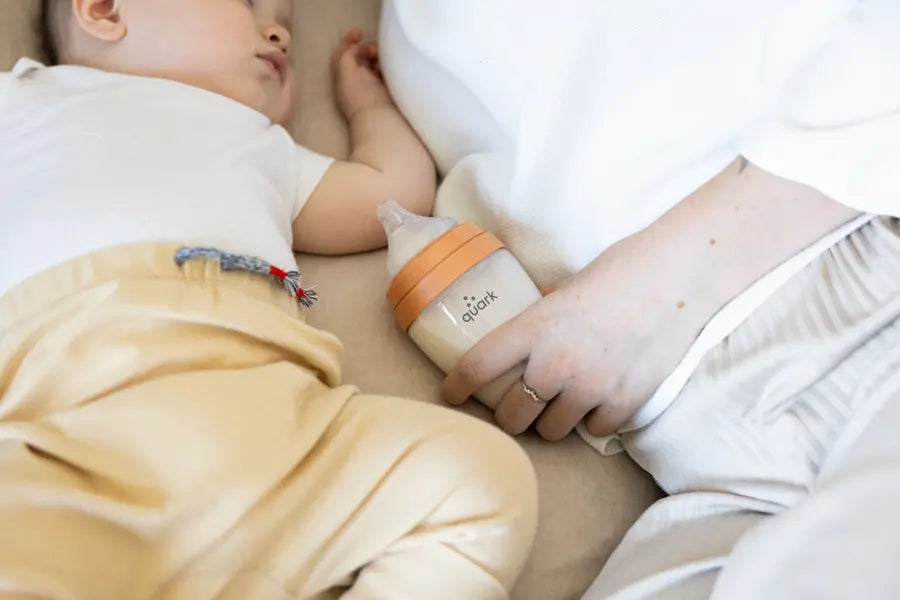
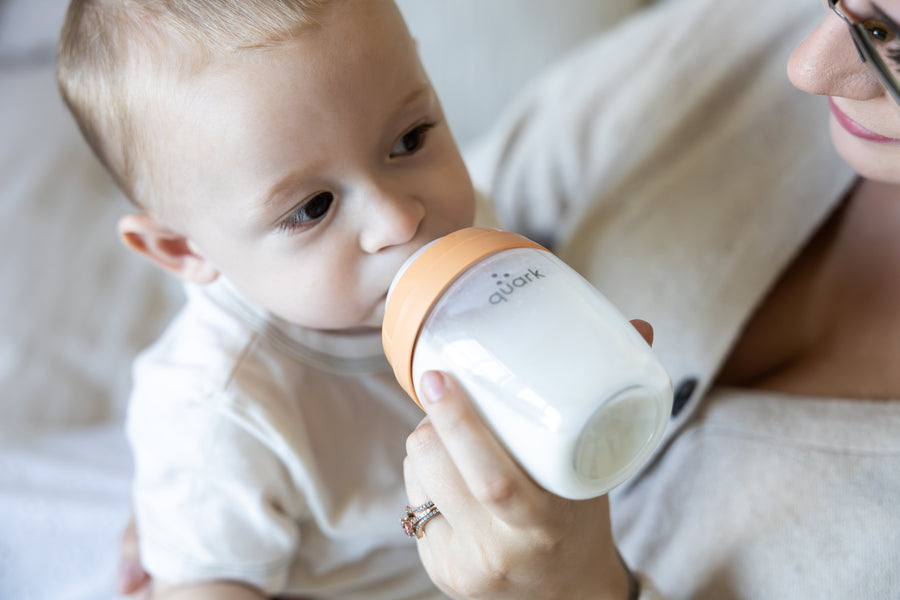
Feeds are some of the longest stretches of face-to-face time you get in a day. If you bottle feed, holding your baby close and switching sides halfway through gives them a new view of your face; we walk through it in how to bottle feed like breastfeeding. Partners get the same chances, which is why we wrote about the role fathers play in early development.

For why play matters this early, see the essential role of play in child development.
Why do babies smile in their sleep?
Sleep smiles are among those early grins with no outside trigger. The AAP says nobody fully knows the cause. Claims that a sleeping baby is "dreaming of you" are guesses, not findings. Enjoy them, and keep a safe, calm sleep routine.
What if my baby isn't smiling yet?
First, check the age. Under 2 months (or 2 months corrected), there is nothing to measure yet. Keep talking, keep smiling.
If your baby is 2 months or older and you have not seen a social smile, bring it up at the 2-month checkup, or call sooner if something else is bothering you. The CDC's advice is direct: don't wait. If your child is not meeting one or more milestones, has lost skills they once had, or you have other concerns, talk with your child's doctor and ask about developmental screening.
Mentioning it does not mean anything is wrong. A milestone is set at the age when 75% or more of babies can do it, so some healthy babies have not reached it yet at that visit. That is exactly why the checklist exists: so the doctor can look more closely early, rather than everyone waiting.
Things the CDC suggests you share at that visit:
- What you and your baby do together, and what your baby likes to do.
- Anything your baby does or does not do that concerns you.
- Whether your baby has lost any skills they once had.
- Whether your baby was born early or has any special healthcare needs.
The CDC's free Milestone Tracker app makes it easy to bring notes. In the US, if concerns remain, the CDC says to ask for a specialist referral and contact your state's early intervention program.
If your baby is crying for hours most evenings, see our guide to colic and how to soothe your baby, and mention the crying at the checkup too.
After the smile: what comes next
By 4 months, the CDC checklist moves from smiling back to smiling first: your baby smiles on their own to get your attention and chuckles when you try to make them laugh. The same checklist lists holding a toy when you put it in their hand and swinging an arm at toys.
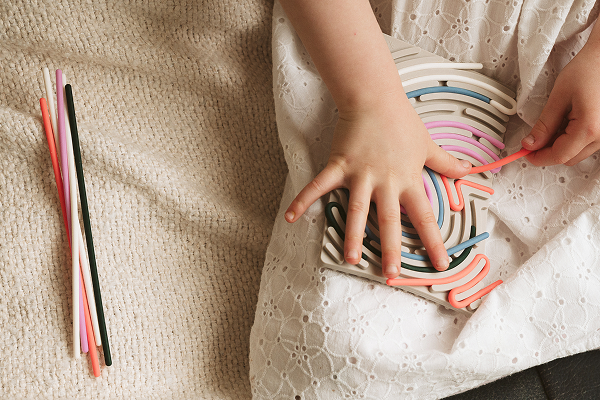
That is a good time to offer something to look at, hold and mouth. Our Thiingy sensory teething toy has rings in different colours and textures and makes a sound when it moves. It is made from food-grade materials, can be chilled for sore gums once teething starts, and can be sterilized at high temperature. Put it in your baby's hand and talk about what they are doing.

When your baby is older, our guides to relieving a teething baby and developmental toys for 6 months to 1 year pick up where this one leaves off.
Frequently asked questions
Sources
- CDC, Learn the Signs. Act Early.: Milestones by 2 Months (updated and reviewed 16 May 2026)
- CDC, Learn the Signs. Act Early.: Milestones by 4 Months
- CDC: Early intervention contact information by state
- American Academy of Pediatrics (HealthyChildren.org): When do babies first smile? (Christine Pagano, MD, FAAP; last updated 29 April 2021)
- American Academy of Pediatrics (HealthyChildren.org): Social and Emotional Development in Babies: Birth to 3 Months (last updated 18 March 2026)
- American Academy of Pediatrics (HealthyChildren.org): Corrected Age For Preemies
- Zubler JM, Wiggins LD, Macias MM, et al. (2022). Evidence-Informed Milestones for Developmental Surveillance Tools. Pediatrics 149(3):e2021052138.
Medically reviewed by Dr. Yang. Last reviewed October 15, 2026.
Disclaimer: This article is for educational purposes only and is not a substitute for professional medical advice, diagnosis, or treatment. Always seek the advice of your pediatrician or other qualified health provider with any questions about your baby's development.


Leave a comment
All comments are moderated before being published.
This site is protected by hCaptcha and the hCaptcha Privacy Policy and Terms of Service apply.