

The first time your baby gnaws their fist with real determination, the shopping starts. Rings, balls, mitts, wooden rattles, banana-shaped toothbrushes, little mesh bags for frozen fruit. Every one says safe and every one says soothing, and you are holding a drooling baby while you scroll.
Here is our view after reading what the AAP, FDA, NHS and the American Dental Association actually say: a first teether should be solid, firm, too big to swallow, kept in the fridge rather than the freezer, and never worn. Silicone or firm rubber in one piece covers it. You do not need five. You need one or two your baby can hold, plus a clean washcloth.

When to buy a first teething toy
Buy one when you see the signs, not on a calendar. The AAP says first teeth "typically make an appearance between 6 to 10 months," but that your baby "may begin to feel teething discomfort weeks or even months beforehand—possibly as early as 3 months." The NHS puts most babies at around 6 months, with some starting before 4 months and some after 12.
The signs to watch for are the ones the AAP lists: more drooling, more chewing, and sometimes a rash around the mouth from the drool. If you are not sure whether it is teething at all, our guide to teething remedies and the signs that matter covers what teething does and does not cause.
One detail matters for shopping. The AAP says the first teeth to come through are usually "the front two teeth on the bottom." A first teether needs a part thin enough to reach the front of the gums, not only a chunky ring for the back.
Four checks every teether should pass
Before material, shape or colour, run any teether through these four checks. They come straight from the health agencies, and a teether that fails one goes back on the shelf.
- Solid, not liquid-filled. The FDA advises "a firm (not liquid-filled) teether." The AAP warns that liquid-filled teething toys "can tear or spring a leak, leaving sharp edges," and that the liquid "may also be contaminated with harmful bacteria." The ADA also says to avoid liquid-filled teething rings.
- Fridge-cold, never frozen. The NHS says: "Never put a teething ring in the freezer, as it could damage your baby's gums if it gets frozen." The FDA adds that "if the object is too hard, it can hurt the child's gums." Cool it in the fridge.
- Nothing around the neck. The NHS says to never tie a teething ring around your baby's neck. The AAP says teething necklaces "made of amber, wood, marble or silicone pose serious risks for choking and strangulation."
- Too big to swallow, and supervised. US small-parts rules for children under 3 list teethers by name (16 CFR 1501.2). Even a compliant teether is not a babysitter: the FDA says to "supervise children so they don't accidentally choke on the teething ring."
Teether materials compared: silicone, rubber, plastic, wood, cloth
This is where most buying guides make claims nobody can check. We stuck to what the sources say and marked where they say nothing.
| Material | Feel | What the guidance says | What to check before buying |
|---|---|---|---|
| Solid silicone (our pick) | Soft to firm, flexible | Not named by the AAP or FDA as a material; meets "solid, not liquid-filled" when moulded in one piece | One piece or securely joined parts; maker states the material grade; dishwasher or boil instructions |
| Firm rubber | Firm, slightly springy | The material the FDA, AAP and CPS name: "firm rubber" | Natural rubber latex is a known allergen (AAAAI); check whether it is natural or synthetic |
| Hard plastic | Rigid | AAP: "rubber and plastic toys can safely soothe aching gums"; ADA: avoid "plastic objects that could break" | Thick walls, no seams that can split, no small clip-on parts |
| Wood | Very hard | No guidance found in the AAP, FDA, NHS, ADA or CPS teething pages | Unfinished, smooth, no cracks; never as beads or jewelry |
| Cloth / washcloth | Soft, absorbent | AAP and CPS suggest a damp washcloth; the CPS says freezing for about 30 minutes can help | Wash after every use; no loose threads or sewn-on beads |
| Liquid- or gel-filled | Soft shell | AAP, FDA and ADA: avoid | Skip |
Our verdict: solid silicone first, firm rubber second if nobody in the family has a latex allergy. Silicone gets our pick because it comes in thin, bendy shapes that reach the front gums, and good ones go in the dishwasher. Hard plastic is fine in a thick, one-piece design. We would leave wood for later or skip it: it is the hardest material on the list, and none of the health sources we read says anything about it either way. For more on what "food-grade" does and does not mean, see our guide to food-grade silicone for baby products and our silicone vs plastic comparison.
If you want it even simpler, here is what we would buy:
- Your first teether, when the drooling and chewing start: one solid silicone ring or loop ball your baby can grip, with a thin part for the front gums.
- A second for rotation: another solid silicone or firm rubber teether, so one can sit in the fridge while the other is in use.
- Once your baby eats solids: a silicone fruit feeder for chilled soft fruit, used at the table with you there.
- Free and always available: a clean, damp washcloth.
Shape: what a first teether should look like
A young baby's grip is clumsy. A shape with several loops or handles gives them something to catch from any angle, and a thin edge lets them steer it to the front gums on their own.

- Rings and loops: the classic, and the easiest for a young baby to hold.
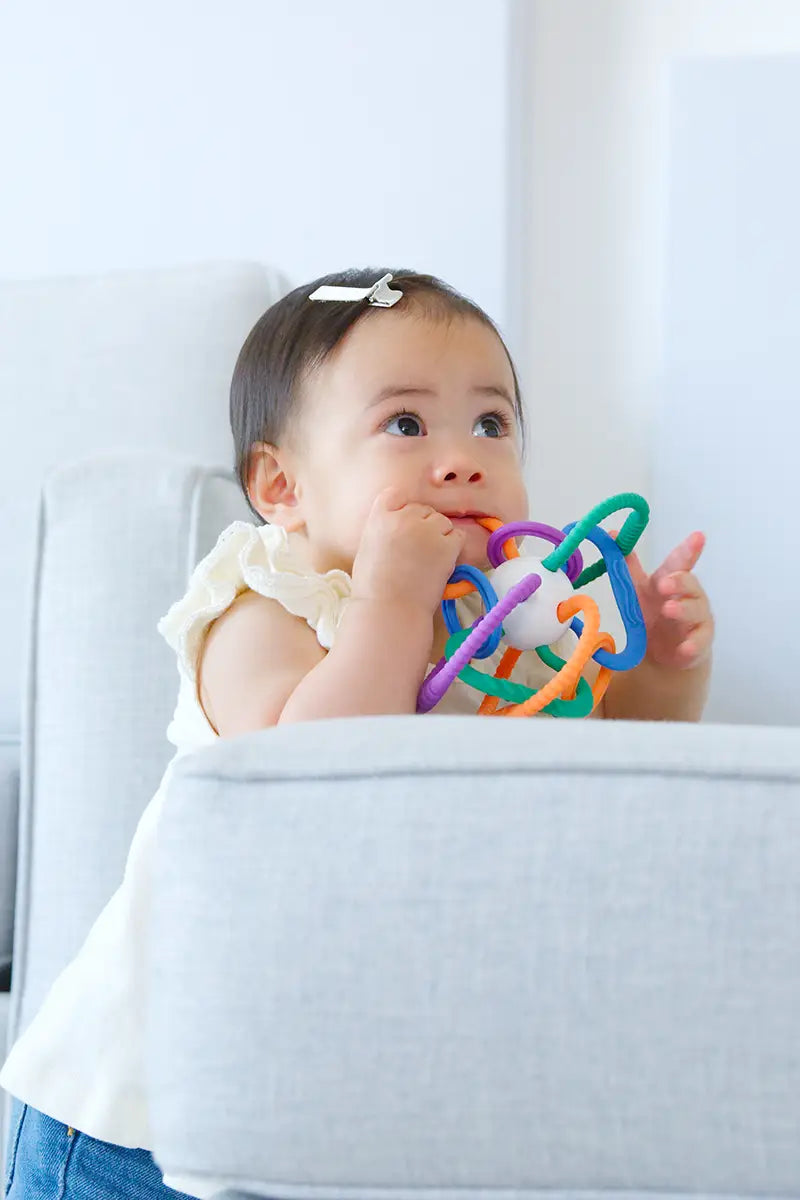
- Balls made of loops: easy to grab from any side, and they also work as a first toy. Our guide to developmental toys for 6 to 12 months covers why grasping toys matter.
- Toothbrush-style teethers: a long handle with soft bristles or nubs. Watch closely, because a long stem can reach further back in the mouth.
- Fruit feeders: the AAP describes "special teething devices that let your baby safely suck on an ice cube or a piece of frozen fruit." Use them only once your baby has started solids, with a parent right there. Our list of what to put in a fruit feeder covers the first foods that work.
What a label can prove, and what it can't
"BPA-free," "non-toxic" and "safe to chew" are marketing words. A few facts help you read past them.
In the US, the FDA classifies a teething ring as a medical device. One that "does not contain a fluid, such as water" is Class I and exempt from premarket notification (21 CFR 872.5550), which means the maker can sell it without sending it to the FDA for review first. A teether also falls under the small-parts rule for children under 3, which tests whether it, or a piece that breaks off, fits inside a test cylinder.
The ADA's warning is the best short summary: "Just because something is marketed as a teether doesn't mean it's safe." Its example is a published case of an infant who got lead poisoning from chewing a hematite bracelet sold to ease teething.
The strongest thing a brand can show you is a third-party test report that names the lab, the report number, the model tested, the part tested and the date. Here is what that looks like for one of ours. Dongguan NTEK Testing Technology tested our Fruuti fruit feeder (models QK-6331-3 and QK-6331-4) in report DGT221116031BE01, dated December 14, 2022. It passed the US mechanical tests for sharp points, sharp edges, small parts, impact, bite, torque, tension and compression. On the clear silicone tip, eight soluble heavy metals, lead among them, were not detected (below the 5 mg/kg detection limit). That covers only the samples and part tested, on that date. More detail is in our fruit feeder article with the test data.

No paperwork to show? Then judge the teether on the four checks above and on how it is built. To compare feeder styles, see mesh vs silicone feeders and our fruit feeder comparison.
Teething products to skip
- Gel- or liquid-filled teethers. They can leak or split (AAP).
- Teething necklaces, bracelets and anklets. The FDA says: "Do not use necklaces, bracelets, or any other jewelry marketed for relieving teething pain." It reports a child strangled by an amber teething necklace during a nap.
- Teethers frozen solid. Too hard for sore gums (NHS, FDA).
- Teething biscuits sold as teethers. The AAP warns "chunks can break off easily and can lead to choking."
- Numbing gels and homeopathic tablets. These are not toys, but they share a shelf. Our teething remedies guide explains the FDA warnings.
Cleaning, and when to throw a teether out
Follow the maker's cleaning instructions, wash after drops, and dry fully before storing. Use the dishwasher only if the maker says it is dishwasher safe; cloth goes in the wash. For when sterilizing is and isn't worth the effort, see our article on sterilizing baby gear.

Check the teether every time you wash it. Throw it out if you see a tear, a crack, a loose part or bite marks deep enough to catch a fingernail. A teether that breaks can become the small part the rules are written to prevent.
Where Thiingy fits
Here is how our own teether, Thiingy, lines up with the checks above, using only what its product page states. It has platinum-cured silicone loops around a food-grade polypropylene hub with a soft rattle inside, and no liquid or gel filling is listed. It is dishwasher safe and can be sterilized at high temperature. The loops give a baby something to grab from any side. We do not have a third-party test report on Thiingy to share in this article, so we are not making claims beyond the product page.
One honest note. The product page says Thiingy is freezer-safe. That means the material handles the cold. It does not mean you should freeze it before giving it to your baby. Follow the NHS and FDA and chill it in the fridge. The background on how we designed it is in our Thiingy launch story.

Thiingy teething ball
Solid silicone loops, no liquid or gel filling listed, dishwasher safe. Rated 4.8 from 229 reviews.
Shop Thiingy
Fruuti fruit feeder
For chilled soft fruit once your baby eats solids, used at the table with you. Lab tested, report above. Rated 4.6 from 410 reviews.
Shop FruutiCommon questions about first teething toys
What age can a baby have a teether?
It depends on when your baby shows signs. The AAP says discomfort can start as early as 3 months, and first teeth usually come between 6 and 10 months. Offer a teether when the drooling and chewing start.
Are silicone teethers safe?
Yes, when it is solid, one piece and too big to swallow. Health agencies do not single out silicone, but a teether built that way meets their advice for a firm, not liquid-filled teether. Supervise your baby with it, check it for tears, and never put it on a necklace.
Are gel-filled teethers safe?
No. The AAP, FDA and ADA all advise a solid teether instead, because filled ones can split or leak.
Should I put a teether in the freezer?
No. The NHS says never to put a teething ring in the freezer, and the FDA says to make sure it is not frozen. Cool it in the fridge. A damp washcloth is the exception: the CPS says about 30 minutes in the freezer can help.
Are wooden teethers better than silicone?
It depends on your baby, but we would start with silicone. Wood is harder, and none of the health sources we checked recommends it. If you use wood, keep it smooth, unfinished and crack-free, and never as beads.
How many teethers do I need?
Two is plenty: one in the fridge and one in use, or one at home and one in the bag. Add a clean washcloth and you have covered the options the AAP suggests.
Sources
- American Academy of Pediatrics, HealthyChildren.org: Teething Pain Relief (last updated July 9, 2025)
- American Academy of Pediatrics, HealthyChildren.org: Baby's First Tooth: 7 Facts Parents Should Know (last updated November 19, 2022)
- US Food and Drug Administration: Safely Soothing Teething Pain and Sore Gums (consumer update, current as of June 26, 2024)
- US Food and Drug Administration: Safety Communication on teething jewelry, December 20, 2018 (archived copy)
- NHS: Tips for helping your teething baby (reviewed October 23, 2025) and Baby teething symptoms (reviewed May 14, 2026)
- American Dental Association, MouthHealthy: Teething
- Canadian Paediatric Society, Caring for Kids: Healthy teeth for children
- American Academy of Allergy, Asthma & Immunology: Latex Allergy
- US Code of Federal Regulations: 21 CFR 872.5550, Teething ring and 16 CFR Part 1501, small parts
- Dongguan NTEK Testing Technology Co., Ltd.: test report DGT221116031BE01 on Quark Fruuti, models QK-6331-3 and QK-6331-4 (December 14, 2022)
Written by the Quark Editorial Team. Medically reviewed by Dr. Yang. Last reviewed October 30, 2026.
This article is general parenting guidance and is not a substitute for advice from your own doctor. If your baby has a fever, diarrhea, or seems more unwell than teething would explain, call your pediatrician.



Leave a comment
All comments are moderated before being published.
This site is protected by hCaptcha and the hCaptcha Privacy Policy and Terms of Service apply.