


The morning bottle is the easy part. Getting it labeled, portioned, and cold enough that your provider can actually serve it — that’s the part nobody warns you about.
Quark Baby · Medically reviewed by Dr. Yang · 6 min read
It’s 7:40, the bag is half-packed, and you’re standing at the fridge trying to remember whether yesterday’s bottle got dated, whether the ice pack is still frozen, and whether you have a marker that actually survives condensation. The drop-off itself takes thirty seconds. It’s the prep behind it — done half-asleep, against the clock — that turns a daycare morning into a scramble.
Here’s the good news: almost all of that friction is solvable the night before, and once you know exactly what your provider needs, the routine gets boring fast. This is the system — what to label, how to portion, how to keep milk cold on the way there, and why the center handles bottles the way it does — written for the parent doing it on autopilot at dawn.

Why daycares are so particular about bottles
If your provider seems exacting about labels and timing, that’s the system working, not red tape. Licensed centers store milk from many families in shared refrigerators, and most operate under local food-safety and childcare licensing rules. A mislabeled or mishandled bottle isn’t just inconvenient — in the worst case, it’s how the wrong baby gets the wrong milk. So treat their rules as the bar, not the suggestion. Send bottles the way your center needs them and you become the parent whose drop-offs never get handed back.
Label everything — name and date
Labeling is the one thing here you fully control, and it’s the one that matters most. Put your baby’s full name and the date the milk was expressed or prepared on every bottle. Public-health guidance specifically recommends dating expressed breast milk so the oldest gets used first and storage limits can be tracked — the same logic your provider runs on.
- Label the bottle and the cap — caps get separated during washing and need to find their way back.
- Use waterproof labels or permanent marker on tape. Ballpoint pen smears the moment condensation hits it.
- Add your baby’s name to the insulated bag itself, not just the bottles.
- If your center uses its own label or sign-in system, follow theirs exactly — it overrides any generic tip here.
Know the storage clock
Your provider stores bottles in a shared fridge and serves them within set time limits, so the amount you send and how you date it actually matters. The figures below reflect current U.S. CDC guidance. Treat them as a general baseline — your center’s licensing rules and your pediatrician can set tighter limits, and those win.
Breast milk
| Where it’s kept | General guidance |
|---|---|
| Refrigerator | Up to about 4 days |
| Room temperature | Up to about 4 hours |
| Thawed (from frozen), in the fridge | Within about 24 hours |
| Once warmed or left at room temp | Use promptly — within about 2 hours |
Prepared formula
| Situation | General guidance |
|---|---|
| Prepared, kept refrigerated | Within about 24 hours |
| Prepared, at room temperature | Within about 2 hours |
| Once your baby starts drinking | Within about 1 hour |
General baselines from current public-health guidance — always confirm against your provider’s policy and your pediatrician.
For the full picture on each, see our guide to warming milk and reading temperature, and ask your provider where their limits sit relative to these.
Keep it cold on the way there
That storage clock assumes the milk stayed properly cold. A bottle that rides in a warm tote has already burned through part of its safe window before it reaches the fridge, and your provider has no way to know how much. So pack it like the cold chain is the whole job, because it is:
- Use an insulated bag with a frozen ice pack, and keep the bottles touching the ice pack — not just sharing the bag with it.
- Send milk cold from the fridge, never pre-warmed. Warming belongs at feed time, not at the start of a commute.
- For frozen breast milk, ask whether your center prefers it frozen or thawed — and don’t refreeze anything that’s already thawed.
- Hand bottles directly to staff so they go straight into the fridge instead of sitting in a cubby.
A labeled, cold, well-packed bottle is one your provider can store and serve without guessing — and guessing is the thing you never want them to do.
Warming happens at the center, at feed time
Providers warm a bottle when the baby is ready to eat, not in advance, and they warm it gently — a warm-water bath or a bottle warmer, never a microwave, because microwaves create scalding hot spots that public-health guidance specifically warns against. You usually don’t need to send a warmer to a center, but it helps to know the routine: milk is brought gently to body temperature and tested before it reaches your baby.
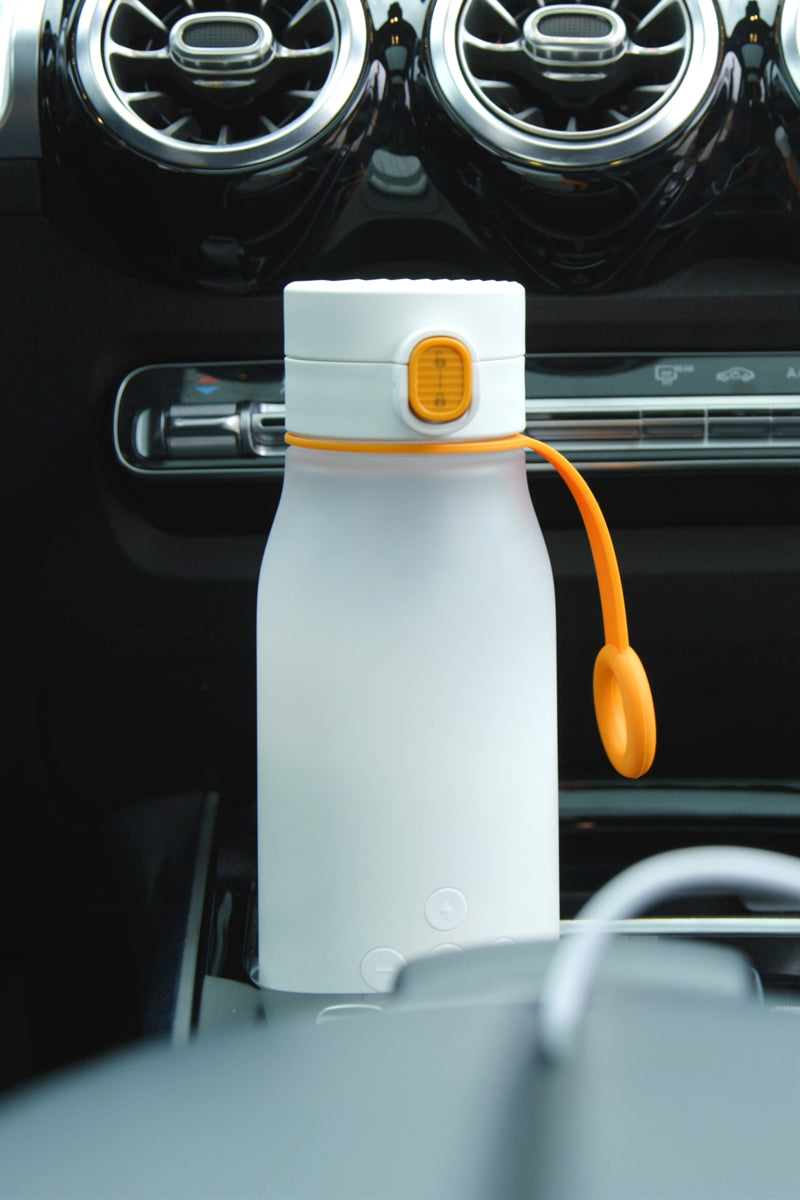
Where a warmer actually helps is everywhere the center isn’t — the pickup, the car ride home, the errand that runs long. For those on-the-go feeds, a cordless option like the BuubiBottle Smart Portable Milk Warmer heats milk or water to a body-warm 37–50 °C (98–122 °F) range, shows the live temperature on the side, and charges over USB-C, so you’re not hunting for a kettle in a parking lot. It holds 300 ml / 10 oz and the cap locks closed, so it rides in the diaper bag without leaking. If you’re weighing it against a plug-in unit, our portable vs. traditional warmer breakdown covers the trade-offs, and how long a warmer actually takes sets expectations.
The leftover rule — the one nobody likes
Once your baby has started drinking from a bottle, whatever’s left gets thrown out rather than saved for the next feed. The reason is simple and not negotiable: the mix of milk and saliva lets bacteria grow. Providers follow this strictly, which is why a half-finished bottle you’d have kept at home comes back empty. The fix isn’t to argue the rule — it’s to send realistic portions so there’s less to lose.
Send the right amount, split smart
Ask your provider how many feeds your baby takes during the day and roughly how much per feed, then send a little more than you expect — split across several smaller bottles rather than one big one. Smaller portions mean a started bottle wastes less when the once-drinking clock runs out, and they slot into a shared fridge more easily. Date them so the oldest milk goes first.
Your daycare bottle checklist
- ✓ Label every bottle and cap with full name + date
- ✓ Portion into several smaller bottles; send a little extra
- ✓ Chill it — send cold from the fridge, never pre-warmed
- ✓ Pack in an insulated bag with a frozen ice pack, bottles touching the pack
- ✓ Hand bottles directly to staff at drop-off
- ✓ Follow the center’s own labeling and sign-in system
- ✓ Expect a started bottle’s leftovers to be discarded — that’s correct, not wasteful
- ✓ Reset and refill the night before, not at 7:40 a.m.
You can’t make daycare mornings slow down — but you can take the guesswork out of the bottle. Label it, portion it, keep it cold, and let your provider do the rest the way their rules require. Do it the same way every day and within a week it stops being a decision and starts being muscle memory. That’s the whole goal: one less thing to think about before 8 a.m.
Common questions
What should I write on a daycare bottle?
Your baby’s full name and the date the milk was expressed or prepared, on both the bottle and the cap. If your center has its own label system, follow that.
How long can my provider keep refrigerated breast milk or formula?
As a general baseline, current CDC guidance is up to about 4 days for refrigerated breast milk and up to about 24 hours for refrigerated prepared formula. Your center’s rules and your pediatrician can be stricter — defer to them.
Should I warm bottles before sending them?
No. Send milk cold from the fridge in an insulated bag with an ice pack. Warming happens at the center at feed time.
Can I send frozen breast milk?
Often yes — ask whether your center prefers it frozen or thawed. Thawed milk shouldn’t be refrozen, and should be used within the window your provider specifies.
Why does daycare throw out milk my baby didn’t finish?
Once a baby drinks from a bottle, saliva introduces bacteria that can grow, so a started bottle’s leftovers are discarded. It’s standard safety practice. Smaller portions waste less.
How much milk should I send?
Ask how many feeds and how much per feed, then send a little extra across several smaller bottles — easier to store and less waste under the once-drinking rule.
Reviewed for accuracy by Dr. Yang (Pediatrics) · Last reviewed June 2026 · General informational guidance, not a substitute for advice from your own healthcare provider or your childcare center’s licensing rules. Storage figures reflect current public-health (CDC/AAP) recommendations at the time of writing; always confirm against your provider’s policy and your pediatrician. Portions of this content draw on AI assistance and are reviewed by a qualified medical reviewer before publication.


Leave a comment
All comments are moderated before being published.
This site is protected by hCaptcha and the hCaptcha Privacy Policy and Terms of Service apply.