






Nipples & Anti-Colic
Vented bottles have a real mechanical job — reducing the air your baby swallows — but "anti-colic" is a broader promise than the hardware can keep.
Medically reviewed by Dr. Yang · 2026-06-25

It's 2 a.m. Your baby just finished a feeding and is now pulling their knees to their chest and screaming. You're googling "anti-colic bottle" with one hand and patting their back with the other. The product descriptions all say the same thing: "reduces colic." But no one explains what the vent inside the nipple actually does, or, more importantly, whether the screaming happening right now has anything to do with air at all.
Here's an honest answer to both questions.
What "anti-colic" means on the bottle label
The term is not regulated. Any bottle maker can print it on packaging. What most vented or "anti-colic" systems actually target is one specific phenomenon: aerophagia, the swallowing of air during feeding.
When a baby feeds from a standard sealed bottle, they draw milk out by creating suction. As the level drops, a partial vacuum forms inside. The baby has to suck harder to pull milk through that increasing resistance, and during those extra-hard sucks, they're more likely to gulp air along with the milk. A vent disrupts this cycle: it lets a small amount of air into the bottle to equalize pressure, so the internal vacuum never builds, the milk flows at a steadier rate, and the baby doesn't need to work as hard between sips.
That's the mechanism. It's real, it's measurable, and it matters. A 2018 randomised controlled trial published in BMC Pediatrics (Kreitschmann et al.) found that infants fed with vented teats averaged 36.7 sucks per minute versus 48.4 sucks per minute with non-vented teats, a statistically significant difference. The researchers noted that the higher sucking frequency required with non-vented teats implies a higher risk of aerophagia.
What a vent cannot do: resolve colic that isn't caused by swallowed air. And here's the uncomfortable part: most of the time, it isn't.

The honest science on colic
Colic is defined by a specific pattern: prolonged crying for more than three hours a day, more than three days a week, for more than three weeks, in a baby who is otherwise healthy and well-fed. Estimates suggest it affects somewhere between 3% and 28% of infants worldwide, a wide range that itself tells you something about how hard it is to study and define.
Despite decades of research, the underlying cause remains unknown. The evidence points away from a purely digestive explanation: X-ray images taken during crying episodes show a normal gastric outline, not a stomach distended with gas. A 2012 review in World Journal of Gastroenterology (Savino et al.) noted that organic causes, including gastrointestinal problems, account for fewer than 5% of excessive crying in infants. The leading hypothesis today is neurodevelopmental: colic may represent the upper end of normal crying distribution in an immature nervous system, resolving on its own as the brain matures — typically by 12 weeks in 60% of cases and by 16 weeks in 90%, according to StatPearls.
That doesn't mean swallowed air is irrelevant. A 2018 study in Acta Paediatrica found that colicky infants showed significantly disrupted suck-swallow-breathing coordination compared to controls: longer feeding times (37 minutes versus 23 minutes in the 2–4 week group), more frequent feeds, and absence of rhythmic 1:1:1 suck-swallow-breath ratios. Whether disordered feeding mechanics are a cause or a consequence of distress remains unclear. But the data does suggest that how a baby feeds is worth paying attention to.
"Gas appears to be a marker in colic, not the cause. But swallowed air can still cause real discomfort — and that's where the vent earns its role."
What the RealFeel internal vent actually does
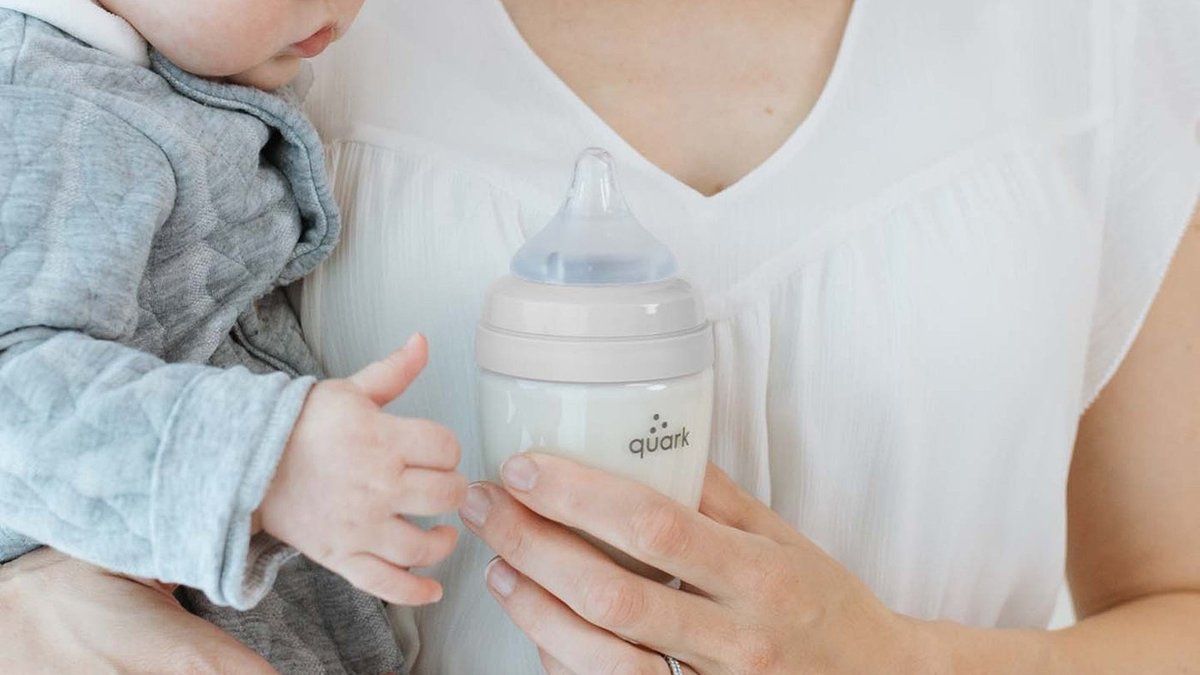
The RealFeel nipple uses an internal vent channel that runs through the nipple body. As your baby draws milk, air enters the bottle through this channel rather than being blocked by a building vacuum. The result: milk flow stays consistent throughout the feed, the baby doesn't have to increase suction force as the bottle empties, and less air gets pulled in alongside the milk.
Fewer gulps of air mean less gas in the stomach and intestines. For a baby who is fussy, gassy, and uncomfortable after feeding (not necessarily colicky in the clinical sense, just clearly uncomfortable with a tight, round belly), addressing swallowed air is a reasonable, low-risk first step.
The RealFeel nipple is available in four flow stages: Slow (0m+), Medium (3m+), Fast (6m+), and Flex (9m+). Matching the nipple flow rate to your baby's developmental stage matters as much as the vent itself. A flow that's too fast causes gulping; too slow causes frustration and harder sucking. Both increase air ingestion. Using the right stage for your baby's age is foundational.

When a vent helps — and when it won't
A vented nipple can reduce swallowed air during feeding. So if your baby's discomfort pattern fits any of the following, it may be worth trying:
- Fussiness occurs during or shortly after feeding, not hours later
- You can see or hear your baby gulping air while drinking
- The belly looks visibly distended or feels tight after feeds
- Gas-related sounds (burps, flatulence) accompany the crying
- Comfort comes fairly quickly with burping or bicycle-leg massage
These signs point toward aerophagia (air in the gut), not necessarily toward colic as a clinical entity.
A vent is much less likely to help if the crying follows no feeding pattern at all, if it peaks in the evening regardless of feeds, or if your baby seems inconsolable despite feeding, burping, and positioning. That pattern is more consistent with the neurodevelopmental theory of colic, and no bottle design addresses that. The same honest accounting applies to simethicone gas drops: the AAP has noted that studies suggest they do not help for colic, and they are increasingly discouraged for routine use.
It also bears saying: a 2025 review in BMJ Paediatric Open (James & Savargaonkar) found that the scientific evidence supporting the benefit of burping for colic prevention remains "limited and conflicting," and the same is true for many interventions parents reach for first. Not because parents are wrong to try. Colic itself is genuinely poorly understood.

What else actually helps during the colic weeks
Because the evidence on colic treatment is mixed across the board, the clinical consensus is to prioritize parental support and reassurance alongside practical comfort measures. Things that do have some research support:
- Rhythmic movement. Rocking, pram rides, car rides. The motion and vibration calm the nervous system, not the gut.
- White noise. Whooshing or shushing sounds mimic the womb environment and can shorten crying episodes.
- Correct nipple flow for age. Use the right nipple stage: Slow for under 3 months, unless a lactation consultant advises otherwise.
- Probiotic Lactobacillus reuteri DSM 17938. This is the one intervention with the most consistent evidence across multiple trials, particularly for breastfed infants. Ask your pediatrician before starting any supplement.
- Dietary changes in breastfeeding parents. For some infants, eliminating cow's milk protein from the nursing parent's diet shows modest benefit. Discuss with your care team.
What you can safely do alongside any of these: feed with a vented nipple at the appropriate flow stage, burp mid-feed and after, and keep your baby upright for 20–30 minutes post-feed. These are low-risk steps even if the evidence for each is imperfect.
When to call your pediatrician
Colic is a diagnosis of exclusion: a real cause needs to be ruled out first. See your doctor promptly if your baby shows any of the following alongside persistent crying: fever; blood in stool or urine; vomiting (not just spitting up); poor weight gain or feeding refusal; a visibly tender or rigid abdomen. These are not signs of colic. They need medical evaluation. If you're feeling overwhelmed or unsafe, call your care team. That's what they're there for.

The bottom line
An anti-colic vent does one job well: it keeps a vacuum from building inside the bottle, which means your baby swallows less air during feeding. If swallowed air is part of what's making your baby uncomfortable, that's a genuine help. If the crying is driven by the neurodevelopmental storm of true colic, no bottle design will resolve it. It will pass on its own, usually by 12–16 weeks.
Both things can be true at once. Reducing the air your baby ingests during a feed is a good idea regardless. The RealFeel nipple is built to do that efficiently. Pair it with the right flow stage for your baby's age, burp mid-feed, and remember: the colic window closes. You will get to the other side of it.

Common questions
Do anti-colic vents actually reduce gas?
Usually, yes — when gas is caused by swallowed air during feeding. A vent equalizes pressure inside the bottle so your baby doesn't create a vacuum while sucking, which reduces the amount of air pulled in with the milk. The RealFeel nipple's internal vent runs through the nipple body itself, so pressure equalization happens continuously throughout the feed rather than only at the base of the bottle. What vents can't do is reduce gas caused by digestion itself (breaking down lactose, for example), which is a separate process.
Can an anti-colic bottle stop colic?
No — and any product claiming otherwise is overpromising. Clinical colic is poorly understood and appears to be primarily neurodevelopmental. A 2018 RCT in BMC Pediatrics found that while vented teats changed sucking patterns, parental surveys showed no relation between teat type and colic symptom scores. A vented bottle may reduce feeding-related discomfort, which is genuinely useful, but it is not a colic treatment.
Which nipple flow should I use to reduce air swallowing?
It depends on your baby's age and strength — but using a flow that's too slow or too fast both cause problems. Too slow: the baby sucks harder, pulling in more air. Too fast: the baby gulps to keep up. For the RealFeel nipple, Slow (0m+) suits newborns, Medium (3m+) suits babies around three months, Fast (6m+) for six months, and Flex (9m+) for older babies transitioning feeds. When in doubt, go one stage slower than you think.
Is it normal for my baby to be gassy even with a vented bottle?
Yes. Infant digestive systems are immature and gas is normal regardless of bottle type. A vent reduces one source of gas (swallowed air) but doesn't affect gas produced by digestion. If your baby seems in significant pain from gas, bicycle-leg exercises, tummy massage, and upright positioning after feeds can help. If the discomfort seems severe or feeding is affected, talk to your pediatrician.
Are anti-colic drops (simethicone) worth trying alongside a vented bottle?
No clear evidence supports them for colic. The AAP has noted that studies suggest simethicone does not help with colic, and its use is increasingly discouraged for that purpose. Simethicone works by breaking up gas bubbles in the gut, so it theoretically helps with intestinal gas — but the evidence that this reduces colic crying is not there. Ask your pediatrician before adding any supplement or medication.
When will colic end?
Usually by 12–16 weeks. According to the Rome IV criteria and multiple population studies, colic symptoms resolve by 12 weeks in approximately 60% of infants and by 16 weeks in around 90%. If symptoms persist beyond four months or worsen, that's a reason to return to your pediatrician to reassess the diagnosis.
Sources
- Kreitschmann C, et al. "Sucking behaviour using feeding teats with and without an anticolic system: a randomized controlled clinical trial." BMC Pediatrics. 2018. https://pmc.ncbi.nlm.nih.gov/articles/PMC5857083/
- Savino F, et al. "Infantile colic, facts and fiction." World Journal of Gastroenterology. 2012;18(12). https://pmc.ncbi.nlm.nih.gov/articles/PMC3411470/
- James V, Savargaonkar R. "Science of the burp: understanding aerophagia and eructation in newborns." BMJ Paediatric Open. 2025;9(1):e004066. https://pubmed.ncbi.nlm.nih.gov/41167623/
- Biagioli E, et al. "Suck, swallow and breathing coordination in infants with infantile colic." Acta Paediatrica. 2018. https://www.ncbi.nlm.nih.gov/pmc/articles/PMC5843038/
- Johnson JD, Cocker K, Chang E. "Infantile Colic: Recognition and Treatment." American Family Physician. 2015;92(7):577–82. https://pubmed.ncbi.nlm.nih.gov/26447441/
- StatPearls. "Infantile Colic (Nursing)." National Center for Biotechnology Information, National Library of Medicine. https://www.ncbi.nlm.nih.gov/books/NBK568787/
- Garrison MM, Christakis DA. "Effectiveness of treatments for infantile colic: systematic review." BMJ. 2000. https://www.ncbi.nlm.nih.gov/pmc/articles/PMC1114305/
- Fishbein M, Daniak D. "Aerophagia During Infant Feeding Causing Gastroesophageal Reflux Disease like Symptoms." Journal of Pediatric Gastroenterology and Nutrition. 2020;71(2):e77–e78. https://pubmed.ncbi.nlm.nih.gov/32732791/
- American Academy of Pediatrics / HealthyChildren.org. "Gas Relief for Babies." https://www.healthychildren.org/English/ages-stages/baby/diapers-clothing/Pages/Breaking-Up-Gas.aspx
- Huertas-Ceballos A, et al. "Looking for new treatments of Infantile Colic." BMC Pediatrics. 2014. https://ncbi.nlm.nih.gov/pmc/articles/PMC4050441
Medical disclaimer: This article is for informational purposes only and does not constitute medical advice. It has been medically reviewed by Dr. Yang (2026-06-25). If your baby shows signs of illness, is not gaining weight, or you are concerned about their wellbeing, contact your pediatrician or healthcare provider. Colic is a diagnosis of exclusion — always rule out other causes with a qualified clinician before attributing prolonged crying to colic.




Leave a comment
All comments are moderated before being published.
This site is protected by hCaptcha and the hCaptcha Privacy Policy and Terms of Service apply.