

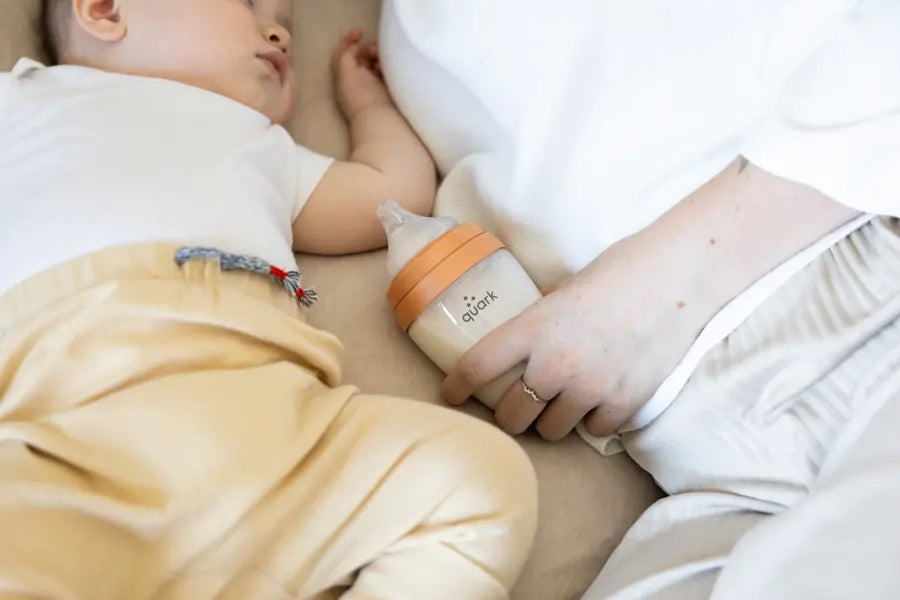





Feeding Fundamentals
Flow rate is the single most important spec on a bottle nipple — yet the label is almost always wrong. Here's what actually drives flow, why it matters for safe feeding, and how to read your baby's cues to get it right.
Medically reviewed by Dr. Yang · 2026-09-11

You've just opened your new bottle. There are four nipples in the bag: Slow, Medium, Fast, Flex. Your newborn is crying and you have absolutely no idea which one to use.
You start with Slow because that sounds safest. The baby works furiously for 40 minutes and finishes maybe half the bottle before giving up exhausted. You switch to Medium and now milk dribbles down the chin and your baby makes a wet gulping sound that tightens your chest a little. You end up back on Slow and convince yourself you'll figure it out tomorrow.
If you are working out which flow rate fits your baby, ours is the RealFeel bottle nipple.
You are not doing anything wrong. Flow rate is genuinely confusing because bottle manufacturers use words like "Slow" and "Fast" to mean almost nothing consistent. A 2016 study by Pados et al. published in MCN: The American Journal of Maternal/Child Nursing tested 260 nipples across 26 types from 15 common brands and found real milk flow rates ranging from 1.68 mL per minute to 85.34 mL per minute — a range the stage labels completely fail to capture. What one brand calls "Medium" another brand calls "Newborn."
So let's talk about what flow rate actually is, how to read your baby's signals, and what to do when something feels off.
What Flow Rate Actually Measures
Flow rate is the volume of milk that passes through a nipple per minute, measured under controlled pressure. It's not just about hole size. The nipple material, wall thickness, hole geometry, and even how tightly you screw the ring onto the bottle all affect how much milk moves.
Research by Pados et al. (2016) found that even nipples labeled identically within the same brand showed meaningfully different flow rates. Two nipples from the same box can deliver meaningfully different flow. This is not a manufacturing defect; it's physics. What it means for you practically: the nipple stage on the package is a starting point, not a guarantee.
Why does any of this matter beyond feeding comfort? Because swallowing and breathing share anatomy. Every swallow requires a brief pause in breathing. When milk comes too fast, a baby must swallow more rapidly, interrupting breathing more frequently. If that pace exceeds what an infant can coordinate, residual milk can remain in the throat between swallows, which is a risk factor for aspiration. Slower, paced feeding gives the baby control over that rhythm.
What "Variable Flow" Means on a Nipple
A variable-flow nipple is one whose flow changes with how hard your baby sucks. On a staged nipple (Slow, Medium, Fast) the opening sets a ceiling: the same gentle suck gets roughly the same amount of milk every time, and the only way to change the rate is to change the nipple. On a variable-flow nipple, a stronger suck lets more milk through and a lighter suck lets less, so the baby, rather than the hole, sets the pace of the feed.
That is why a variable-flow nipple such as the RealFeel Flex belongs at the end of the sequence, not the beginning. It rewards a baby who already regulates intake well; it hands a newborn a throttle they cannot yet control. If you are weighing whether it is time to change stages at all, our guide on when to move up a nipple flow without rushing walks through the cues one at a time.

The Four Quark Baby Flow Stages — and What Each One is Actually For
The RealFeel nipple comes in four stages designed to match your baby's developing suck strength and feeding coordination, not just their age in months. Age is the guide, not the rule.
Slow (0 months+)
This is the starting nipple for newborns. Their suck is strong but their swallow-breathe coordination is still being worked out. A slower flow gives them time to swallow, take a breath, and swallow again without feeling overwhelmed. It's also the right nipple for any baby who has had a feeding break (illness, prematurity, or a hospital stay) because the coordination can regress.
What a good feed looks like on Slow: steady rhythmic sucking, some natural pauses, no straining or fussing, no milk pooling at the corners of the mouth.
Medium (3 months+)
Around three months, most babies have grown stronger jaw muscles and better suck-swallow-breathe coordination. They can handle more milk per minute without the respiratory scramble a faster flow would cause in a younger baby. Medium is often where babies spend the most time; it covers a wide developmental window.
Watch for the transition signals: if your baby is spending 35–40 minutes on a feed and still seems hungry at the end, Medium may be the right move up from Slow.
Fast (6 months+)
By six months, babies are sitting with support, starting solids, and their oral motor skills are significantly more mature. Fast flow suits this stage because they can coordinate an efficient swallow at higher volumes. Going to Fast too early (say, at 6 weeks) is where feeding trouble begins.
Flex (9 months+)
Flex nipples are variable-flow: the more suction the baby applies, the more milk flows. This mirrors how the breast actually works (let-down varies) and suits older babies who self-regulate their intake well. It's also useful for babies who are experienced breastfeeders and bottle-feeders simultaneously, as it matches the variable flow they're used to.
The Four Stages at a Glance
If you only skim one thing: start on Slow, and let the feed, not the calendar, tell you when to change.
| Stage | Starts from | How the flow behaves | Best for |
|---|---|---|---|
| Slow | 0 months+ | Fixed, slowest | Newborns; any baby returning from a feeding break |
| Medium | 3 months+ | Fixed, moderate | The widest stretch of the first year |
| Fast | 6 months+ | Fixed, fastest | Bigger volumes alongside solids |
| Flex | 9 months+ | Variable, rises with suction | Experienced feeders who self-regulate |
Starting ages are the ones printed on the RealFeel nipple listing. They are starting points; the cues below decide the move. All four stages fit both the BuubiBottle Mini and Max, so the bottle stays and only the nipple changes as your baby grows, which is the whole point of one bottle system from newborn to toddler. When the nipple stage ends, the same body takes the BuubiBottle Sip straw lid.

What a Correctly-Paced Feed Looks and Sounds Like
A complete bottle feed, for a baby on the right flow rate at the right stage, should take roughly 15 to 30 minutes. Indiana WIC's paced feeding guidance uses this window as a reference, and it mirrors the typical duration of a nursing session at the breast. This matters because it gives the baby enough time for satiety hormones to signal fullness before the bottle is empty. A feed that's over in seven minutes is often a sign the flow is too fast.
During a correctly-paced feed:
- The baby sucks steadily, with natural brief pauses every 3–5 swallows.
- Breathing stays even. No spluttering, no gasping.
- Hands stay relaxed. Fisted, splayed fingers, or wide eyes mid-feed are classic "too fast" signals.
- Milk stays in the mouth. No streams dribbling down the chin.
- The baby loses interest before or when the bottle is done. Satiated babies stop sucking and release the nipple. Don't prompt them to finish.
A practical technique that lactation consultants recommend across the board: keep the bottle horizontal (nipple only half-filled with milk) rather than tipping it steeply upward. Gravity adds flow. When the bottle is near-horizontal, the baby controls how much milk enters by their own suction. A well-designed nipple is built for exactly that responsiveness. The RealFeel's internal anti-colic vent lets you hold this position without the nipple collapsing.
A feed that's over in seven minutes is often a sign the flow is too fast — even if the baby seems satisfied. Satiety signals take time to reach the brain.
Reading the Signals: When Flow Rate is Wrong
Signs the flow is too fast
These are the signals to watch for, compiled from Indiana WIC's paced feeding guidance and clinical feeding research:
- Gulping and audible swallowing — the baby is trying to keep up with more milk than they can comfortably swallow per breath.
- Milk dribbling from the mouth corners — the baby has more milk in the mouth than they can handle; some escapes.
- Wide eyes or splayed fingers mid-feed — a stress response; the baby feels overwhelmed.
- Choking or sputtering — milk is arriving faster than the swallow can clear it.
- The feed is done in under 10 minutes — for most infants under 6 months, this is too fast.
If you see two or more of these consistently, drop to the previous flow stage. It's not a step backward. It's the right call.
Signs the flow is too slow
- Frantic, rapid sucking with no swallowing rhythm — the baby is working hard but getting little reward.
- Feeds consistently running over 40 minutes — the baby is tiring out before they've taken enough volume.
- Frustration, pulling off the nipple, or fussing during the feed — often misread as wind or reflux, but flow rate is frequently the culprit.
- Baby seems hungry again very soon after a feed — they didn't finish because the effort-to-reward ratio was too low.
Two things look like a flow problem and are not. A baby who suddenly refuses the bottle altogether is usually telling you something else; our guide to the top reasons a baby refuses the bottle covers those. And a breastfed baby who fights every nipple stage may be dealing with nipple confusion or bottle preference rather than flow. When several feeding problems stack up at once, our complete guide to baby feeding problems helps you sort which one to fix first.

How to Test: The Swallow-Count Method
You don't need equipment. Watch and listen during a feed. A comfortable feeding rhythm sounds like: suck–suck–suck–swallow–breath, or suck–suck–swallow–breath, with an audible soft swallow (a small "kuh" or "guh" sound). If you're counting more than 3–4 continuous swallows without a breath pause, the flow is likely too fast for that baby at that stage. If you're counting 10+ sucks before a swallow, or the sucks sound "dry," the flow is probably too slow.
You can time a feed, too. Fill the bottle to a known volume. If 90 mL disappears in 8 minutes, the flow is too fast regardless of what the nipple package says.
A Note on Nipple Labels vs. Reality
This bears repeating: the label is a starting point. The 2016 Pados et al. study in MCN: The American Journal of Maternal/Child Nursing found that nipple names — slow, medium, fast, newborn — do not provide clear or reliable flow information. Two nipples from different brands with the same label can deliver vastly different flow rates; in the study, nipples with identical designations sometimes differed by many multiples of mL per minute. A nipple labelled "slow flow" by one manufacturer may deliver more mL per minute than another brand's "medium flow." The only reliable guide is watching your baby feed.
This is why the RealFeel nipple stages are defined by developmental age and feeding readiness, not vague size descriptors, so there's at least a consistent reference frame to start from.
If your baby is struggling at the breast and the bottle: A consistent pattern of choking, stress signals, or extremely slow feeds at every nipple stage can indicate an underlying feeding coordination issue unrelated to flow rate. Ask your pediatrician for a feeding assessment or referral to a speech-language pathologist or IBCLC who specialises in infant feeding. This is normal to seek; many babies benefit from a short round of feeding therapy.
What the Nipple Is Made Of, and What an Independent Lab Found
The material matters more than the marketing word for it. The RealFeel product listing describes the nipple as platinum-cured liquid silicone rubber (LSR). In February 2024, SGS-CSTC Standards Technical Services (Qingdao) Co., Ltd. tested the BuubiBottle Mini+Max set, the bottle system these nipples ship with, under report number QDHL2401001434CW, and identified the nipple material as LSR silicone homopolymer. Two results in that report speak directly to the nipple:
- Six phthalates (DBP, BBP, DEHP, DINP, DNOP, DIDP) were not detected on the nipple, meaning below the method detection limits of 30 to 100 mg/kg, against a regulatory limit of 1,000 mg/kg (GC-MS, Health Canada Book 5 method C-34.3; Phthalates Regulations SOR/2016-188).
- Six soluble heavy metals (antimony, arsenic, barium, cadmium, chromium, selenium) were not detected on the nipple, below detection limits of 2.5 to 10 mg/kg (ICP-OES, ASTM F963-17 clause 8.3).

Two honest limits on that evidence. "Not detected" means below the stated detection limit, not zero. And a report covers the samples it tested: models MINI+MAX-ORANGE, MINI+MAX-PURPLE and MINI+MAX-GREY, tested between 31 January and 4 February 2024. It describes those nipples on that date, not every nipple ever made. We publish the report number so you can ask for it rather than take our word. If material questions are what brought you here, we have gone deeper on silicone versus plastic feeding products, on microplastics in baby bottles and on the Grilamid TR-90 bottle body.
How Many Nipples You Need, and When to Replace One
Keep two nipples in your baby's current stage for every bottle in rotation, so one can be drying while the other is in use, and buy the next stage before the cues arrive rather than at 3 a.m. when they do. That is the whole shopping list; a drawer full of every stage at once is money spent on guesses. Our newborn feeding kit checklist and the first 90 days starter set show how few pieces a working routine actually needs.
Silicone wears, and a worn hole is a faster flow you did not choose. Before each wash, hold the nipple up to the light and pull the tip gently. Replace it if the tip has thinned or gone sticky, if the hole has torn or looks stretched, if the silicone has turned cloudy or cracked, or if it no longer springs back when you let go. There is no fixed calendar for this; the check is the calendar. If a nipple that used to work suddenly produces the "too fast" signs above, check it for wear before you blame the stage. Washing and drying are the other half of nipple care, and we have argued elsewhere that you probably do not need to sterilize every day; the wide neck is what makes the daily wash quick. Families mixing breast and bottle will find the nipple-stage question comes up again in combo feeding basics.
Putting It Together: Starting Kit for New Parents
If your baby is newborn to 6 weeks: start on Slow, hold the BuubiBottle Mini (5oz/150ml) horizontal, keep feeds to 15–30 minutes, and let the baby decide when they're done. That's the full protocol. Most "feeding problems" at this stage are a flow mismatch, not a formula problem or a reflux problem.
If your baby is 3–5 months and feeds are consistently frustrating, try Medium for one feed. Watch for the signals above. Give it 2–3 feeds before deciding.
If your baby is 6 months or older and you're bottle-feeding alongside solids, the BuubiBottle Max (8oz/240ml) with a Fast nipple handles bigger volumes without rushing the feed.
If you are still choosing the bottle itself, start with how to pick the right bottle for a breastfed baby and how to introduce a bottle to a breastfed baby. For the technique side of a calm feed, paced bottle feeding is the method every cue in this article assumes (new to bottles? how to bottle feed a newborn starts from zero), and anti-colic vents explains why the nipple can stay collapsed-free while you hold the bottle flat. Warming the milk to the right temperature is its own small science; the temperature babies prefer covers it.

The Most Important Thing
Flow rate is adjustable. That's the underrated part. If something feels off (a feed is lasting too long, your baby is gulping, or you're both dreading the bottle), change one variable at a time, starting with flow. You don't need to replace the whole bottle or overhaul your routine. Nine times out of ten, moving one nipple stage in either direction fixes it.
Trust what you're seeing. You are with your baby every feed. The signals are there; now you know what to look for.
Common Questions
How do I know when to move up a flow stage?
It depends. The clearest signal is a consistent pattern of frustrated, prolonged feeds (over 35–40 minutes) where the baby tires before finishing. Age is a guide: Medium at 3 months, Fast at 6 months, Flex at 9 months. Some babies are ready earlier, some later. Never move up if feeds are going well at the current stage.
My newborn is gulping on the Slow nipple. Is something wrong?
Usually, no. Check your bottle angle first. If the bottle is tipped steeply (nipple fully submerged in milk), gravity adds to the flow regardless of stage. Try holding the bottle more horizontal so the nipple is only half-filled with milk. If gulping persists with correct positioning, talk to your pediatrician about whether a feeding evaluation would help.
Do I need to move to a faster flow as my baby gets older?
Usually, yes, but only when feeding cues tell you to. Some babies stay on Medium until 9 months with no issues. There is no deadline for moving up a stage. The goal is a comfortable 15–30 minute feed, not hitting the "age-appropriate" nipple by a certain date.
Can I use a fast-flow nipple to make feeds quicker at night?
No. Using a flow stage that's too fast for your baby's developmental stage forces them to swallow faster than they can comfortably coordinate breathing. The short-term gain of a quicker feed isn't worth the feeding stress, and at night a tired baby's coordination is at its worst. Stick to the stage appropriate for your baby's age and ability.
My baby takes 45 minutes on Medium. Is that bad?
It depends. If the baby finishes the bottle and seems content, a longer feed isn't automatically a problem; some babies are slow, methodical feeders. If the baby doesn't finish and seems exhausted or frustrated, that's a different signal: the flow may be too slow, or there may be something else going on worth discussing with your provider.
Does the Flex nipple replace the others?
No. Flex is designed for babies 9 months and older who have strong, mature suck mechanics. For younger babies, a variable-flow nipple can deliver too much milk too unpredictably. Use the staged nipples in order, and move to Flex when your baby is developmentally ready.
What does "variable flow" mean on a bottle nipple?
It means the flow changes with your baby's suck. A staged nipple delivers a fixed rate set by its opening; a variable-flow nipple such as the RealFeel Flex lets more milk through when your baby sucks harder and less when they ease off. It suits older babies who already pace themselves, which is why it is labelled 9 months and up.
Do RealFeel nipples fit other brands' bottles?
No. RealFeel nipples are made for the BuubiBottle Mini and Max and are not designed for other bottle systems. The upside is the reverse: every stage fits both BuubiBottle sizes, so changing flow never means changing bottles.
Written by the Quark Baby team.
Medically reviewed by Dr. Yang · 2026-06-25
Medical disclaimer: This article is for informational purposes only and does not constitute medical advice, diagnosis, or treatment. Always consult your pediatrician or a qualified healthcare provider with questions about your infant's feeding, health, or development.
Sources
- Pados BF, Park J, Thoyre SM, Estrem H, Nix WB. "Milk Flow Rates From Bottle Nipples Used After Hospital Discharge." MCN Am J Matern Child Nurs. 2016;41(4):237–243. https://www.ncbi.nlm.nih.gov/pmc/articles/PMC5033656/
- Pados BF, Park J, Dodrill P. "Know the Flow: Milk Flow Rates From Bottle Nipples Used in the Hospital and After Discharge." Advances in Neonatal Care. 2019;19(1):32–41. https://journals.lww.com/advancesinneonatalcare/Abstract/2019/02000/Know_the_Flow__Milk_Flow_Rates_From_Bottle_Nipples.7.aspx
- Pados BF. "Milk Flow Rates From Bottle Nipples: What We Know and Why It Matters." Nursing for Women's Health. 2021. https://www.sciencedirect.com/science/article/pii/S1751485121000787
- Indiana WIC. "Paced Feeding." Indiana WIC Resources. https://indiana.wicresources.org/paced-feeding/
- KellyMom (Wilson-Clay B, Hoover K). "How to Bottle-Feed the Breastfed Baby." KellyMom.com. https://kellymom.com/bf/pumpingmoms/feeding-tools/bottle-feeding/
- Texas Health Resources. "Paced Bottle Feeding." Texas Health Baby Care. https://www.texashealth.org/baby-care/Infancy/paced-bottle-feeding
- Institute for the Advancement of Breastfeeding and Lactation Education (IABLE). "Bottle Nipple Flow Rates." https://lacted.org/questions/bottle-nipple-flow-rates/
- Centers for Disease Control and Prevention. "About Feeding From a Bottle." CDC Infant and Toddler Nutrition. https://www.cdc.gov/infant-toddler-nutrition/bottle-feeding/index.html
- SGS-CSTC Standards Technical Services (Qingdao) Co., Ltd. Test Report QDHL2401001434CW, BuubiBottle Mini+Max (models MINI+MAX-ORANGE / -PURPLE / -GREY), test period 2024-01-31 to 2024-02-04, issued 2024-02-04. Applicant: Quark Baby LTD, Vancouver. Report held on file; available on request.


Leave a comment
All comments are moderated before being published.
This site is protected by hCaptcha and the hCaptcha Privacy Policy and Terms of Service apply.