


This article is for general information and is not medical advice. Talk to your pediatrician before starting solids, especially if your baby was born early, has severe eczema, or has already reacted to a food.
By Justin Gurinskas, Co-Founder, Quark Baby. Checked against current guidance from the CDC, the American Academy of Pediatrics, Health Canada and the Canadian Paediatric Society.
You have a steamer basket of sweet potato, half a bag of frozen peas, a ripe pear, and a baby who has now tried all three on their own. The next question is the one that actually gets you through the week: what can you put together, and does any of it need cooking before it goes in the blender?
Here is the short version. Almost every fruit and vegetable can be blended for a baby, but the American Academy of Pediatrics says that apart from mashed raw banana, "most other fruits and vegetables should be cooked until they are soft." Pair a smooth, mild base (sweet potato, pear, squash, oatmeal) with one stronger accent (peas, spinach, lentils, chicken), and only combine foods your baby has already eaten on their own. The rest of this guide gives you a cook-first list, puree combinations by age including a full sample day at 7 months, and the handful of things that never go in.

Which foods can you blend for babies?
Nearly all of them. Vegetables, fruit, meat, fish, lentils and grains can all be pureed. What decides whether a food is ready for the blender is whether it is soft first. The CDC's preparation advice is to "cook hard vegetables and fruits, such as carrots and apples, so you can easily mash or puree them," and to cook food "until it is soft enough to easily mash with a fork." The Canadian Paediatric Society adds that very ripe, soft fresh fruit, peeled and seeded, can be offered without cooking.
If you only skim one thing, skim this table. It sorts the foods parents blend most often by whether they need cooking, and by the job each one does in a combination.
| Food | Cook first? | Role in a combo | Pairs with |
|---|---|---|---|
| Banana | No, mash ripe | Base | Oatmeal, yogurt, blueberry |
| Avocado | No, mash ripe | Base | Banana, pear, peas |
| Pear (our pick) | Yes, unless very ripe | Base or thinner | Peas, spinach, lentils, chicken |
| Apple | Yes | Base | Carrot, squash, oatmeal |
| Sweet potato | Yes | Base | Chicken, peas, broccoli |
| Butternut squash | Yes | Base | Apple, red lentil, yogurt |
| Carrot | Yes | Base | Apple, pear, parsnip |
| Peas | Yes | Accent | Pear, sweet potato, mint |
| Spinach, kale | Yes | Accent | Pear, sweet potato, yogurt |
| Broccoli | Yes | Accent | Sweet potato, potato, apple |
| Red lentils | Yes, until very soft | Accent (iron) | Squash, carrot, apple |
| Chicken, beef, fish | Yes, well cooked | Accent (iron) | Sweet potato, carrot, pear |
| Infant cereal, oatmeal | Mix with milk or water | Thickener (iron if fortified) | Any fruit puree |
| Plain whole-milk yogurt | No | Base | Fruit your baby has already had |
Pear is our pick for the first cube in your freezer. It is mild, it blends thin, and it softens the grassy or bitter edge of almost any green you stir it into. Health Canada also asks that meat, eggs, poultry and fish are always cooked well, so there is no raw option for anything in the protein rows.

Foods that do not blend well
Celery and asparagus stay stringy however long you run the blender, and raw apple or pear turns gritty rather than smooth. Cook them very soft or leave them out until your baby is managing more texture. A smooth puree is also not automatically a safe one: the choking rules further down apply to what goes into the bowl, not just to how it looks.
How to build a combination: one base, one accent
Every combination that works has two parts. The base is a starchy vegetable or soft fruit that purees smooth and carries other flavors. The accent is the stronger, thinner or more fibrous food you want your baby to eat more of. Peas, spinach and broccoli blend thin and a little stringy on their own, which is why they are easier to serve stirred into sweet potato or pear.
- Bases: sweet potato, butternut squash, pear, apple, banana, avocado, infant cereal or oatmeal.
- Accents: peas, spinach, kale, broccoli, red lentils, pureed chicken, beef or fish.
- Thinners: breast milk, formula or water, added a spoonful at a time. The CDC suggests mixing infant cereals and cooked grains with breast milk, formula or water to keep them smooth.
Start around half and half and shift toward the base if your baby makes a face. That one rule produces most of the combinations below without needing a recipe. When you want one anyway, our broccoli and sweet potato puree and parsnip and pea puree follow exactly this pattern.

Before you combine: one new food at a time
Combinations come after single foods, not instead of them. The CDC's advice is to let your baby "try one single-ingredient food at a time at first" and to "wait 3 to 5 days between each new food," and the AAP's starting-solids page gives the same 3 to 5 days. Other guidance is shorter: Health Canada, introducing allergens one at a time, says to wait two days before introducing a new food, and the AAP's allergy page says to wait at least a day. We follow the 3 to 5 day window for first foods, because if a rash appears, you want to know which food caused it. Once your baby has had two foods separately with no problem, blending them together adds nothing new to watch for.
If your baby is not yet showing signs of readiness, start with our guide to the signs your baby is ready for solid foods. And if you are deciding between purees and finger foods, baby-led weaning vs spoon-feeding covers the trade-offs.
Baby food combinations by age
What changes with age is texture and how many ingredients go in, not the pairing logic. The CDC says it is easier for babies to start with "very smooth" mashed, pureed or strained foods and to move to "thicker and more lumpy foods" as their eating develops. Health Canada asks that lumpy textures are offered no later than nine months, because delaying them is associated with feeding difficulties later.
| Age | Texture | Ingredients per combo | Examples |
|---|---|---|---|
| About 6 months | Very smooth, runny | 2, both already tried | Apple + carrot · pear + pea · banana + infant cereal |
| 7 months | Thicker puree, finely mashed | 2 to 3, one iron-rich | Sweet potato + chicken · squash + red lentil + apple |
| 8 to 9 months | Mashed with soft lumps | 2 to 3 | Spinach + pear + yogurt · pea + mint + ricotta |
| 10 to 12 months | Minced, chopped, soft finger foods | Family-style mixes | Squash + lentil + cumin · salmon + sweet potato + peas |
Baby food combinations for 6 months
At the start, keep it to two foods your baby has already eaten separately, blended completely smooth and thin enough to drip slowly off the spoon. This is a month for getting used to spoons and swallowing, not for variety. Good first pairs: apple and carrot, pear and pea, banana and iron-fortified infant cereal, sweet potato and apple. Breast milk or formula is still where most of your baby's nutrition comes from, and Health Canada says to let your baby decide how much to eat.
Purees for 7 months: what a day can look like
Seven months is when many parents feel stuck repeating the same three cubes. It is also the month to add a third ingredient, make the puree a little thicker, and put an iron-rich food in at least one meal. Health Canada publishes a sample menu for a 7-month-old, and it is more useful than any list of recipes because it shows how the foods spread across a day. Here are the solid foods from it, offered alongside breastfeeding on cue:
| Time | Foods on Health Canada's menu | One combination to try |
|---|---|---|
| Morning | Iron-fortified infant cereal; mashed strawberries or other soft fruit | Infant cereal + pear |
| Snack | Whole grain toast in small pieces or strips | (finger food, no blending) |
| Midday | Iron-fortified infant cereal; hard-boiled egg, mashed, minced or grated; cooked, mashed sweet potato or other vegetable | Sweet potato + mashed egg |
| Snack | Unsweetened stewed prunes, pureed | Prune + apple |
| Early evening | Ground or finely minced dark chicken or other meat; cooked, mashed broccoli or other vegetable | Chicken + broccoli + sweet potato |
Health Canada describes these menus as "only a guide," and formula-fed babies start solids at the same age. Notice that the menu puts an iron-rich food (cereal, egg, chicken) in three separate meals. That matches its advice to offer iron-rich foods "a few times each day," and it is the part of a 7-month day that is easiest to miss when you are rotating fruit cubes.
Other 7-month combinations that follow the same pattern: sweet potato with pea and pear, butternut squash with red lentil and apple, carrot with chicken and parsnip. Our chicken, potato and carrot puree is a good first meat combination. If your baby pushes the thicker texture back out with their tongue, thin it again for a few days and retry rather than forcing it.

Baby food combinations for 8 months
By 8 months the goal shifts from smooth to textured. Mash instead of blending, leave soft lumps in, and put a few soft finger foods on the tray at the same meal. If you use a fruit feeder for that practice, see what to put in a fruit feeder. Combinations that work: spinach with pear and plain yogurt, sweet potato with chicken and carrot, pea with mint and ricotta, apple with oatmeal and a pinch of cinnamon. Because Health Canada's line is lumps by nine months at the latest, treat eight months as the time to start, not the deadline.
Stage 2 baby food combinations
"Stage 2" is a jar label rather than a medical term. It usually means a thicker puree with two or three ingredients, the stage most babies are at somewhere between 7 and 9 months. The best stage 2 combinations include an iron-rich protein or a fortified grain: sweet potato with chicken and carrot, squash with red lentil and apple, or pear with infant cereal and blueberry. Our easy homemade baby food recipes include several stage 2 combinations with quantities.
Baby food combinations for 9 to 12 months
From around nine months, combinations start to look like small versions of your own dinner: minced chicken with mashed sweet potato and peas, lentils with squash and a little cumin, flaked salmon with potato (our strawberry, salmon and leek puree is one example). Health Canada's 11-month sample menu includes mashed canned salmon, mashed sweet potato and mashed cooked green peas at the same meal. The CPS recommends offering your baby the healthy foods your whole family is eating, and checking store-bought baby food labels for added salt or sugar. Our guide to starting baby-led weaning covers the finger-food side of this stage.

What can I mix with pear puree?
Almost anything. Pear is mild, naturally sweet and thin enough to loosen a stiff puree without watering down its flavor, which makes it the most forgiving partner in a first-foods rotation. These are the pear combinations we come back to:
- Pear and pea: the classic. Pear rounds off the grassy taste peas have on their own.
- Pear and spinach: the easiest way to get spinach past a baby who refuses it plain.
- Pear and red lentil: the lentil adds iron and thickens a runny pear puree.
- Pear and infant cereal or oatmeal: a filling breakfast from the first weeks of solids.
- Pear and avocado: no cooking needed if the pear is very ripe and well mashed.
- Pear and chicken: it sounds unlikely, but the sweetness offsets the savory taste well.
- Pear and blueberry: a good first "purple" food, mild despite the color.
Two practical notes. Peel pear for younger babies, because the skin stays gritty even after cooking. And if the puree comes out too runny, stir in infant cereal rather than boiling it down.
Iron: the nutrient to plan every combination around
If you plan combinations around one thing, make it iron. The CDC says that once your child starts eating foods around 6 months, "it is important to give foods with enough iron," and Health Canada recommends iron-rich foods as the very first foods. The CDC separates two kinds:
- Heme iron, in red meat, poultry, fish and eggs, which the body absorbs more easily.
- Non-heme iron, in iron-fortified infant cereals, tofu, beans, lentils and dark leafy greens, which is less easily absorbed.
This is where combining foods does real work. The CDC says that pairing non-heme iron with foods high in vitamin C "can help your baby absorb needed iron," and lists citrus, broccoli, cabbage, berries, papaya, tomatoes and sweet potatoes as vitamin C sources. So lentils with sweet potato, infant cereal with blueberries, or spinach with broccoli are better than the sum of their parts. For more on protein foods, see the top protein-rich foods for your baby.
Pair an iron food with a vitamin C food in the same bowl. That one habit makes a combination worth more than either food on its own.
How to make baby food combinations at home
The easiest system is to cook single purees in a batch and combine them at mealtime, instead of cooking every combination separately.
- Cook single foods soft. Steam, bake or boil one ingredient at a time until it mashes easily with a fork. The AAP says fresh foods should be cooked with no added salt or seasoning.
- Blend each one smooth, adding breast milk, formula or water a spoonful at a time.
- Portion and freeze. A tray with small separate pods lets you thaw one portion of each food.
- Combine at feeding time. Thaw one portion of a base and one of an accent, stir together and check the texture.
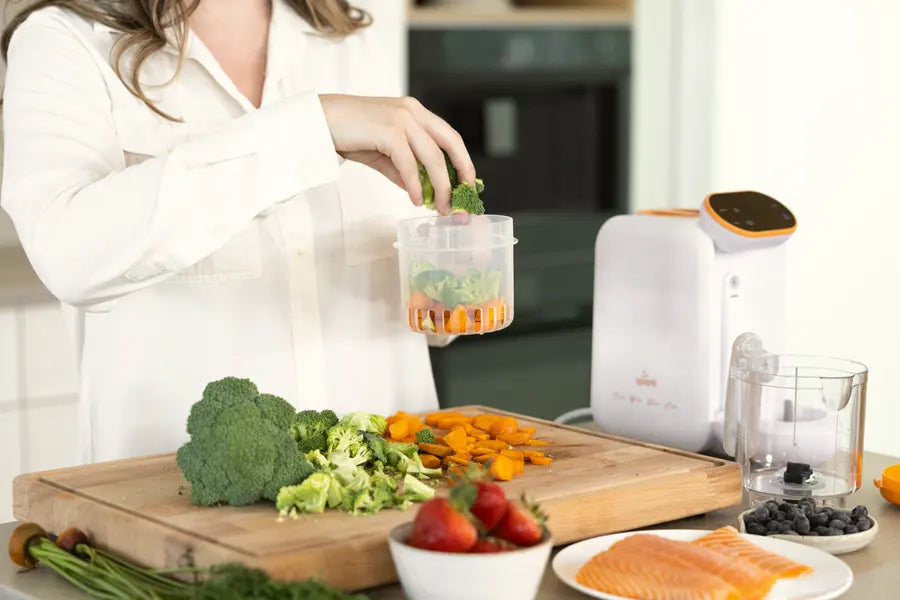
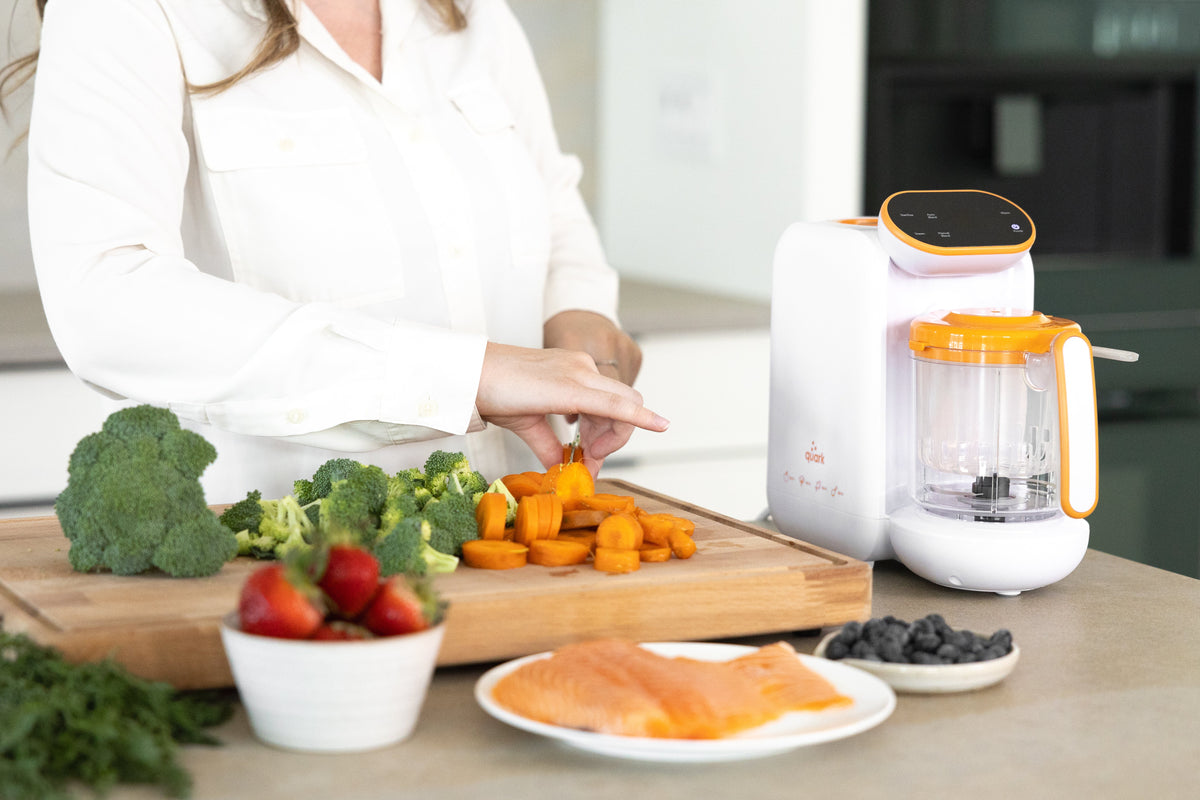
We make the Quook baby food maker for the cook-and-blend step, because it steams and blends in the same unit, so the softened vegetables never have to move to a second appliance. Our Chiill silicone freezer tray has seven 1.4 oz pods with a lid, so each pod holds one base or one accent. A separate steamer and blender work just as well; our comparison of a baby food maker vs a steamer and blender is honest about when the extra appliance is not worth it. For step-by-step cooking of meat and grains, see how to use a baby food maker for vegetables, fruit, meat and grains.
Storing and freezing combinations
The AAP's advice is to refrigerate any food you do not use and to check for signs of spoilage before serving it, because fresh food is not bacteria-free and spoils faster than a sealed jar. Label each container with the food and the date, thaw in the fridge, and stir and check the temperature before serving. We keep the full timelines for fridge and freezer in one place, our guide to baby food storage, so they are not repeated in slightly different words across articles. In warm weather, read storing homemade baby food in the summer.

For days out or daycare, our Storii containers clip an ice pack into the lid. Our guide to packing a first-foods kit for daycare or grandparents covers the rest.
What never goes into a baby food combination
- Honey, before 12 months. Health Canada and the Canadian Paediatric Society both say not to give honey to a baby under one year old, because of the risk of infant botulism. Sweeten with fruit instead.
- Cow's milk as a drink, before 12 months. The CDC says cow's milk is not recommended as a drink until after 12 months, but that other cow's milk products, such as yogurt without added sugars, can be introduced earlier. Plain whole-milk yogurt in a combination is fine.
- Choking hazards. The CDC's list includes uncut grapes, berries, cherries and melon balls, and chunks or spoonfuls of nut and seed butters. Blend these fully or leave them out. Never stir a lump of thick peanut butter into a puree.
- Added salt and sugar. The AAP says fresh baby foods should be cooked with no added salt or seasoning. Mild spices such as cinnamon or cumin are a better way to add interest.
For the complete list, see our guide to foods to avoid for babies.
Using combinations to introduce allergens
Combinations are a convenient way to introduce common allergens, because you can stir a small amount into a food your baby already eats. The AAP says there is no evidence that waiting beyond 4 to 6 months to introduce foods such as egg, dairy, soy, peanut and fish prevents food allergy. Its allergy page suggests mixing and thinning a small amount of peanut butter into cereal, pureed fruit or yogurt, and introducing one new allergen at a time.
If your baby has or has had severe, persistent eczema, or has reacted to a food such as egg, the AAP considers them at high risk for peanut allergy and asks that you talk to your pediatrician first. Our guide to reducing food allergy risk goes through this step by step.
If your baby spits it out, that is normal.
A new taste or a thicker texture often comes straight back out on the first few tries, and the CDC notes that babies may cough, gag or spit up while they adjust to new textures. The AAP's advice if your baby cries or turns away is not to make them eat, go back to milk feeds for a while and try again. Offer the same combination another day before deciding your baby does not like it.
Frequently asked questions
Most weeks, you do not need new recipes. You need four or five single foods in the freezer, one iron-rich accent, and the habit of stirring two together. Start with the pairs your baby already likes, add one new thing at a time, and let the textures get thicker as your baby gets better at eating. If something about your own baby's feeding worries you, your pediatrician is the right person to ask.
Sources
- Centers for Disease Control and Prevention: When, What, and How to Introduce Solid Foods (updated and reviewed April 14, 2026)
- Centers for Disease Control and Prevention: Iron (updated and reviewed April 14, 2026)
- Centers for Disease Control and Prevention: Choking Hazards (updated and reviewed March 11, 2026)
- American Academy of Pediatrics (HealthyChildren.org): Starting Solid Foods
- American Academy of Pediatrics (HealthyChildren.org): When to Introduce Egg, Peanut Butter and Other Common Food Allergens (last updated June 12, 2025)
- American Academy of Pediatrics (HealthyChildren.org): Choking Prevention
- Health Canada: Infant nutrition (includes the 7-month and 11-month sample menus)
- Health Canada: Nutrition for Healthy Term Infants: Recommendations from Six to 24 Months
- Canadian Paediatric Society (Caring for Kids): Feeding your baby in the first year (last updated January 2020)
Medically reviewed by Dr. Yang. Last reviewed October 1, 2026.
Disclaimer: This article is for educational purposes only and is not a substitute for professional medical advice, diagnosis, or treatment. Always seek the advice of your pediatrician or other qualified health provider with any questions regarding your baby's health or feeding.


Leave a comment
All comments are moderated before being published.
This site is protected by hCaptcha and the hCaptcha Privacy Policy and Terms of Service apply.