


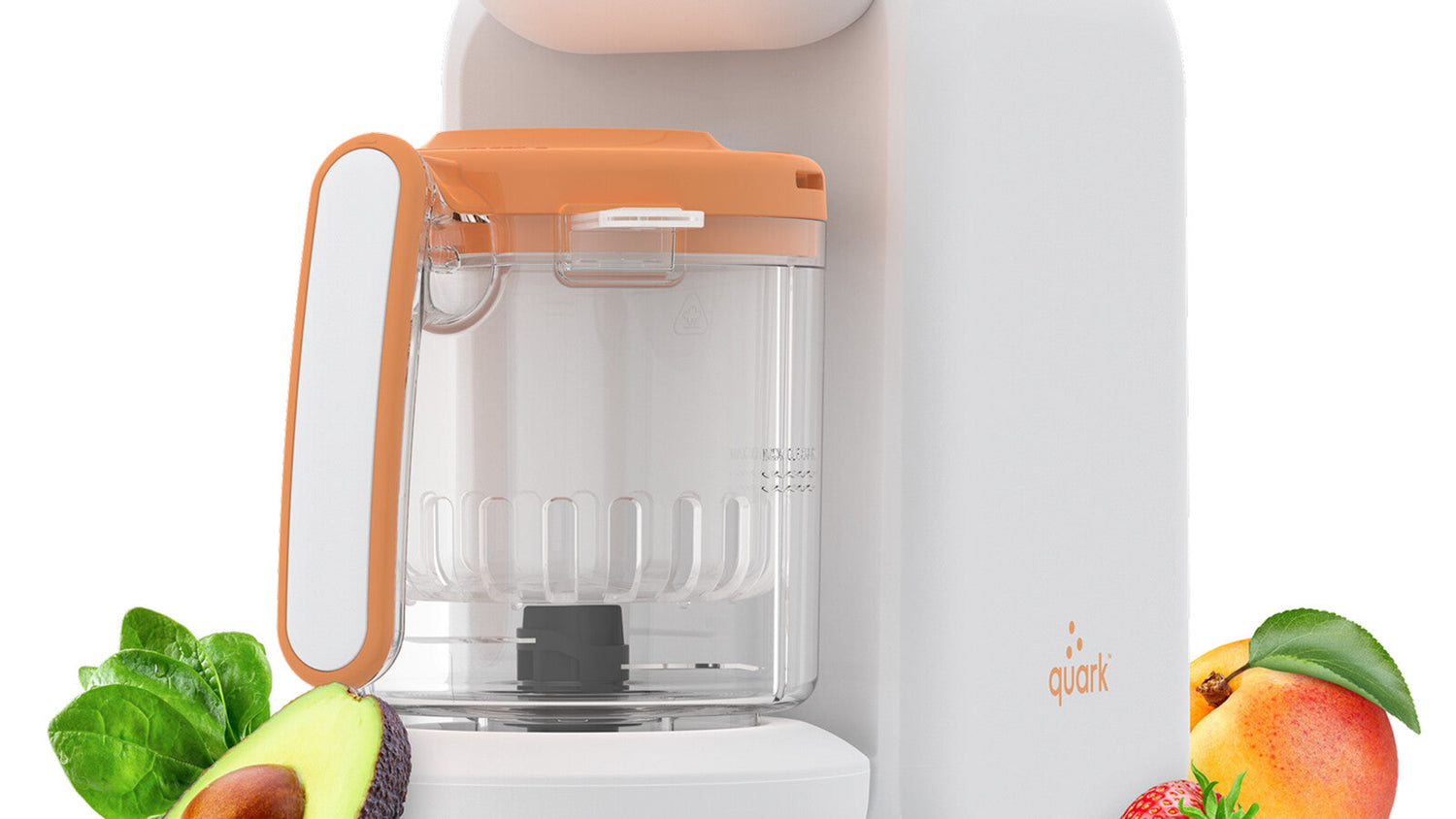
Quick answer: Choose a dedicated baby food maker if you want steaming and blending of small baby portions in one compact, easy-to-clean routine. Choose a steamer plus blender if you already own both and batch-cook for the family. Either works — pick the one whose cleanup you will actually keep up with.
When parents start thinking about homemade purées, the real question is rarely “Do I need another appliance?” It is “Which setup will make safe, age-appropriate baby food feel realistic on a normal weekday?” A dedicated baby food maker, a steamer plus blender, and a household blender can all work. The best choice depends on how often you cook, how much counter space you have, and how much cleanup you can tolerate.
Quark Baby’s Quook all-in-one baby food maker, bottle warmer, and sterilizer is built for parents who want steaming, blending, bottle warming, and steam sterilization in one easy-to-use, easy-to-clean station — but the right answer for your family depends on the trade-offs below.
How do a baby food maker, a steamer + blender, and a plain blender compare?
At a glance: the maker wins on workflow and cleanup, the steamer-plus-blender wins on batch size and using gear you already own, and a plain blender is cheapest but does not cook. Match the choice to your weekly routine, not to which option sounds healthiest.
| Dimension | Dedicated baby food maker | Steamer + blender | Household blender only |
|---|---|---|---|
| Convenience | Steam-to-blend in one workflow, few transfers | Two appliances, more hot transfers and steps | Blends only; you cook the food separately first |
| Cost | One appliance; lower cost per portion with regular use | Often already owned; no new spend | Already owned; cheapest if it handles small batches |
| Control over ingredients | Full control; you pick every ingredient and texture | Full control | Full control |
| Freshness / nutrients | Made fresh in small batches as needed | Made fresh; well suited to larger batches | Made fresh, depending on how you cook |
| Cleanup | Usually fewest parts to wash | Most parts: basket, pot/tray, jar, lid, spatula | Blender jar plus your cooking dishes |
| Batch size | Best for frequent small portions | Best for large family batches | Can struggle to blend very small portions smoothly |
Is a baby food maker worth it versus a steamer and blender?
It is worth it when the simpler workflow is the thing that makes homemade purées actually happen. A dedicated baby food maker combines cooking and blending into one baby-focused routine. Instead of steaming vegetables in one pot, transferring them to a blender, scraping the sides, and washing everything separately, the process is built around small portions and quick steam-to-blend transitions.
This setup is most useful when homemade baby food is part of your weekly rhythm. It helps with early purées such as carrots, squash, peas, apples, and pears once your baby is ready for solids, and makes it easier to adjust texture as your baby moves from smooth purées toward thicker blends and soft mashed foods. Texture still needs parent judgment as feeding skills develop.
A steamer plus blender is the traditional DIY route — flexible, familiar, and sensible if you already own a good steamer and a blender that handles small amounts well. It shines for bigger family batches: steam sweet potatoes for dinner, set aside a baby-safe portion before seasoning, then blend only what your baby needs. The trade-off is workflow: more parts, more hot transfers between containers, and more surfaces to clean. If those extra steps mean you stop making homemade food after the first week, a simpler routine may be the more practical choice. The Quook exists precisely to remove that friction, steaming and blending small portions in a single station so the busy-weekday version of homemade purées stays realistic.
Can I just use a regular blender for baby food?
Yes, but a household blender does not replace the cooking step. Vegetables, fruits, meats, beans, and grains still need to be cooked soft enough for your baby’s stage. A blender-only setup is easiest when you already prepare family meals and adapt a baby-safe portion before adding salt, sugar, honey, or strong seasonings — though many full-size blenders struggle to pull very small portions into the blades without extra liquid.
Do not let blender power create a false sense of readiness: a perfectly smooth purée is not automatically appropriate for every baby. The right texture depends on your baby’s stage and feeding skills. Always supervise feeding and avoid common choking hazards.
What food-safety rules apply to homemade baby food?
Start with readiness, then handle food carefully at every step. The AAP describes around 6 months as the typical time to introduce foods other than breast milk or infant formula, while noting every child is different. Signs include sitting with support, good head and neck control, opening the mouth when food is offered, and moving food from a spoon to the back of the mouth instead of pushing it out.
- No honey before 12 months. Honey can cause infant botulism in babies under one year — never add it to homemade purées for this age.
- No added salt or sugar. Babies do not need them, and added salt is hard on developing kidneys. Set aside a baby portion before seasoning family food.
- Safe storage. Cool fresh purées promptly; refrigerate and use within about 24–48 hours, or freeze for longer. Do not leave perishable baby food at room temperature for more than two hours, do not save a container a spoon has gone back into from the baby’s mouth, and do not refreeze thawed food. Label every portion with the date.
- Safe reheating. Heat reheated food until steaming, then stir and cool to a safe eating temperature, checking for hot spots before serving.
- Choking textures by age. Early foods should be soft, puréed, or mashed for your baby’s stage. Avoid or modify small, hard, round, or sticky foods — whole grapes, nuts, popcorn, chunks of meat or cheese, and hard raw vegetables.
- Early allergen introduction. There is no evidence that delaying baby-safe forms of common allergens prevents allergy. Introduce them in age-appropriate textures, watch for reactions, and ask your pediatrician for individualized guidance if there is a family history of allergy or eczema.
These points are summarized from AAP / HealthyChildren.org and Health Canada infant-feeding guidance; see Sources below.
Where does Quook fit?
Quook is designed for parents who want homemade purées without building a mini appliance collection. Its 5-in-1 design steam cooks, blends, chops, warms bottles, and sterilizes small parts in one compact station with a digital touch panel and auto/manual blending. The biggest advantage is consolidation: the real comparison is often not one appliance versus one appliance, but one compact station versus a separate steamer, blender, bottle warmer, and sterilizer that each need space and cleaning. If counter space and cleanup are what will decide whether you keep cooking, the all-in-one Quook is the most complete fit in the Quark Baby lineup — though it still does not replace pediatric guidance, safe food handling, or feeding supervision.
Frequently asked questions
Is a baby food maker worth it versus a steamer and blender?
It is worth it when the simpler workflow is what makes homemade purées actually happen on a busy day. A dedicated maker steams and blends small portions in one station with fewer parts to wash. A steamer plus blender is just as capable, and better for large family batches, but the extra dishes stop some parents from cooking at all.
Is a baby food maker safer than a steamer and blender?
Neither is inherently safer. Safety comes from clean hands and surfaces, thorough cooking, age-appropriate texture, fast cooling, and correct storage — not from the appliance. A maker can reduce hot transfers between containers, but it does not replace food-safety habits or feeding supervision.
When should I start making homemade baby food?
Most babies are ready for solids around 6 months, when they can sit with support, hold their head steady, open their mouth for the spoon, and move food to the back of the mouth instead of pushing it out. Every baby is different, so follow readiness cues and your pediatrician, not the calendar alone.
How long can I store homemade baby food?
Refrigerate freshly made purées promptly and use within about 24 to 48 hours; freeze for longer storage and label every portion with the date. Do not leave perishable baby food at room temperature for more than two hours, never save a container a spoon has gone back into from the baby’s mouth, and do not refreeze food that has been thawed.
Sources
- American Academy of Pediatrics (HealthyChildren.org): Starting Solid Foods
- Health Canada: Nutrition for Healthy Term Infants — Recommendations from Birth to Six Months


Leave a comment
All comments are moderated before being published.
This site is protected by hCaptcha and the hCaptcha Privacy Policy and Terms of Service apply.