

This article is for general information and is not medical advice. If your baby was born early, is in a hospital feeding program, or has a medical condition, follow the feeding plan from your own care team.
It is 3am. The bottle is in your hand, the baby is working up to a proper cry, and you are wondering whether you have to stand there warming it or whether you can just feed. Here is the short version, straight from the CDC: breast milk does not need to be warmed, and neither does formula. If you do warm it, aim for body temperature, about 37°C (98.6°F), and check a few drops on the inside of your wrist. It should feel warm, not hot.
The rest of this guide covers whether warm milk is actually better than cold, why no health authority publishes a "maximum" number, how to tell when a bottle is too hot, and how long warmed milk keeps. The questions parents search for most are answered at the end.

Do babies need warm milk?
No. The CDC says it plainly: "Breast milk does not need to be warmed. It can be served room temperature or cold." Its formula guidance says the same thing: "You do not need to warm infant formula before feeding, but some people like to warm their baby's bottle." The NHS adds that you can feed expressed milk straight from the fridge if your baby is happy to drink it cold.
So warming is a choice, and a perfectly reasonable one. Some babies take a warm bottle more readily; plenty of others drink it cold without a second thought. Your baby's reaction is the best guide you have.
One practical reason to decide early: whatever you do most often becomes what your baby expects. A baby who has only ever had warm bottles may push back at a cold one on the day you are stuck without a way to warm it. If your baby takes milk cool, you can skip warming entirely and never have to solve that problem away from home. For more on the bottle side of this, see our guide to bottle feeding a breastfed baby.
Is warm milk better than cold milk for babies?
For a healthy, full-term baby, the evidence does not show that one is better. Temperature is about what your baby will accept, not about nutrition or digestion.
The most useful summary is a 2026 systematic review and meta-analysis in Breastfeeding Medicine (Gök and Turan, 2026). It pooled five studies with 373 newborns and found no statistically significant effect of milk temperature on heart rate, oxygen saturation, body temperature, or time to full feeding. Its conclusion: room-temperature milk, near-body-temperature milk, and other warming methods "appear to be equally well tolerated."
Two details matter when you read that research. First, nearly all the trials we could find were run with premature babies in neonatal units, not with healthy full-term babies at home. Second, those trials point in different directions. A 2019 trial of 80 premature babies (Uygur et al.) found fewer apnea episodes and less anti-reflux treatment when feeds were warmed to 32 to 34°C instead of room temperature. A 2025 trial of 26 premature babies with feeding difficulties (Ferrara-Gonzalez et al.) found cold milk was safe and improved one measure of feeding quality. If your baby was born early, milk temperature is a question for your NICU or pediatric team, not for a general guide like this one.

A calm feed matters more than the exact temperature of the bottle.
Warm or cold, the milk is the same milk. The only temperature that is actually a risk is hot.
Is it different for newborns?
For a healthy baby born at full term, the rules are the same from day one. The CDC and NHS guidance above is not limited by age: a newborn can have milk cold, at room temperature, or warmed to body temperature, and the one firm rule is that it is never hot. Two things are different in the first weeks.
- Formula for babies under 2 months often starts out hot. The AAP recommends boiled water for mixing powdered formula for babies younger than 2 months, so a newborn's formula bottle usually needs cooling rather than warming. Cool it to body temperature and test it on your wrist before feeding.
- Babies born early have their own plan. Most of the research on milk temperature was done with premature babies, and its results differ. If your baby was premature or spent time in a neonatal unit, ask that team what temperature they want feeds at home.
What temperature should baby milk be?
If you warm it, aim for body temperature: about 37°C, or 98.6°F. The NHS describes the target as "body temperature, which means it should feel warm or cool, but not hot." The CDC's formula guidance says the same in four words: "warm, not hot."
You will see specific upper limits quoted online, such as 40°C or 104°F. We checked the CDC, the AAP and the NHS, and none of them publish a maximum number. They give you a target (body temperature) and a test (your wrist). We think that is the right way round: a display reading tells you the temperature where the sensor sits, but your wrist tells you what your baby's mouth is about to feel.
If you only skim one thing: the right warm-bottle temperature is the same as your baby's body temperature.
| Reference point | °F | °C | What it means for a bottle | Source |
|---|---|---|---|---|
| Fridge (back, not the door) | 39°F or colder | 4°C | Safe to feed cold | AAP |
| Room temperature | Up to 77°F | Up to 25°C | Safe to feed as is | AAP, CDC |
| Body temperature (the target if you warm) | 98.6°F | 37°C | Feels warm or neutral on your wrist | NHS, CDC |
| Water for mixing powdered formula | 158°F or hotter | 70°C or hotter | Too hot to feed: mix, then cool to body temperature | NHS |
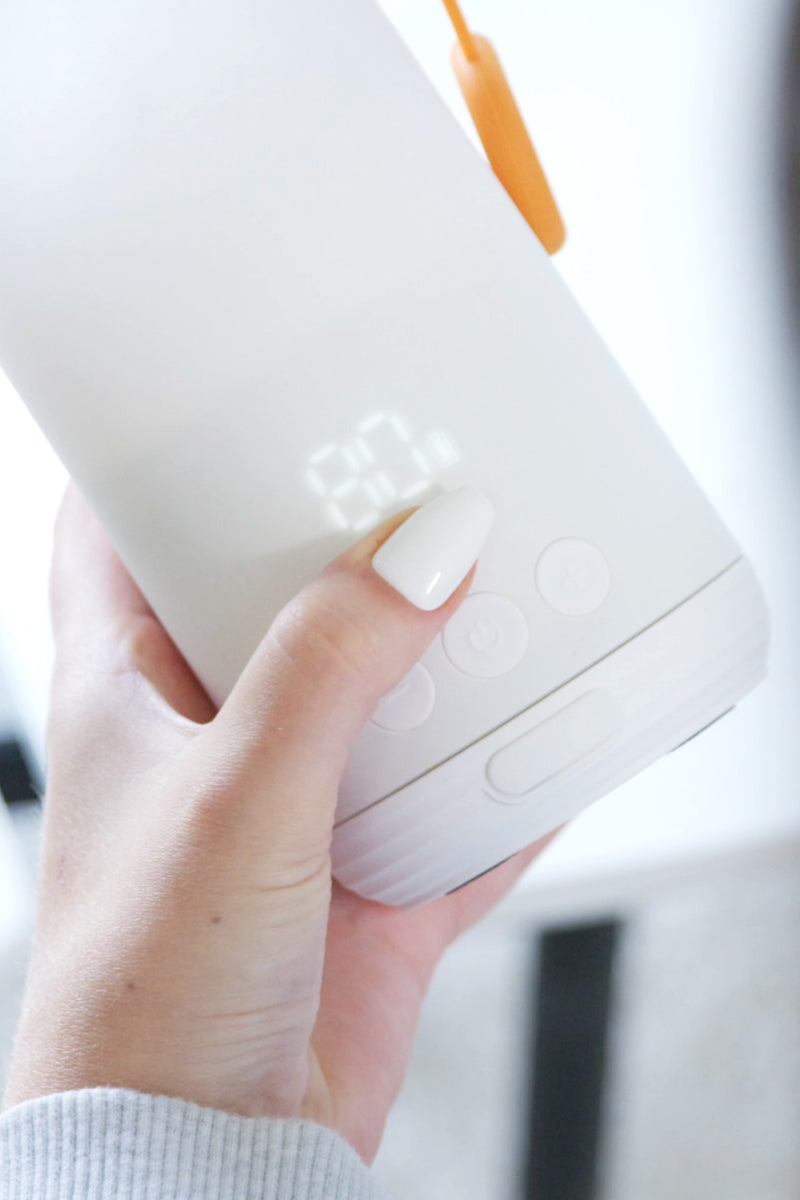
Setting a warmer to 98°F, close to body temperature. A display gets you near the target; the wrist test still has the final word.
How do you know if milk is too hot for your baby?
Test it every time, even with a warmer that shows the temperature. The CDC, the AAP and the NHS all describe the same wrist check:
- Swirl the bottle gently. The CDC suggests swirling breast milk to remix fat that has separated, and it mixes any warmer and cooler milk too.
- Shake a few drops onto the inside of your wrist.
- It should feel warm or neutral. If it feels hot, it is too hot to feed.
Do not judge by holding the outside of the bottle. Milk can be much hotter inside than the bottle feels, and uneven heating is exactly why the CDC says never to warm breast milk or formula in a microwave: it creates hot spots "which can burn a baby's mouth." The CDC also advises against heating breast milk directly on the stove.
Will a baby cry if the milk is too hot?
Some babies will pull away or cry. Do not count on it. A hungry baby may take a few gulps before reacting, and a very young baby cannot tell you what is wrong. The wrist test exists so that your baby is never the thermometer.
If a bottle comes out too hot, nothing is ruined. Put the cap on and hold the bottle under cold running water, or stand it in a bowl of cold water, keeping the water away from the nipple. Swirl, then test on your wrist again before feeding. If you think your baby has already drunk milk that was too hot and they seem to be in pain, will not feed, or you can see redness or blistering in their mouth, call your pediatrician.
How do you warm a bottle safely?
Gentle and even is the goal. The method differs a little between breast milk and formula.
Breast milk
The CDC's method: keep the container sealed and place it in a bowl of warm water, or hold it under warm, but not hot, running water for a few minutes. The AAP gives the same advice. Swirl rather than shake, then do the wrist test. If you are starting from frozen, our breast milk storage and thawing guide covers the steps before this one.
Formula
The CDC suggests warming a formula bottle under warm running water, keeping the water off the nipple. You can also skip warming: the AAP notes that a bottle made with powdered formula and room-temperature tap water just before a feed is ready to go with no extra warming.
The one case where formula starts out hot is when you are using very hot water to mix powder. The AAP recommends boiled water for babies under 2 months, babies born prematurely, and babies with weakened immune systems. The NHS asks for water of at least 70°C (158°F) when mixing powdered formula, because water that hot kills harmful bacteria. Either way, the next step is the same: cool the capped bottle under cold running water or in an ice bath until it reaches body temperature, then test it on your wrist. Our comparison of warming breast milk vs formula goes into the differences in more detail.

Pouring water for a formula bottle from the Warmer PRO, which has a Formula Preparation Mode that heats water to 158°F (70°C). That water is for mixing, not for feeding: cool the made-up bottle to body temperature first.
What to skip
- Never use a microwave for breast milk or formula. The CDC and the NHS say so for both, and the AAP for breast milk, because of hot spots.
- Do not heat milk directly on the stove. The CDC names this alongside the microwave.
- Do not use boiling water for a breast milk bath. Warm water does the job; the CDC's wording is "warm, but not hot."
If you are deciding between a warm water bowl and a dedicated warmer, we compare speed, safety and cleanup in bottle warmer vs warm water bowl, and answer the bigger question in do you need a bottle warmer.
How long is warmed milk good for?
Less time than cold milk in the fridge, so warm only what you are about to use.
| Milk | Once warmed or at room temperature | Leftovers after a feed | Source |
|---|---|---|---|
| Breast milk | Use within 2 hours | Use within 2 hours, then discard | CDC |
| Formula | Use within 2 hours of preparing | Discard within 1 hour from the start of the feed; do not refrigerate leftovers | CDC, AAP |
Whether you can warm the same bottle twice is a separate question, and the answer is different for breast milk and formula. We cover it in is it safe to reheat a baby's bottle. For planning bottles ahead for daycare or a long day, see our daycare bottle prep checklist.
Warming a bottle at night and away from home
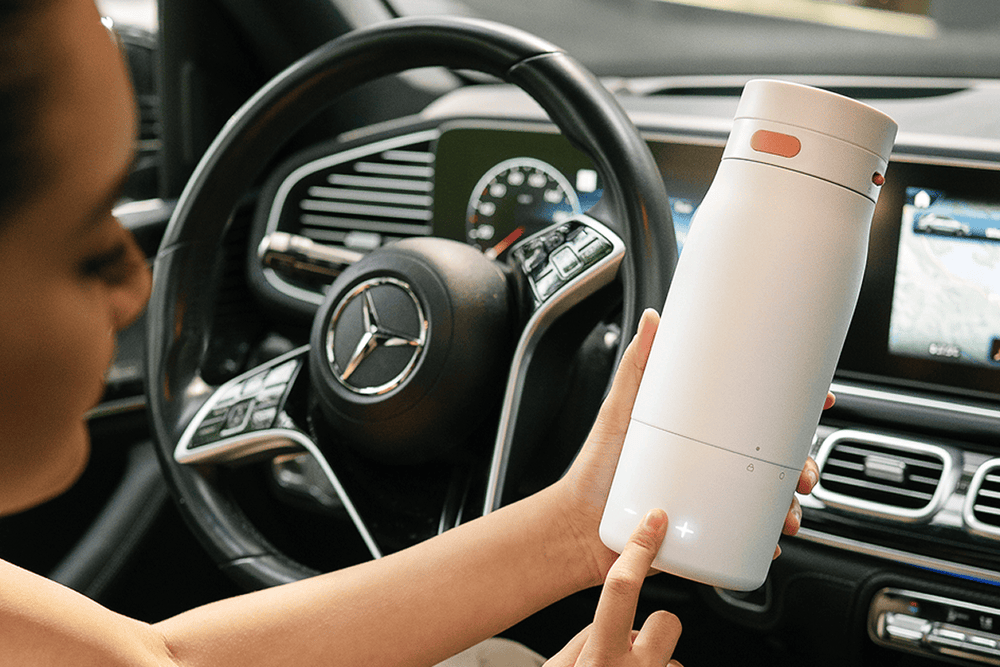
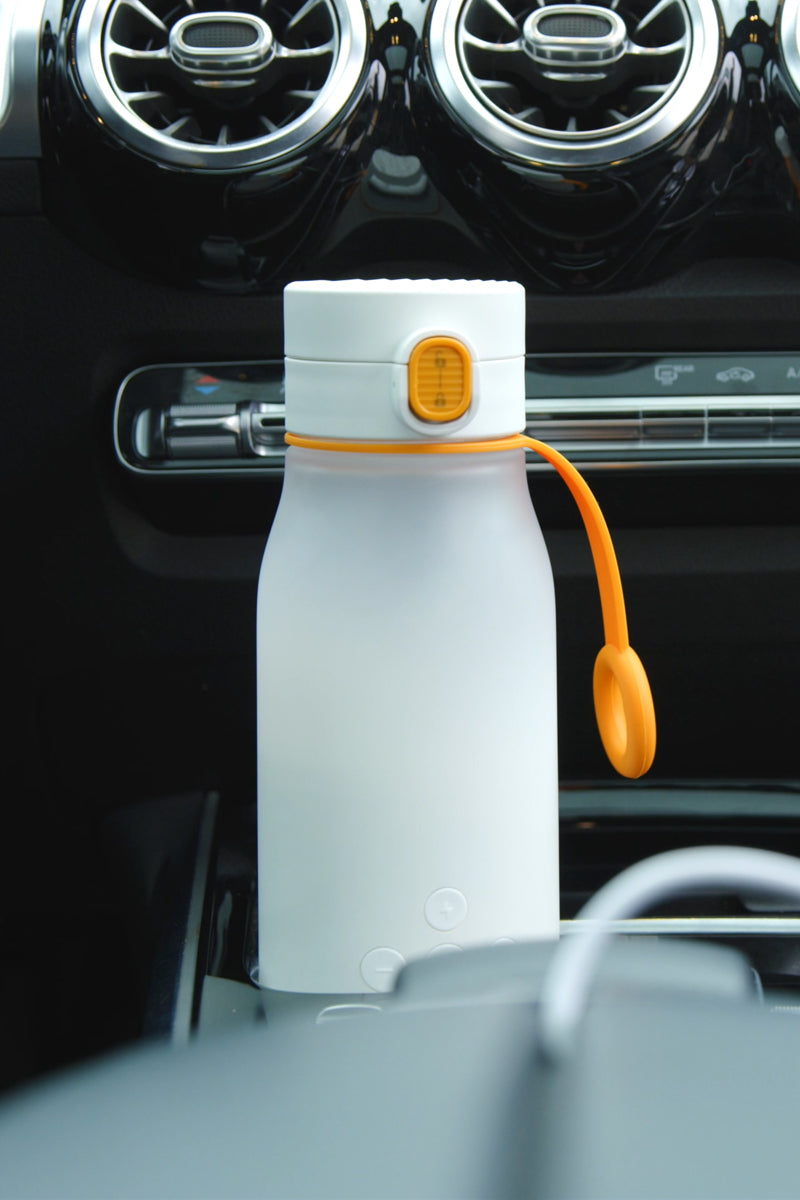
At home, a bowl of warm water works fine. The harder moments are the 3am feed when you do not want to go to the kitchen, and the car, the airport or a park bench, where there is no warm tap at all. That is where a portable warmer is genuinely useful, and where a baby who takes cool milk makes life easier still.

A cordless warmer means the body-temperature target does not depend on finding a kitchen.
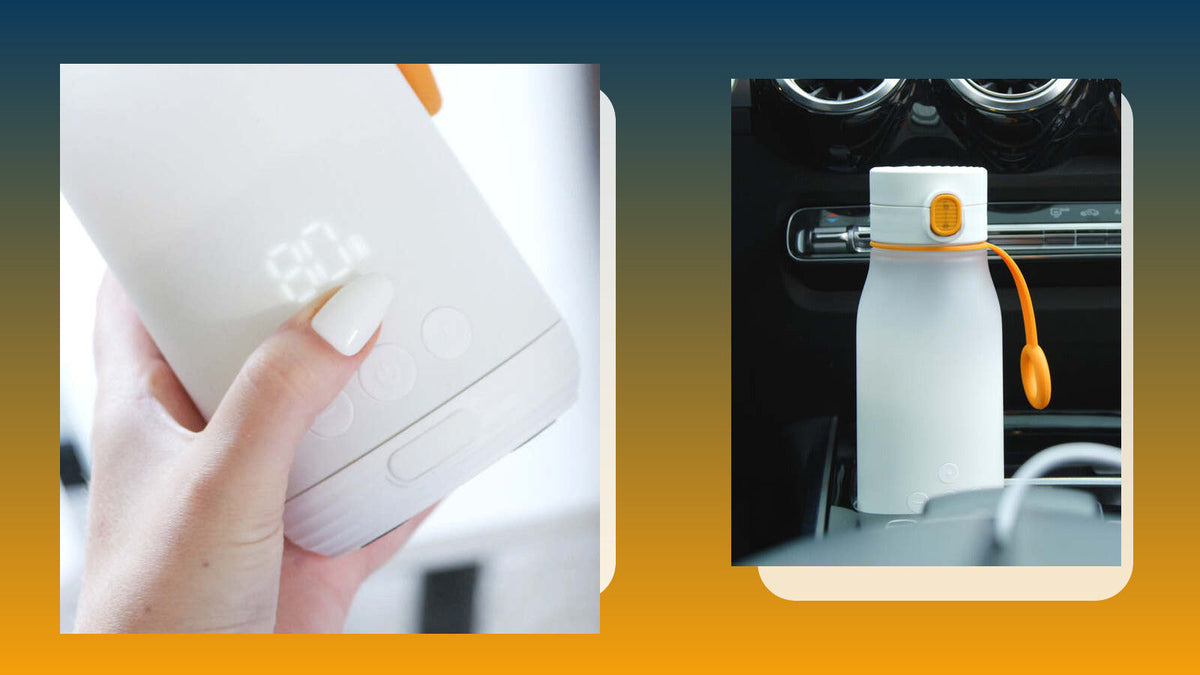
We make the BuubiBottle Portable Milk Warmer PRO for exactly those moments. You set the temperature to a single degree in Fahrenheit or Celsius and it remembers that setting for next time, so at night you are not re-choosing a number in the dark. An illuminated display shows the real-time temperature, the vacuum-insulated stainless steel vessel holds 17 ounces, and it runs all day on a charge over USB-C. The original BuubiBottle Smart Portable Milk Warmer is the smaller, 10-ounce option, warming between 37°C (98°F) and 50°C (122°F). Whichever you use, finish with the wrist test.
For night routines specifically, read how to warm a bottle at night without fully waking up. For travel days, see warming breast milk and preparing formula away from home.
Related reading
- Portable bottle warmer temperature guide for breast milk and formula
- How long does a bottle warmer take?
- How to bottle feed a newborn
- Your complete guide to formula feeding
Common questions
Warming a bottle is one of those jobs that feels like it has to be exactly right, and it really only has one rule: never hot. Warm, cool or straight from the fridge, your baby is getting the same good milk. If you are unsure about your own baby, especially if they were born early, your pediatrician is the right person to ask.
Sources
- Centers for Disease Control and Prevention: Breast Milk Storage and Preparation (updated August 14, 2026; reviewed March 25, 2026)
- Centers for Disease Control and Prevention: Preventing Cronobacter in Infants (reviewed September 29, 2025)
- American Academy of Pediatrics (HealthyChildren.org): Storing and Preparing Expressed Breast Milk (last updated 7/7/2025)
- American Academy of Pediatrics (HealthyChildren.org): How to Safely Prepare Formula with Water (last updated 2/25/2026)
- NHS: How to make up baby formula
- NHS: Expressing and storing breast milk
- Gök Ç, Turan T (2026). The Effects of Feeding Breast Milk at Different Temperatures on Newborns: A Systematic Review and Meta-Analysis. Breastfeeding Medicine, 21(4):265-274. doi:10.1177/15568253251413231
- Uygur O, Yalaz M, Can N, Koroglu OA, Kultursay N (2019). Preterm Infants May Better Tolerate Feeds at Temperatures Closer to Freshly Expressed Breast Milk: A Randomized Controlled Trial. Breastfeeding Medicine, 14(3):154-158. doi:10.1089/bfm.2018.0142
- Ferrara-Gonzalez L, Kamity R, Htun Z, Dumpa V, Islam S, Hanna N (2025). From Warm to Cold: Feeding Cold Milk to Preterm Infants with Uncoordinated Oral Feeding Patterns. Nutrients, 17(9):1457. doi:10.3390/nu17091457
Medically reviewed by Dr. Yang. Last reviewed September 30, 2026.
Disclaimer: This article is for educational purposes only and is not a substitute for professional medical advice, diagnosis, or treatment. Always seek the advice of your pediatrician or other qualified health provider with any questions regarding your baby's health or feeding.


Leave a comment
All comments are moderated before being published.
This site is protected by hCaptcha and the hCaptcha Privacy Policy and Terms of Service apply.