

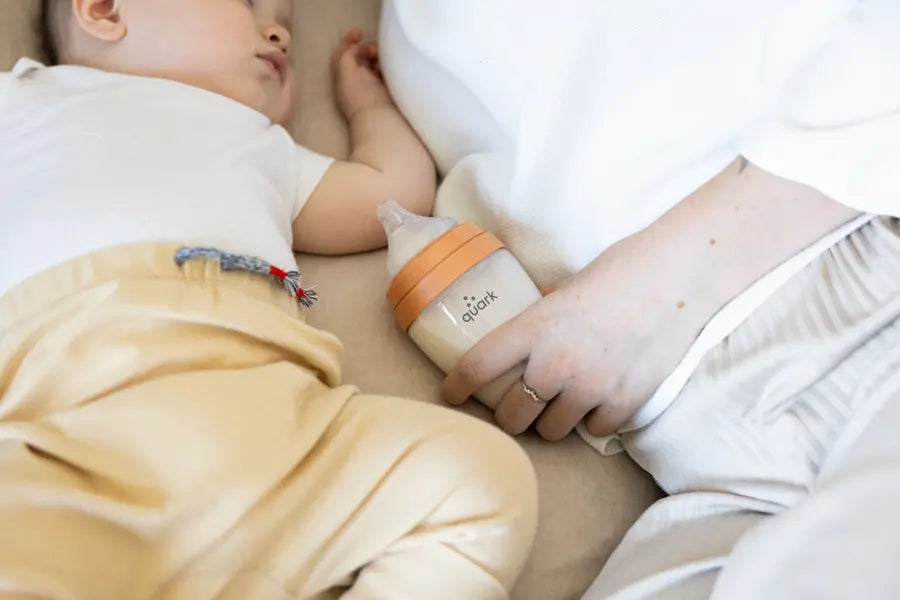




Maybe your supply is not keeping up, you are going back to work, or you just want someone else to take a feed so you can sleep. Adding formula does not have to mean the end of breastfeeding.
Your body makes milk as milk is removed, so you can combo feed without losing your supply as long as milk keeps coming out at roughly the same times: nurse first, and when a bottle replaces a breastfeed, pump or hand express then. Below is how to start, three routines with a recommended pick, and what to do when work, nights or low supply get in the way.
How combo feeding affects your milk supply
The NHS puts the basic rule this way: "The more you breastfeed, the more your baby's sucking will stimulate your supply and the more milk you'll make." Every bottle works the other way unless you replace the missed removal. WIC, the US Department of Agriculture's nutrition program, is direct about it: "Giving your baby formula can cause your baby to breastfeed less," and it adds that "combination feeding can put your milk supply at risk," but "it doesn't have to."
That gives you two levers: your baby still nurses at each feed (a top-up after the breast), or you express at the time of the feed you replaced. Do neither, and your body makes less at that time of day. Fine if you want that; a problem if you do not.
When to start combo feeding
National guidance gives a stage, not a number of weeks. WIC says "Do not start combination feeding until you are breastfeeding regularly and well." The NHS says it "can take several weeks for you and your baby to feel happy and confident with breastfeeding," and that once "you've both got the hang of it," bottles of expressed milk or formula can usually be added. The CDC says most breastfed babies "should not be fed infant formula in the first few days."
If your doctor advises formula sooner for a medical reason, follow that plan. You can still protect your supply by expressing. For newborn amounts per feed, see our guide to combo feeding a newborn.

How to combo feed, step by step
- Pick your goal first. Keep your full supply, or let it settle lower with formula covering the rest? Both are valid; the steps differ.
- Add one bottle at a time. The NHS advises introducing formula "gradually to give your body time to reduce the amount of milk it makes," which "helps lower your chance of getting uncomfortable, swollen breasts, or mastitis." Keep one new bottle in place for a few days before you add another.
- Express at replaced feeds if you want to keep supply. The US Office on Women's Health (OWH) says that when you cannot breastfeed, "make sure to pump during the times your baby would normally eat." Hand expression counts; our hand expression guide shows how.
- Keep nursing often. WIC says "Regular breastfeeding at least 8-12 times a day helps you keep a healthy milk supply, especially in the early weeks." Feed on cue; our hunger cues guide covers the early signs.
- Let someone else give the first bottles. The AAP's HealthyChildren site suggests someone else offer "about ½ ounce of breast milk an hour or two after a regular feeding," and to stop "if more than ten minutes pass," trying again the next day. The NHS and WIC also suggest someone else give the first bottles.
- Feed the bottle slowly. The CDC advises holding the bottle "at an angle," letting your baby take breaks, and stopping at signs of fullness "even if the bottle is not empty." Our paced bottle feeding guide walks through it.
Three combo feeding routines, and which to start with
Our pick for most families protecting supply: the top-up. Your baby nurses at every feed, so milk removal never stops, and you do not have to add pumping. It does not free you from feeds, though. For time away, use a replaced feed and express then; a split day suits long separations.
| Routine | What it looks like | Milk removed at the bottle feed? | Pumping needed to keep supply |
|---|---|---|---|
| Top-up | Breastfeed first, then offer a small bottle | Yes, your baby nursed first | None for that feed |
| Replaced feed | The same feed each day is a bottle, given by someone else | Only if you express at that time | One session per replaced feed |
| Split day | Nurse before and after work; bottles while you are apart | Only if you express while apart | OWH: two to three sessions in a workday |
So can you combo feed without pumping? Yes, with the top-up routine, or with a replaced feed if you are happy for your supply to drop at that time of day. For bottles, labels and washing up, see our combination feeding logistics guide.
Going back to work
Start early. The NHS suggests beginning "a few weeks beforehand to give both of you time to readjust." WIC suggests that "in the week or two before you go back," you give "one or two feedings a day from a bottle," and warns "it may take your baby several days to adjust."
At work, OWH says to "pump during the times you would feed your baby if you were at home," and that "you may need to pump two to three times each day at work." It also says pumping "can take about 10 to 15 minutes once you are used to using your breast pump." Some babies drink less by day and nurse more at night, which OWH calls "reverse-cycling." For a sample timetable, see our pumping schedule for working parents.
The CDC says pumped milk keeps "in the refrigerator for up to 4 days"; see our breast milk storage guide.

Dropping a night feed
The NHS says "It's important to breastfeed at night because this is when you produce more hormones (prolactin) to build up your milk supply." If a partner takes a night bottle, start with one, and express once overnight if you want to keep your full supply. See how a partner can take night feeds.
If your supply is low
First check. WIC says "most of the time your body makes exactly what your baby needs." Softer breasts, short feeds and small pumping yields are on its list of things "you should NOT worry about." The real checks are diapers and weight gain. The AAP says that after the first 4 to 5 days, a baby should have "at least 5 to 6 wet diapers a day."
To build supply, WIC suggests checking the latch, offering both breasts, and to "Hand express or pump after a feeding." The NHS agrees that "Expressing some breast milk after feeds once breastfeeding is established will help build up your supply." As your supply grows, WIC advises you to "decrease the infant formula as your milk supply increases." A lactation consultant can help.
If you want your supply to drop
Go slowly: replace one feed at a time, and wait until your breasts feel comfortable at that time before replacing the next. In its mastitis advice, the NHS says "do not stop breastfeeding suddenly." Our guides to engorgement and drying up your milk supply go further.
When to get help
- Fewer wet diapers than the AAP's 5 to 6 a day after the first 4 to 5 days, or worries about weight gain: call your pediatrician.
- A hot, painful, swollen area on one breast, especially with flu-like aches or a high temperature: these are NHS-listed signs of mastitis. The NHS says to keep breastfeeding, and to see a GP if symptoms "do not get better 12 to 24 hours after treating it at home."
- Bottle refusal that does not ease: see our bottle refusal guide.
Also: the CDC says babies fed only breast milk, or "less than 32 ounces of infant formula each day need extra vitamin D." A baby getting breast milk plus less than that much formula is in this group, so ask your pediatrician about drops.
The bottle and warmer we make for this
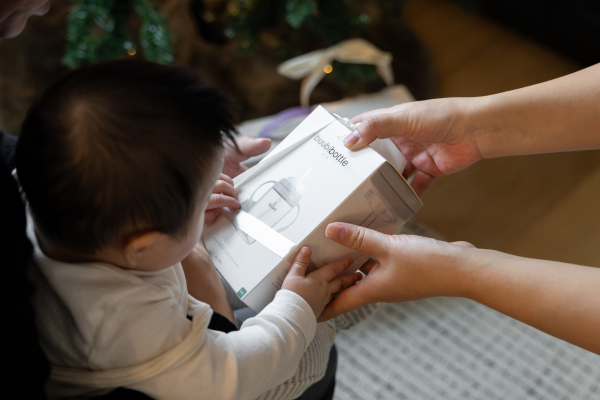
We designed the BuubiBottle Starter Set for breast-and-bottle routines. It holds two bottle sizes and 8 RealFeel nipples in Slow, Medium, Fast and Flex flows; the smaller Mini suits small top-ups. The nipple has a breast-like slope, but no nipple can promise a baby will take it, and our own product page says so.
For pumped milk and night bottles, the BuubiBottle Portable Milk Warmer PRO warms milk to a temperature you set, down to a single degree. It is cordless, and its Formula Preparation Mode heats water to 158°F (70°C) for powdered formula.

What we corrected from our earlier version
- We said the CDC and WIC advise waiting "4–6 weeks." Neither gives a number of weeks. Corrected.
- We recommended "power pumping" and said prolactin "peaks overnight (around 2–5 a.m.)." Neither is in the national guidance we checked. Removed.
- We said to pump at work "every 3–4 hours." Now OWH's advice: when your baby would feed.
- We said our bottle offers "an easy switch between breast and bottle." We have no evidence for that. Removed.
Common questions about combo feeding
Does combo feeding reduce milk supply?
It depends on whether milk is still removed. A bottle that replaces a breastfeed lowers supply at that time unless you express then. A top-up after nursing does not remove a feed.
Can you combo feed without pumping?
Yes. Nurse first and offer formula as a top-up, or replace a feed and let your supply adjust at that time of day. You only need to pump if you want to keep your full supply while a bottle replaces a feed.
Do I need to pump every time my baby has a bottle?
No. Only when the bottle replaces a breastfeed and you want to keep that supply.
Can I go back to breastfeeding more later?
Yes, you can try. Ask a midwife, health visitor or lactation consultant for support. The NHS suggests skin-to-skin contact, expressing about "8 times a day, including once at night," and to "Decrease the number of bottles gradually, as your milk supply increases."
What bottle is best for a breastfed baby?
No single bottle is proven best. The NHS says "There's no evidence that 1 type of teat or bottle is better than any other." Slow, paced feeding is what you control; see our guide to bottle preference.
Sources
- NHS: How to combine breast and bottle feeding (page last reviewed March 30, 2023)
- NHS: Breastfeeding: the first few days (page last reviewed September 14, 2026)
- NHS: Breastfeeding: is my baby getting enough milk? (page last reviewed April 30, 2026)
- NHS: Mastitis (page last reviewed March 17, 2023) and Bottle feeding advice (page last reviewed April 2, 2024)
- USDA WIC Breastfeeding Support: Combination Feeding and Maintaining Milk Supply, Low Milk Supply and Using Bottles with a Breastfed Baby (read October 22, 2026)
- US Office on Women's Health: Pumping and storing breastmilk and Breastfeeding and going back to work (pages last updated October 23, 2025)
- CDC: How Much and How Often to Breastfeed (April 16, 2026), About Feeding From a Bottle (March 11, 2026), How Much and How Often to Feed Infant Formula (April 21, 2026) and Breast Milk Storage and Preparation (August 14, 2026)
- American Academy of Pediatrics, HealthyChildren.org: Introducing the Bottle (last updated November 2, 2009) and How Often and How Much Should Your Baby Eat? (last updated April 2, 2024)
Written by the Quark Editorial Team. Medically reviewed by Dr. Yang. Last reviewed October 22, 2026.
This article is general parenting guidance and is not a substitute for advice from your own doctor, midwife or lactation consultant. Talk to them before introducing formula, especially if your baby was premature, has a health condition or is not gaining weight.


Leave a comment
All comments are moderated before being published.
This site is protected by hCaptcha and the hCaptcha Privacy Policy and Terms of Service apply.