





Somewhere around week three, someone asks whether your baby is "on a schedule yet." You are three weeks in. You have been awake since 4:40 a.m. The honest answer is that today looked nothing like yesterday, and you are not sure whether that is a problem.
It is not a problem. A newborn does not run on a schedule, and the ones you find online mostly describe a baby who already sleeps in long blocks. What you can build in the first three months is smaller and more useful: three fixed points in the day that stay put, with everything else allowed to move around them.

What a newborn routine can be, and what it can't
The strongest evidence here is an absence. In its 2016 consensus statement on how much sleep children need, the American Academy of Sleep Medicine set a figure for every age band from four months upward: "Infants 4 months to 12 months should sleep 12 to 16 hours per 24 hours (including naps) on a regular basis to promote optimal health." For younger babies, the panel wrote a footnote instead of a number: "Recommendations for infants younger than 4 months are not included due to the wide range of normal variation in duration and patterns of sleep, and insufficient evidence for associations with health outcomes." The American Academy of Pediatrics had a liaison on that panel and supports the resulting guidelines.
Read that again, because it changes what you should expect of yourself. The most authoritative body on paediatric sleep looked at the newborn evidence and declined to publish a target. Every newborn schedule you have been handed is somebody's convention, not a clinical standard.
That does not make routines useless. It changes what a routine is for. In the newborn stage a routine is a tool for the adults: it makes the day predictable enough that you can eat, hand the baby over, and know roughly when the next hard part arrives. Your baby will develop longer sleep stretches on their own timeline, and that timeline is not something a schedule accelerates.
When to start: around two to three weeks, with one condition
Two to three weeks postpartum is a reasonable point to add structure, once feeding is established and your baby is gaining weight. Before that, the priority is feeding volume and recovery, and the first two weeks have their own rhythm. If your second night at home was rough, that is a known and well-described pattern, not a sign that you need a schedule sooner.
The condition is weight. AAP guidance is explicit that healthy full-term babies can be fed responsively: "For most healthy, full-term infants, parents can look to their baby rather than the clock for hunger cues. This is called feeding on demand, or responsive feeding." The exception is equally explicit: "If your baby is having trouble gaining weight, don't wait too long between feeding ― even if it means waking your baby." A routine never overrides that. If your paediatric provider has asked you to wake your baby to feed, the wake schedule wins and the routine bends around it. We cover when waking is the right call separately.
Why we are not giving you a wake-window chart
Search "newborn wake windows" and you will find confident tables: 35 to 60 minutes at 0 to 4 weeks, 60 to 90 minutes at 1 to 2 months, and so on down the page. Several of those tables sit on large baby-brand blogs with no citation attached to a single row.
We are not going to add another one, for the reason above: no major paediatric body publishes newborn wake windows, so any chart you read is a convention with a confident font. Treating those minutes as a target is how parents end up watching a clock instead of a baby, then feeling behind when the numbers do not land.
What works better is a cue sequence, because it is observable. Tiredness in a newborn tends to arrive in a rough order: first quiet and still, then looking away from your face, then jerky arm movements, yawning, and finally crying. Crying is late. If you are consistently catching your baby at the crying stage, shorten the awake stretch tomorrow by ten minutes and watch again. That is a feedback loop you can actually run, and it does not require the chart to be right about your baby.
If you want rough ranges to sanity-check yourself against, our sleep guide sets them out as general guidance only, and a NICU nurse walks through the newborn stage here.

The three anchors that hold
Fix these three, and let the rest of the day float. They are chosen because they are things you control, and because they survive a bad night.
| Anchor | What you set | What you deliberately do not set |
|---|---|---|
| Morning wake-up | A start time inside roughly a 30-minute band, most days | Night wake-ups, or the time the last feed ended |
| Feed order | A feed on waking, rather than immediately before sleep | The interval between feeds, or the volume taken |
| Bedtime cue | The same short sequence, in the same order, every night | The clock time bedtime actually lands on |
1. A morning wake-up you can keep
Start the day at roughly the same time, give or take fifteen minutes, even after a broken night. This is the single anchor that pulls the rest of the day into alignment, because everything downstream is measured from it. Open the blinds, and keep the room dim and quiet in the evening. You cannot make a newborn's body clock mature faster, but you can stop sending it mixed signals.
2. Feed on waking, not on the way to sleep
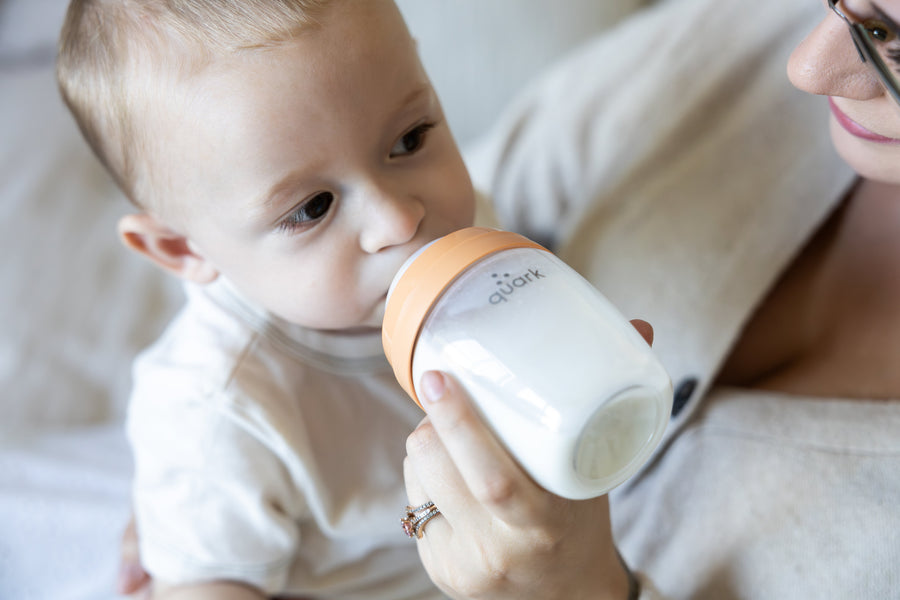
Offering the feed after your baby wakes, rather than as the last step before sleep, has one practical benefit: a baby who feeds while alert usually takes a fuller feed, which makes the next stretch more predictable. Paced bottle feeding helps here, and early hunger cues tell you when to start.
This is an ordering preference, not a rule, and it is not a reason to withhold a feed. Newborns feed frequently and often fall asleep at the breast or bottle. That is normal biology, not a habit you have broken. How long a feed should run and what to watch for is a better thing to track than the order.
3. A bedtime cue that takes five minutes
The bedtime sequence works because it repeats, not because it is elaborate. Dim the lights, change the nappy, feed, then a short song in the same spot. Four steps, same order, roughly twenty minutes. On a bad evening you can compress it to five minutes and it still does its job, which is why a short sequence beats a long one.

One family's day at six to ten weeks
Below is an example, not a target. It exists so you can see how the three anchors sit in a day, and it assumes a baby who has started consolidating a little. If your day looks nothing like this, that is information about your baby rather than a verdict on your parenting.
| Time | What happens |
|---|---|
| 7:00 AM | Wake, feed (breast or bottle) |
| 7:45 AM | Awake time: tummy time, talking, a change of room |
| 8:30 AM | First nap |
| 10:00 AM | Feed |
| 10:45 AM | Walk outside |
| 11:30 AM | Second nap |
| 1:00 PM | Feed |
| 1:45 PM | Nappy-free time, singing, reading |
| 2:30 PM | Third nap |
| 4:00 PM | Feed |
| 4:45 PM | Low light, quieter play |
| 5:30 PM | Short catnap |
| 6:30 PM | Feed |
| 7:00 PM | Bath, story, song |
| 7:30 PM | Bedtime |
| Overnight | Responsive night feeds, as many as your baby asks for |
Note what the table does not contain: a target number of night feeds. AAP guidance puts newborn feeding at roughly every two hours for breastfed babies, "so 10-12 sessions in 24 hours is the norm," and every two to three hours for bottle-fed babies with "8 times… generally recommended as the minimum every 24 hours." A newborn who wakes three times a night is inside normal. A simple feeding and nappy log is more useful in these weeks than a schedule, because it answers the question your provider will actually ask.
The night feed decides how the routine feels
Daytime structure is what people write about. Night feeds are what determine whether you can sustain any of it. The difference between a night feed that costs you twenty minutes and one that costs you an hour is usually the walk to the kitchen: you get up, wait for milk to warm, come back, and by then you are fully awake and so is the baby.
Keeping the warming step in the room removes that. The BuubiBottle Portable Milk Warmer PRO is cordless with a stainless steel vessel and a temperature display, so a bottle can be brought up to temperature at the bedside without a trip downstairs and without a light in the hallway. We wrote about setting the nursery up for this and how to run the 3 a.m. feed without fully waking up, and how long warming actually takes.

If you are combination feeding, the night is also where the logistics bite. Our combination feeding guide and the breast milk storage guide cover what to prepare before bed. A small bottle suits newborn volumes better than a large one: the BuubiBottle Mini is a 5 oz shatterproof bottle for exactly this stage, and the newborn feeding kit checklist lists what else is worth having within arm's reach.
Safe sleep is the part with no flexibility
Everything above is adjustable. This section is not. Wherever your routine puts a nap, the sleep environment follows the same rules every time.
The AAP's 2022 safe sleep recommendations are specific. Put your baby on their back for all sleep, including naps. Use a firm, flat sleep surface, one that does not incline more than ten degrees. Keep soft objects and loose bedding out of the sleep area, including pillows, quilts, blankets, bumper pads and toys. Room-share, with the baby on a separate sleep surface, for at least the first six months. And on swaddling, the AAP is direct: "When your baby looks like they're trying to roll over, you should stop swaddling them," which for many babies is around three to four months and can be earlier.
Canadian guidance lines up. The Canadian Paediatric Society advises: "For the first 6 months, the safest place for your baby to sleep is on their back, in a crib, cradle or bassinet that is in your room (room sharing)," on "a firm, flat mattress with a tightly fitted bed sheet, no gaps between the mattress and sides," with "no loose, soft items, including blankets, pillows, bumper pads, mattress toppers, sleep positioners, or toys."
Two practical consequences for a routine. A bottle does not go into the sleep space, so if the bedtime sequence ends with a feed, the feed finishes before your baby goes down. And a bedside setup should mean the warmer and bottle live on a shelf or dresser, not in the cot.
When the routine breaks, and it will
Growth spurts, developmental leaps, teething, travel and illness all flatten a routine, usually for two to five days. The anchors are what you rebuild from: hold the morning wake time, keep the bedtime sequence, and let naps and feed intervals go wherever they need to go until things settle.
Some patterns are worth naming so you do not read them as failure. Evening fussiness that clusters between roughly 5 p.m. and 10 p.m. is common in the first months, and persistent inconsolable crying has its own explanation and its own approach. Cluster feeding in the evening is normal and often precedes the longest sleep stretch of the night. If you also have an older child, the school run is the anchor you build the day around instead, and naps have to bend to pickup times.
Persistent crying with poor feeding, poor weight gain, fever, or a change you cannot explain is a call to your paediatric provider, not a routine problem.
Common questions
Can you put a newborn on a schedule?
No, not in the sense of fixed clock times. Newborn sleep and feeding vary too much day to day, which is why the American Academy of Sleep Medicine declined to publish sleep-duration recommendations for babies under four months at all. What you can set is a consistent morning wake time, a feed-on-waking order, and a repeatable bedtime sequence. The rest moves.
When should I start a routine with my newborn?
Usually around two to three weeks, once feeding is established and your baby is gaining weight. If your provider has asked you to wake your baby for feeds because of weight gain, follow that instruction first and add structure later.
Do wake windows actually work for newborns?
It depends on how you use them. As a rough sanity check they are fine. As a target they tend to backfire, because no paediatric body publishes newborn wake windows and the tables you find online are conventions rather than guidance. Watching the cue order (still, then looking away, then jerky movements, then yawning) gives you a signal specific to your baby.
How many night feeds is normal for a newborn?
Usually more than you expect. AAP guidance describes 10 to 12 breastfeeding sessions in 24 hours as the norm for newborns, and a minimum of about 8 feeds in 24 hours for bottle-fed newborns, spread across day and night. Night feeds are part of the routine in this stage rather than an interruption to it.
Does a bottle warmer help with a night routine?
Yes, mainly by removing the trip to the kitchen. A cordless warmer such as the BuubiBottle Portable Milk Warmer PRO brings milk to temperature at the bedside, which keeps the feed short and the lights low. It does not change how often your baby wakes, and no device does.
My baby's day looks nothing like the sample schedule. What am I doing wrong?
Probably nothing. The sample day describes one baby at six to ten weeks. Newborn sleep and feeding patterns vary widely enough that a published example is a reference point, not a benchmark. Check the three anchors instead, and raise feeding or weight concerns with your paediatric provider.
Sources
- Paruthi S, Brooks LJ, D'Ambrosio C, et al. "Recommended Amount of Sleep for Pediatric Populations: A Consensus Statement of the American Academy of Sleep Medicine." J Clin Sleep Med 2016;12(6):785–786. doi.org/10.5664/jcsm.5866
- American Academy of Pediatrics, HealthyChildren.org: How Often and How Much Should Your Baby Eat?
- American Academy of Pediatrics, HealthyChildren.org: A Parent's Guide to Safe Sleep (2022 policy recommendations)
- Canadian Paediatric Society, Caring for Kids: Safe sleep for babies
Written by the Quark Editorial Team. Medically reviewed by: Dr. Yang. Last reviewed: August 31, 2026.
This article is general parenting guidance and is not a substitute for advice from your own paediatric provider. Talk to your doctor or paediatric provider about your baby's feeding, weight gain and sleep, especially if you have concerns about any of them.


Leave a comment
All comments are moderated before being published.
This site is protected by hCaptcha and the hCaptcha Privacy Policy and Terms of Service apply.