

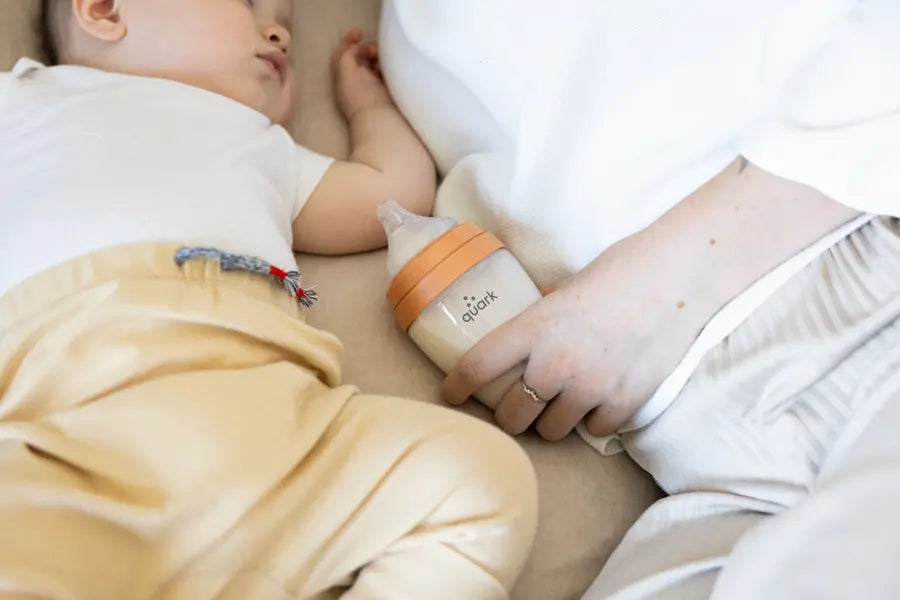

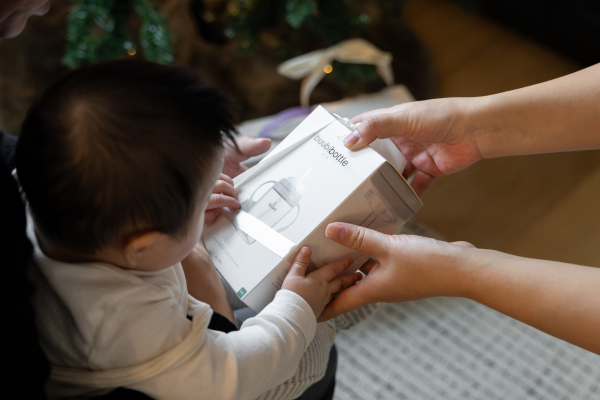
Four ounces, gone in five minutes, and then a good part of it came back up onto your shoulder. That is the problem paced bottle feeding was designed for: a bottle can deliver milk faster than a baby can tell they are full.
Paced feeding is a few free changes to how you hold your baby and the bottle. Below are the steps, each traced to its source, and what the technique can and cannot do. We also correct some things our own earlier version of this page overstated.
What paced bottle feeding is
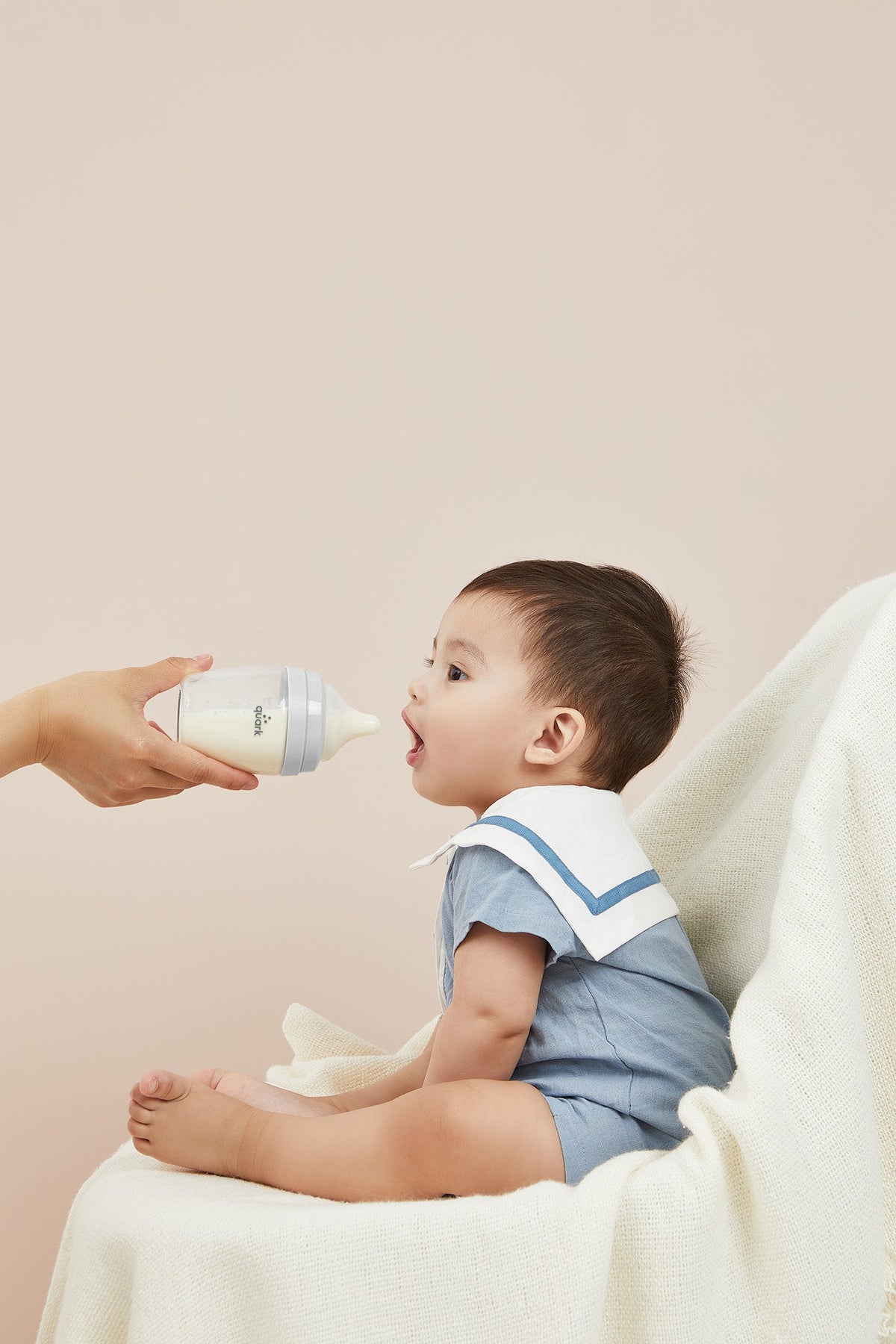
Paced bottle feeding lets your baby control how fast milk arrives. You hold your baby semi-upright, keep the bottle close to level so milk flows only when they suck, and let them take breaks. The name comes from lactation practice: in 2002 Dee Kassing, writing in the Journal of Human Lactation, described a bottle method that "requires babies to expend effort and use their oral anatomy in ways very similar to breastfeeding," for breastfed babies who needed bottles.
Public-health bodies now teach these steps for every bottle-fed baby. UNICEF UK's Baby Friendly Initiative calls it responsive bottle feeding, and the CDC's bottle-feeding advice describes the same three moves: angle the bottle, allow breaks, stop at fullness. So "pace feeding vs responsive feeding" is one technique with two names, and it works for formula and expressed breast milk alike.
What you need for paced feeding
- A slow-flow nipple that does not pour when the bottle is nearly level. More on choosing one below.
- A small bottle, so you offer a modest amount and add more if your baby is still hungry. The CDC suggests starting "by offering your baby small amounts" and offering more "if they show signs of hunger."
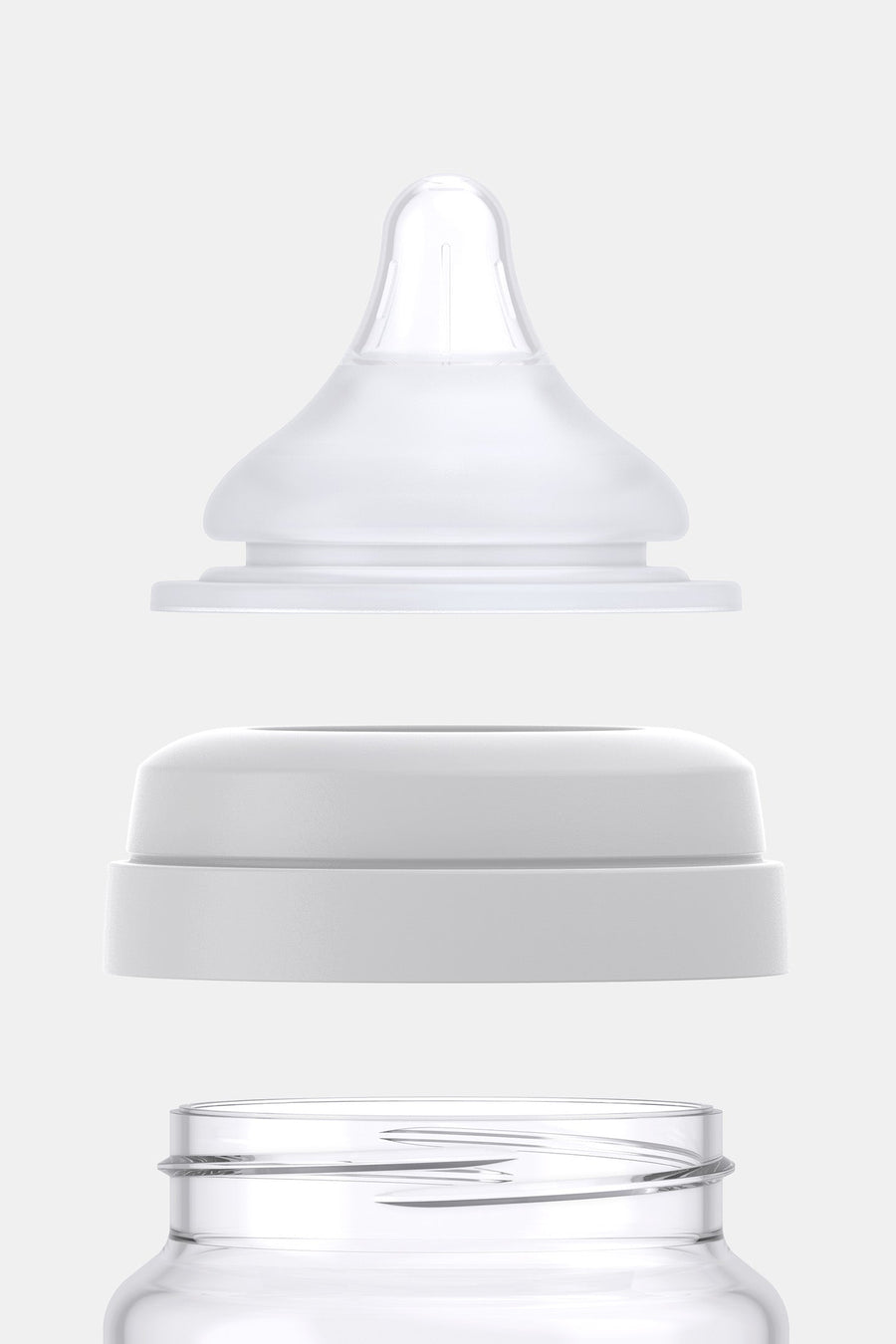
- Clean supplies. The CDC says keeping "the bottles, nipples, rings, caps, and any valves or membranes" clean is "very important to prevent germs from getting in your baby's milk or infant formula." A wide-neck bottle is easier to scrub.
How to pace a bottle feed, step by step

- Start on early hunger cues, not crying. UNICEF UK lists "moving their head, opening their mouth and sucking on their fingers," and notes that "crying is the last sign of wanting to feed." See our guide to early hunger cues.
- Hold your baby semi-upright and close. The NHS: "Hold your baby in a semi-upright position for bottle feeds. Support their head so they can breathe and swallow comfortably."
- Invite the latch. Brush the nipple against the top lip and wait for a wide mouth, then, in UNICEF UK's words, "allow your baby to draw it further back into their mouth."
- Keep the bottle close to level. UNICEF UK says to hold it "in a horizontal position (slightly tipped) to prevent milk from flowing too fast," and the NHS says the same. The CDC: "Position the bottle at an angle rather than straight up and down so the milk only comes out when your baby sucks."
- Pause when your baby asks for a break. The CDC: "Let your baby take breaks from drinking when they seem to want them." UNICEF UK: "Gently remove the teat or bring the bottle downwards to cut off the flow of milk."
- Swap sides partway. UNICEF UK: "It can be useful to alternate the side you hold your baby during feeds."
- Stop when your baby is done. The CDC: "Watch your baby for cues that they are full, and then stop, even if the bottle is not empty." Then hold them upright to bring up wind.
One rule is about safety, not pacing. The CDC says "do not prop or leave the bottle in your baby's mouth," because it "can increase your baby's risk of choking, ear infections, and tooth decay." A paced feed is always held.
How long a paced feed takes, and how often to pause
Most guides give you a number: pause every three to five swallows, or every 20 to 30 sucks. Some of our older articles did too. The numbers disagree, and none comes from the AAP, CDC, NHS or UNICEF UK, which set no pause count and no feed length. The NHS says only: "Always give your baby plenty of time to feed." Their instruction is to watch your baby.
The break signals are specific. UNICEF UK says your baby may "splay their fingers and toes, spill milk out of their mouth, stop sucking, turn their head or push the bottle away." Gulping, coughing and spluttering mean the same. A bottle finished in a few minutes and followed by spit-up suggests the flow is outrunning your baby; the NHS advice on babies sick after feeds begins, "Check that the hole in your baby's teat is not too big."
What paced feeding can and can't do
The steps are standard advice. The evidence for the benefits people attach to them is thinner than most guides admit, so here it is claim by claim.
| Claim | What the sources support | Source |
|---|---|---|
| It lets your baby stop when full | Yes. A near-level bottle, breaks and stopping at fullness are standard advice | CDC; NHS; UNICEF UK |
| It slows the feed down | Yes. In a 2025 experiment with 29 mothers and full-term babies, paced feeds were slower and longer than the same babies' typical bottle feeds | Ventura et al. 2025 |
| Bottle-fed babies can overfeed | Yes. The AAP says they "may be more likely to overfeed, because drinking from a bottle is faster and may take less effort than breastfeeding" | AAP |
| Pausing helps a baby notice fullness | Supported as advice: "pausing can be helpful to give them a chance to realize when they're full" | AAP |
| Paced feeding makes babies drink less | Not shown. In the 2025 experiment, intake did not differ significantly between paced and typical bottle feeds | Ventura et al. 2025 |
| Paced feeding prevents childhood obesity | Not shown for pacing alone. A 2022 trial in six WIC clinics linked a package that included responsive bottle-feeding counselling to less rapid weight gain in infancy, but it tested the whole package and did not follow children into later childhood | AAP; Ventura et al. 2022 |
| Paced feeding treats reflux or colic | Not shown. Drinking too fast can cause spit-up (NHS), but we found no trial showing paced feeding treats reflux or colic | See note |
| Paced feeding prevents bottle preference | Plausible, not proven. It was designed for breastfed babies, but we found no trial measuring breastfeeding outcomes | Kassing 2002 |
A correction. Until this update, this page said paced feeding could "significantly alleviate" reflux and colic, prevents overfeeding and childhood obesity, and reduces nipple confusion. We could not find evidence for those statements as written, so we removed them. The best direct study we found, Ventura et al. 2025 in Early Human Development, is small (29 mothers), and its authors call the results "preliminary evidence." Our page on colic and persistent crying covers what is known there.
Which nipple flow to use
The NHS: "There's no evidence that 1 type of teat or bottle is better than any other." What matters for pacing is flow, because a nipple that pours defeats a level bottle. Start with the slowest flow your baby feeds comfortably on and judge it by the feed, not the age on the box. Gulping means too fast; long, frustrated feeds or a collapsing nipple can mean too slow. See when to move up a flow and what flow labels measure.

| RealFeel flow | Labelled age | Fits |
|---|---|---|
| Slow | 0M+ | BuubiBottle Mini and Max |
| Medium | 3M+ | BuubiBottle Mini and Max |
| Fast | 6M+ | BuubiBottle Mini and Max |
| Flex | Variable (9M+ on the box) | BuubiBottle Mini and Max |
Our pick for paced feeding: the BuubiBottle Mini with the Slow nipple. The Mini is our 5 oz bottle, sized for the smaller feeds of the early months, and the RealFeel Slow nipple is our slowest flow. We will not tell you any nipple guarantees your baby takes the bottle, or the breast; no nipple can. For breast-and-bottle families, the Starter Set adds the larger Max and nipples in several flows.
Teaching it to another caregiver
Paced feeding often breaks down when someone else gives the bottle. Here is a version to text a partner or tape to the fridge:
- Feed when they first root or suck their hands, before they cry.
- Hold them semi-upright and close, where you can see their face.
- Touch the nipple to the top lip and wait for a wide mouth.
- Keep the bottle nearly flat: milk in the nipple, not pouring.
- If they gulp, splutter, splay their fingers or turn away, tip the bottle down and wait.
- Stop when they stop. Do not push to finish the bottle. Never prop it.

For daycare, pair it with clear labelling (our daycare bottle prep guide). If you are breastfeeding, start with how to introduce a bottle to a breastfed baby and our combo feeding guide.
When to talk to your pediatric provider
Paced feeding is a technique, not a treatment. Call your provider if your baby is not gaining weight, has fewer wet diapers than usual, vomits forcefully or often, coughs or chokes at most feeds even on a slow flow, or seems in pain while feeding. The AAP adds: talk with your pediatrician if your baby wants to eat all the time, even when full.
Frequently asked questions
Is paced bottle feeding only for breastfed babies?
No. It started as a method for breastfed babies, but the CDC, NHS and UNICEF UK give the same steps for every bottle-fed baby, whether the bottle holds formula or expressed milk.
How long should a paced bottle feed take?
It depends on your baby. No national health body sets a minutes target; the NHS says to give your baby "plenty of time to feed." In a 2025 study, paced feeds lasted longer than the same babies' typical bottle feeds. A bottle gone in a few minutes, with spit-up afterwards, suggests the flow is too fast.
Does paced bottle feeding help with reflux or colic?
No, not as a treatment, on the evidence we could find. Slowing a too-fast flow can help with spit-up from drinking too quickly. Reflux that is frequent, forceful or painful, and crying that will not settle, need your pediatric provider.
Do I need a special bottle for paced feeding?
No. The NHS says no teat or bottle has been shown to be better than another. You need a nipple slow enough that milk does not pour when the bottle is nearly level.
Sources
- CDC: About Feeding From a Bottle (page dated March 11, 2026)
- American Academy of Pediatrics, HealthyChildren.org: How Often and How Much Should Your Baby Eat?
- NHS: Bottle feeding advice
- UNICEF UK Baby Friendly Initiative: Infant formula and responsive bottle feeding
- Kassing D. Bottle-feeding as a tool to reinforce breastfeeding. J Hum Lact. 2002;18(1):56-60. PubMed 11845739
- Ventura AK, Silva Garcia K, Meza M, Rodriguez E, Martinez CE, Whaley SE. Promoting responsive bottle-feeding within WIC: evaluation of a policy, systems, and environmental change approach. J Acad Nutr Diet. 2022;122(1):99-109. PubMed 34090838
- Ventura AK, Drewelow VM, Richardson TN. Does paced bottle-feeding improve the quality and outcome of bottle-feeding interactions? Early Hum Dev. 2025;201:106181. PubMed 39693774
Written by the Quark Editorial Team. Medically reviewed by: Dr. Yang. Last reviewed: October 19, 2026.
This article is general parenting guidance and is not a substitute for advice from your own pediatric provider. Talk to your doctor or pediatric provider about your baby's feeding, weight gain and any concerns about how feeds are going.



Leave a comment
All comments are moderated before being published.
This site is protected by hCaptcha and the hCaptcha Privacy Policy and Terms of Service apply.