

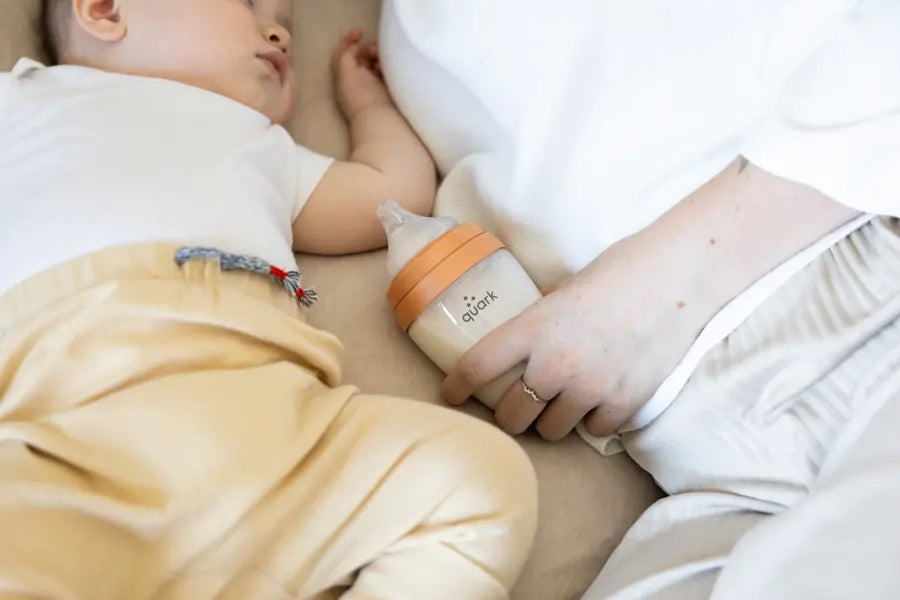


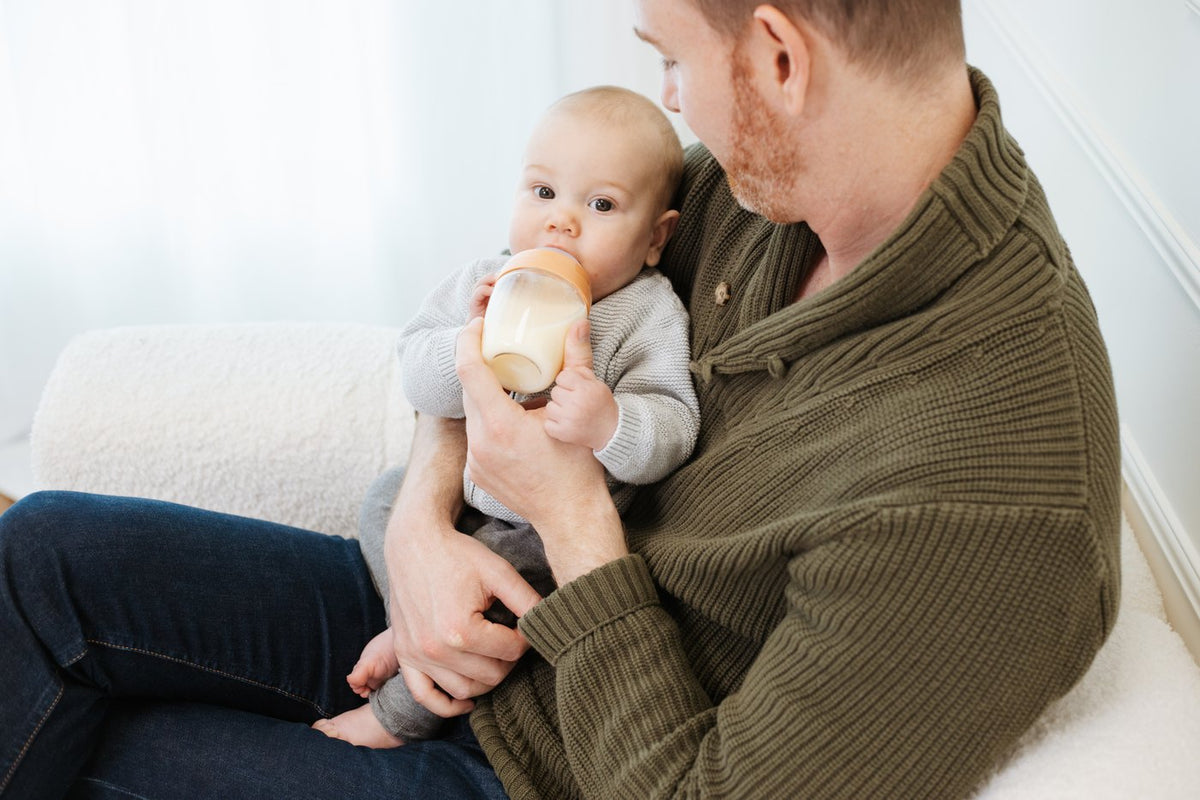
You offered to take the 2 a.m. She said yes. And she still woke up. Here is the handover that fixes that, and the five minutes before bed that make it work.
Most nights it goes like this. The baby stirs, you are already swinging your legs out of bed, quietly pleased with yourself. By the time you have found a clean bottle, worked out which milk in the fridge is the oldest, and stood in the kitchen waiting for it to warm, the crying has escalated and she is sitting up in bed. You did the feed. She lost the sleep anyway.

If she wakes up anyway, the shift did not happen
This is the part most "get dad involved" articles skip. Doing a feed and taking a shift are two different things. A shift is a block of hours during which the other parent is off duty, does not listen for the monitor, and does not get up. If she surfaces at every cry to check whether you have it handled, she has done the light-sleep half of the night's work while you did the visible half, and nobody has actually gained rest.
So the job is not "help with feeds." The job is to make yourself independently competent at the whole loop: hear the baby, get the milk ready, feed, settle, reset. If you are still working out the basics of the routine itself, start with our practical guide to a daily newborn routine, then come back to the night shift.
A feed is twenty minutes of work. A shift is the hours she gets to stop listening.
What actually helps most
One finding first, because it changes what "helping" means. A 2020 systematic review (Ogbo et al.) pulled together seven studies on what partners do that actually changes feeding outcomes. Four of the seven found that plain verbal encouragement (telling her she is doing well, that this is hard, that you can see it working) was associated with longer breastfeeding. One study put the odds ratio at 3.25 (95% CI 1.95 to 5.42).[1]

The same review found that taking over housework and non-feeding baby care also mattered: dishes and diapers showed a measurable association with higher exclusive breastfeeding rates.[1] So the most useful thing you do around a feed is often not holding the bottle. It is holding everything else. The night shift is one piece of that, and the piece most couples improvise badly.
Set the shift up before bed, in five minutes
Everything that goes wrong at 3 a.m. is something you could have decided at 9 p.m. Before you go to sleep, do the reset yourself, every night, so she never has to check it:
- A clean, capped bottle within arm's reach of where you will feed
- The milk portioned and where you can find it in the dark, one bottle, not a fridge shelf to sort through
- The warmer charged, or your warming method already set up in the room
- A dim, warm-toned light aimed at the wall, plus a burp cloth and water for you
- A spare set of everything, because there is always one night with a leak
Storage is the piece people guess at, and guessing is how milk gets thrown out. The American Academy of Pediatrics states that freshly expressed breast milk can sit at room temperature (up to 77°F or 25°C) for up to 4 hours, that refrigerated milk is best used within 4 days, and that whatever is left in a bottle after a feed should be used within 2 hours or quickly refrigerated for the next feed.[2] Our breast milk storage guide lays out the full set of windows, and warming breast milk versus formula covers why the two are not handled the same way.
One rule worth agreeing on out loud: where the baby sleeps does not change for your shift. The AAP recommends keeping the baby's sleep space in your room but not in your bed, which it says can reduce the risk of SIDS by as much as 50%, for at least the first 6 months.[3] Feeding in an armchair at 3 a.m. is fine. Falling asleep in it with the baby on your chest is the thing to plan against, and a setup where you are not waiting on anything makes dozing off less likely.
Practise the handover in daylight first
If the baby is breastfed, the first question is when. Wait until breastfeeding is going well. Guidance differs on how long that takes: Nationwide Children's Hospital advises breastfeeding exclusively for the first three to four weeks, while some clinicians push it closer to six.[4] The thing being waited for is not a date. It is a latch that works and a supply that has settled.
The reason to wait is mechanical. At the breast a baby works for the milk with a wide latch, jaw and tongue; most bottle nipples deliver it with far less effort, and a newborn offered the easy option too early can start preferring it. Waiting much past six weeks has its own cost: a baby who has never seen a bottle can refuse one firmly when you finally need it. We go through the trade-off in bottle preference and how to balance both. If your baby is in the NICU, was born early, or has had weight gain flagged, this timing does not apply to you; your care team's plan does.

Then practise before you need it. The AAP suggests that the first bottle goes better when someone other than the mother offers it, somewhere other than the usual nursing spot, starting with about half an ounce of breast milk an hour or two after a regular feeding, while the baby is alert but not frantic with hunger.[5] Read that again: someone other than the mother. The awkward first attempts are literally your job.
Do two or three of these in the afternoon before you take a night on. Our guide to introducing a bottle to a breastfed baby covers the sequence in detail.
How to give the bottle: paced feeding, step by step
A baby who is fed too fast at 3 a.m. finishes wide awake, gassy, and back at square one. Paced bottle feeding is the fix, and it is the technique WIC programs across the US teach to both breastfeeding and formula-feeding parents.[6] It lets the baby control the flow the way they would at the breast, which is what keeps the two compatible.
- Hold the baby upright, not flat. Support the head and neck. Never prop the bottle against a pillow or blanket. That is a choking risk, not a shortcut.
- Touch the nipple to the lip and wait. Let the baby open wide and draw it in. Do not push it in.
- Keep the bottle horizontal. The nipple should be only about half full of milk. This is the part most people get wrong. Tipping the bottle up turns a feed into a firehose.
- Watch for the break signals. Gulping, wide eyes, splayed fingers, milk escaping the corners of the mouth. When you see them, lower the bottle so the nipple empties but stays in the mouth. Bring it back level when sucking starts again.
- Stop when the baby stops. Slowing, turning away, pushing the bottle out, falling asleep: that is the end of the feed, even with milk left. A bottle is not a target to be finished.
A paced feed should take roughly as long as a nursing session would, about 15 to 30 minutes. If you are consistently done in seven, the flow is too fast. Our guide to nipple flow rates covers how to tell, and the full paced-feeding walkthrough goes deeper than we can here.
How many feeds are actually yours
Know the shape of the night before you volunteer for it. According to the AAP, bottle-fed newborns usually eat every 2 to 3 hours, with at least 8 feeds in 24 hours as the general minimum, while breastfed newborns nurse roughly every 2 hours, so 10 to 12 sessions a day is normal.[7] In practice a night block from about 9 p.m. to 2 a.m. is one or two feeds in the newborn weeks, and often just one by three months.
You are not signing up for the night. You are signing up for one or two feeds and the settling around them. Whether to wake a sleeping baby for a feed is a separate question, covered in should you wake your baby for feeding time.
Three ways to split the night
If you only skim one thing here, skim this: pick a pattern deliberately, and tell each other which one you are running tonight. Drifting between them is how you end up both awake at every wake.
The split night. You take the first block, she goes to bed early and gets one long unbroken stretch, then she takes the second half. This is our pick for most couples. Sleep restores in cycles, so four hours in a row do more for her than four hours in pieces, and sleep pressure is highest early, so the first block is where that stretch does the most good. You usually only need one prepared bottle to cover it. Best for: the newborn months, and anyone recovering from birth.
Alternating feeds. You take every other wake. It feels fair, and it is the weakest of the three, because neither of you ever gets a long stretch. Best for: short-term, when one of you is ill or travelling.
Whole nights on, whole nights off. You own Tuesday and Friday completely, including the early wake. Brutal on your night, excellent on hers, and the easiest to plan around shifts. Best for: parents on rotating or on-call schedules.
| Pattern | Her longest unbroken stretch | Bottles you need ready | Works while exclusively breastfeeding? |
|---|---|---|---|
| Split night (our pick) | 4 to 5 hours | 1 to 2 | Yes, with pumped milk |
| Alternating feeds | 2 to 3 hours | 1 per turn | Yes, with pumped milk |
| Whole nights | Full night | 2 to 3 | Harder, supply depends on pumping |
If she is exclusively breastfeeding, the bottles have to come from somewhere, and that somewhere is a pump session that also has to fit in the day. Sort that out together before you promise a block: our pumping schedule guide and combo feeding without sacrificing supply are the two to read.
The gear that decides whether this works at 3 a.m.
The failure point is almost never the feeding. It is the twelve minutes before it: the walk to the kitchen, the bright light, the wait, the guesswork about temperature. Each one is a chance for the baby to escalate and for her to wake up. It is also the most fixable part of the night: how to warm a bottle at night without fully waking up, night feeds without the kitchen trip, and bottle warmer versus hot water mug, which is honest about when you do not need to buy anything.
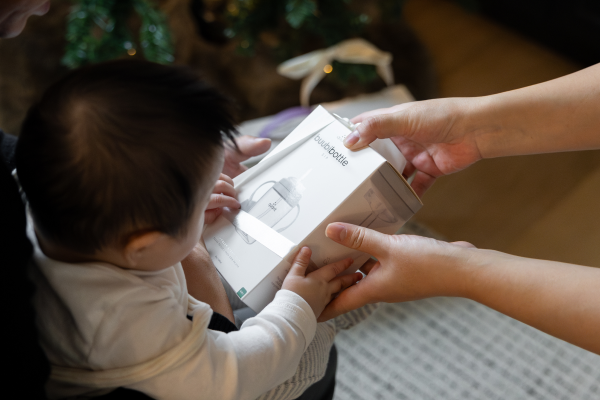
If you do want the warming to happen at the bedside, that is what the BuubiBottle Portable Milk Warmer PRO is built for. It is cordless and silent, holds 17 ounces in a vacuum-insulated stainless steel vessel, and brings milk to the temperature you set, holding it to a single degree. A Formula Preparation Mode heats water to 158°F (70°C) for powdered formula, and the vessel twists off the base for washing. For how long warming actually takes with any device, see how long does a bottle warmer take.
When the baby refuses the bottle from you
It happens, usually in the first week of trying, and it is not a verdict on you. A baby who has only ever fed one way is being asked to learn a new one, at night, from the parent who smells wrong for the job. Offer the bottle before the crying gets serious, in a different hold from the nursing position, ideally with her out of the room or out of the house: many babies who refuse near a nursing parent take a bottle readily when that option is clearly off the table. If fifteen minutes of refusal turns into real distress, hand over and try again tomorrow afternoon. Losing one night is cheaper than teaching the baby that the bottle means a fight. If refusal lasts past a week or two, why babies refuse the bottle works through the causes in order, and the methods that tend to work next picks up from there.
Your own head

Roughly one father in twelve meets criteria for depression in the perinatal period. A meta-analysis of observational studies (Cameron et al., 2016) put the pooled estimate at 8.4% (95% CI 7.2 to 9.6%), with the highest rates falling between three and six months postpartum.[8] That is not a side note to the feeding conversation. A partner who is flattened at month four is not encouraging anyone, and encouragement is the thing the evidence says matters most.
If the fog is not lifting, tell your doctor in those words. We wrote more on this in fathers and mental health.
When to call the pediatrician
Two things to watch for during feeds, both with concrete thresholds.
Not taking in enough. Nationwide Children's Hospital puts a number on it: fewer than six wet diapers a day in a newborn is a dehydration sign, alongside dark urine, a dry or sticky mouth, no tears when crying, sunken-looking eyes, or a soft spot that looks flat or sunken. Call if your baby refuses to feed, shows any of those, or is simply not getting better within 24 hours.[9]
Trouble with the swallow itself. Stanford Medicine Children's Health describes the classic signs of aspiration as a cough, wet or congested breathing, and watery eyes after swallowing. In babies it often shows up as a wet or gurgling sound during or after a feed. An occasional splutter is ordinary. What is worth raising is aspiration that happens regularly, every few swallows, because that pattern points at an underlying cause someone should look at.[10]
Neither list is complete, and you do not need a diagnosis to make the call. "My baby is feeding differently and I do not like it" is a complete reason to phone.
What taking the night feeds is actually worth
Two things, and they are not the same size. The small one is arithmetic: a few hours of sleep moved from your column into hers. The larger one is that the feed is a long stretch of quiet, close, one-to-one time that is otherwise hard to come by when one parent is doing all the feeding. More on that in a father's perspective on balancing breast and bottle and the critical role of fathers in child development.

You will do a feed badly. You will tip the bottle too far, or miss the cue, or hand the baby back because the crying is louder than your confidence. The mothers you are comparing yourself to were also terrible at this in week one; you just did not see it. The version of this that works is not the one where you are instantly good at feeding. It is the one where you notice the milk is low before anyone asks, and say out loud that she is doing well.
Pick a pattern tonight, say it out loud to each other, and do the five-minute reset before bed. Then let her sleep through the first one without checking on you. That last part is the hardest, and it is the one that decides whether any of this worked.
Common questions
Can a dad take night feeds if the baby is breastfed?
Yes. It needs pumped milk ready in advance and a bottle the baby has already accepted in daylight, so plan the practice runs a few days before the first night block.
How much milk should I put in the bottle?
For a breastfed baby, around 3 oz (90 mL) is a common starting point. Exclusively breastfed babies between one and six months take an average of about 25 oz (750 mL) a day, with a typical range of 19 to 30 oz.[11] Divide the daily total by how many times your baby normally feeds: eight feeds a day works out to about 3 oz each. The number does not climb much with age, because breastfed babies grow into bigger bodies rather than bigger feeds. It is a starting point, not a target.
Do I need a bottle warmer to do this?
No. A mug of warm water works. What a warmer changes is repeatability in the dark: same result every time, no kitchen trip, no guessing. Our bottle warmer versus hot water mug comparison is honest about when you do not need one.
Do I need a special bottle for a breastfed baby?
No. What matters is the flow rate and how you hold the bottle, not the brand. Check that the nipple comes in a genuinely slow flow, because plenty labelled for newborns run faster than a breast does. Our RealFeel nipples come in four flow rates (Slow from birth, Medium from three months, Fast from six, and a variable Flex) and fit BuubiBottle Mini and Max only. Whatever you use, a feed reliably over in seven minutes means the flow is too fast. No nipple works for every baby, ours included.
Should I wake the baby to feed during my shift?
It depends on age and how feeding is going. For formula-fed babies in the first few weeks after birth, the AAP advises waking a baby who sleeps longer than 4 to 5 hours and starts missing feedings.[12] Beyond those first weeks, and for babies who are gaining well, follow the plan you have agreed with your own pediatric provider.
Will bottles at night hurt her milk supply?
Supply responds to how often milk is removed, so replacing a night feed with a bottle without replacing that removal can affect it. The usual answer is a pump session or a pattern that keeps the total number of removals steady. Work it through with our combo feeding guide, and raise it with a lactation consultant or your pediatric provider if supply is already a concern.
Sources
- Ogbo FA, et al. Breastfeeding in the Community: How Can Partners/Fathers Help? A Systematic Review. International Journal of Environmental Research and Public Health. 2020 Jan 8;17(2):413. pmc.ncbi.nlm.nih.gov
- American Academy of Pediatrics. Tips for Freezing & Refrigerating Breast Milk. healthychildren.org
- American Academy of Pediatrics. How to Keep Your Sleeping Baby Safe: AAP Policy Explained. healthychildren.org
- Nationwide Children's Hospital. Planning to Be Away from Your Baby: Introducing a Bottle. nationwidechildrens.org
- American Academy of Pediatrics. Introducing the Bottle. healthychildren.org
- Colorado Department of Public Health & Environment, WIC. Paced Bottle Feeding. coloradowic.gov
- American Academy of Pediatrics. How Often and How Much Should Your Baby Eat? healthychildren.org
- Cameron EE, Sedov ID, Tomfohr-Madsen LM (2016). Prevalence of paternal depression in pregnancy and the postpartum: An updated meta-analysis. Journal of Affective Disorders, 206:189–203. pubmed.ncbi.nlm.nih.gov
- Nationwide Children's Hospital. Dehydration: Giving Liquids at Home. nationwidechildrens.org
- Stanford Medicine Children's Health. Aspiration in Children. stanfordchildrens.org
- KellyMom. How much expressed milk will my baby need? (research summary of Neville 1988, Dewey 1983/1991, Cox 1996 and others). kellymom.com
- American Academy of Pediatrics. Amount and Schedule of Baby Formula Feedings. healthychildren.org
This article is general parenting guidance and is not a substitute for advice from your own pediatric provider. If you have concerns about your baby's feeding, weight gain, or sleep, speak to your pediatrician, midwife, or lactation consultant, and talk to your own doctor about your own health.


Leave a comment
All comments are moderated before being published.
This site is protected by hCaptcha and the hCaptcha Privacy Policy and Terms of Service apply.