

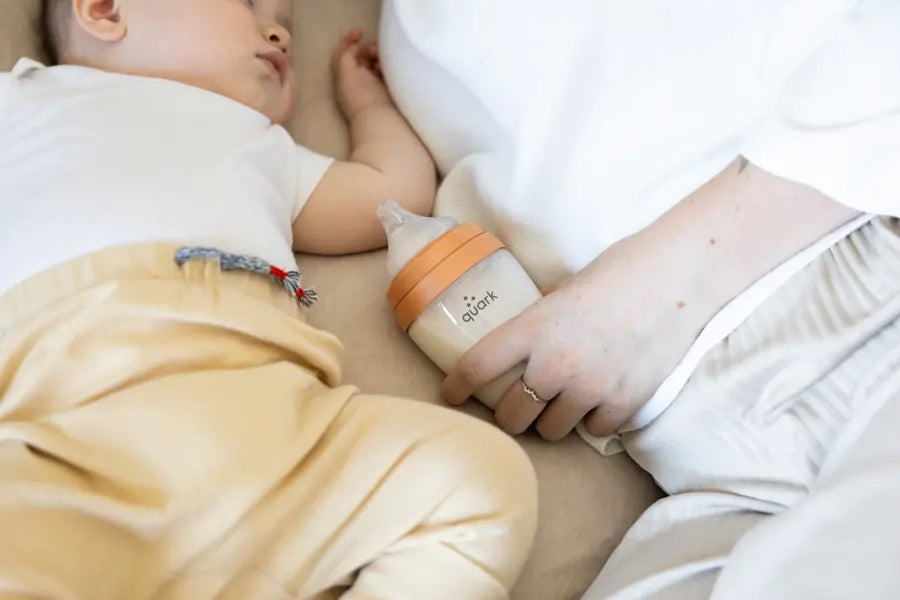

The short version: Combination feeding (running breast milk and formula together) is mostly a logistics problem, not a medical one. The two milks follow different storage clocks: per the U.S. CDC, freshly expressed breast milk lasts up to 4 hours at room temperature, while prepared formula lasts only 2. So the real skill is a clear labelling system, a predictable bottle rotation, and a daily rhythm built around your baby's hunger cues. Get the system right and the day mostly runs itself.
Why combination feeding is really a logistics challenge
If you feed your baby both breast milk and formula, the hardest part usually isn't the feeding itself; it's keeping track of everything around it. Which bottle is oldest? Was that one pumped this morning or yesterday? How long has it been sitting out? Parents who combo-feed are effectively running two small supply chains at once, each with its own clock and its own rules. The good news is that none of it is complicated once you have a system; it just rewards being organised. Our comprehensive guide to combination feeding covers the bigger picture of why families choose this path (supply concerns, returning to work, sharing feeds) and this article zooms in on the day-to-day mechanics that make it sustainable. If you and a partner are splitting feeds, our perspective on balancing breastfeeding and bottle feeding is a useful companion read.

Two milks, two storage clocks
This is the single most important thing to get right, because breast milk and formula simply don't keep for the same amount of time. The figures below come directly from the U.S. Centers for Disease Control and Prevention; see the CDC pages on breast milk storage and preparation and infant formula preparation and storage. Canadian families: always defer to the instructions on your own formula and your provider's advice.
| Situation | Breast milk (CDC) | Prepared formula (CDC) |
|---|---|---|
| Room temperature | Up to 4 hours (fresh, at 25 °C / 77 °F or colder) | Use within 2 hours of preparation |
| Refrigerator | Up to 4 days | Up to 24 hours (refrigerate right away) |
| Freezer | 6 months best; up to 12 months acceptable | Don't freeze prepared formula |
| Once feeding begins | Use within 2 hours of being warmed / at room temp | Use within 1 hour from when feeding begins |
| Leftover in the bottle after a feed | Discard (saliva introduces bacteria) | Throw it out (saliva introduces bacteria) |
Two extra rules for breast milk, both from the CDC: never refreeze it once it has thawed, and don't store it in the fridge or freezer door, where the temperature swings every time it opens. Milk thawed in the fridge should be used within 24 hours. Our complete breast milk storage guide walks through containers, thawing, and labelling in full detail. And if a thawed batch ever looks or smells different from fresh, our guide to breast milk colour variations explains what's normal and what isn't.
A bottle inventory that doesn't fall apart
Once you accept that the two milks run on different clocks, the fix is a simple inventory habit. Three things keep it from unravelling:
- Label everything. Date (and ideally time) every container of expressed milk and every bottle of made-up formula. The CDC specifically advises labelling breast milk with the date it was expressed. A roll of removable tape and a marker by the fridge is all it takes.
- Rotate oldest-first. Treat your fridge like a shop shelf: the oldest safe milk moves to the front and gets used next. This one habit prevents most of the "is this still okay?" guesswork.
- Keep the milks separate and clearly distinguishable. Because their timings differ, you never want to mistake a bottle of yesterday's formula for this morning's breast milk. Different bottle caps, colours, or a dedicated shelf each works.
How many bottles do you actually need? Most combo-feeding families find that six to eight bottles keeps the rotation flowing without a constant dishwasher cycle. You don't need to sterilise them after every use; for most healthy, full-term babies a thorough wash is enough, as we explain in why you probably don't need to sterilise your baby bottles. If bottles are new to you, our step-by-step guide to bottle-feeding a newborn covers a full feed from start to finish.
Building a daily rhythm around hunger cues
Combination feeding doesn't require a rigid timetable; it works best as a flexible rhythm anchored to your baby's hunger, with the two milks slotted in where they make sense. The American Academy of Pediatrics is clear that babies should be fed when they show hunger cues (licking lips, rooting, bringing a hand to the mouth) and that crying is a late sign. As a rough frame, the AAP notes that bottle-fed newborns typically eat every 2 to 3 hours (at least 8 feeds in 24 hours), while breastfed newborns nurse roughly every 2 hours, around 10 to 12 times a day. A combo-feeder lives somewhere between those two patterns.
| Age | Roughly how much per feed (AAP) | Roughly how often |
|---|---|---|
| First days | About 0.5–2 oz | On demand, frequently |
| By end of first month | 3–4 oz | About every 3–4 hours |
| Around 6 months | 6–8 oz | 4–5 feeds in 24 hours |
These are averages, not targets to hit exactly; see the AAP's own guidance on how often and how much your baby should eat emphasises responsive feeding over the clock. To turn the rhythm into something repeatable, our practical guide to a daily newborn routine is a good template, and a calm, paced bottle-feeding approach helps your baby self-regulate regardless of which milk is in the bottle.
A sample combo-feeding day (illustrative only)
Every baby is different, so treat this as a shape rather than a prescription: a morning nursing session when supply tends to be highest; a mid-morning bottle of expressed milk or formula so a partner can take a feed; nursing or a bottle through the afternoon as cues appear; and a formula bottle in the evening if it helps everyone settle. The point is that each feed has a planned source, so you're never scrambling to thaw or mix at the moment your baby is already crying.
Warming two milks without slowing down
Here's the part that's genuinely simpler than it looks: the warming method is the same for breast milk and formula. Stand the sealed bottle in warm (not hot) water, or use a controlled warmer, aim for body temperature (about 37 °C / 98.6 °F), then test a few drops on the inside of your wrist. Never use a microwave for either milk: it heats unevenly and creates scalding hot spots, a point both the CDC make explicitly. When you prepare powdered formula, use water cooled to about 70 °C, and do not reheat or reuse formula that's already been warmed.

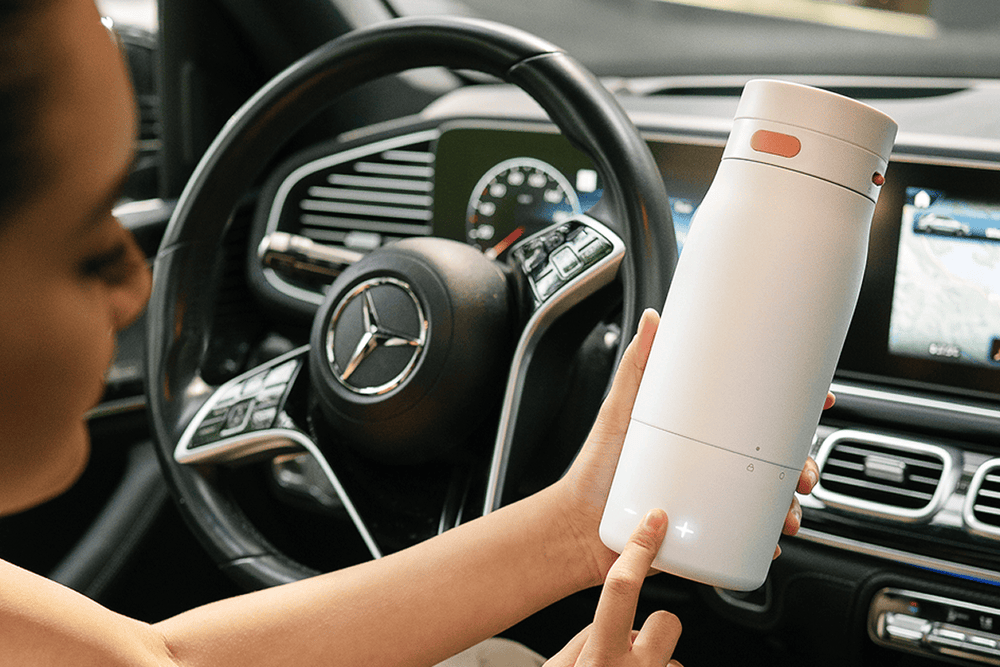
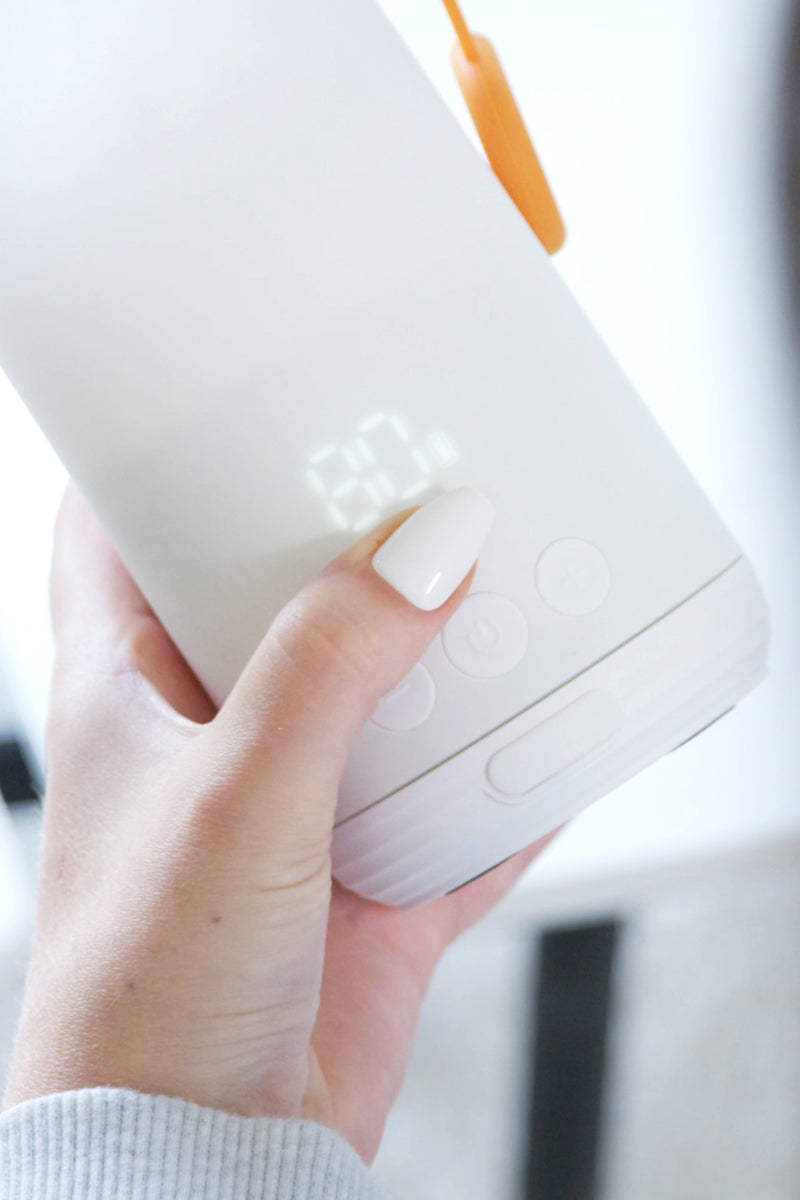
The harder warming problem is everywhere outside your kitchen (the car, a flight, a relative's house) where there's no kettle and no outlet. Because the gentle target is identical for breast milk and formula, a single controlled warmer covers both. The BuubiBottle Smart Portable Milk Warmer charges over USB-C, holds 300 ml/10 oz, is made from Tritan, and warms within a controlled 37–50 °C (98–122 °F) range with a real-time temperature display, so a combo-feeder can hit that body-temperature target away from home for either milk, then finish with the wrist test.
Protecting feeding while you mix methods
A practical worry for combo-feeders is whether bottles will affect breastfeeding. The honest answer is that it varies by baby, and it's worth being thoughtful rather than anxious. A slow-flow nipple and paced feeding help keep the bottle from becoming "easier" than the breast. Our guide to nipple confusion and bottle preference goes through the gentle steps, and the comprehensive guide to bottle feeding for breastfed babies covers technique in depth. If you're trying to maintain or build supply alongside formula, that's exactly the kind of question a lactation consultant or your healthcare provider can tailor to you; combination feeding is highly individual, and personalised guidance beats any generic schedule.
Frequently asked questions
- Can I store breast milk and formula the same way?
- No; they keep for different lengths of time. Per the CDC, fresh breast milk lasts up to 4 hours at room temperature and up to 4 days in the fridge, while prepared formula should be used within 2 hours at room temperature or within 24 hours if refrigerated right away. Always label both with the date and rotate oldest-first.
- Can I mix breast milk and formula in the same bottle?
- It can be done, but it isn't usually recommended as a default because combining them ties the breast milk to formula's shorter timing and means you may waste valuable expressed milk if the bottle isn't finished. Many families prefer to feed breast milk first, then top up with formula in a separate bottle. This is a good question to raise with your pediatrician for your specific situation.
- How many bottles do I need for combination feeding?
- Most combo-feeding families find six to eight bottles keeps the rotation flowing without constant washing. The exact number depends on how many feeds come from a bottle versus the breast each day, and how often you run the dishwasher.
- How long can a warmed bottle sit out?
- Per the CDC, once breast milk is warmed or at room temperature, use it within 2 hours. Prepared formula should be used within 2 hours at room temperature and within 1 hour once your baby starts drinking. After your baby has fed, discard whatever is left in the bottle, for either milk.
- Do I warm breast milk and formula differently?
- No. The method is the same for both: gentle warm water or a controlled warmer, aiming for body temperature, with a wrist test before feeding, and never a microwave, which creates scalding hot spots. The differences between the two milks are in storage timing and mixing, not in the warming itself.
- Will giving bottles hurt my breastfeeding?
- It varies by baby. Using a slow-flow nipple and paced bottle-feeding helps, and many families combo-feed successfully. If you're concerned about supply or your baby starting to prefer the bottle, a lactation consultant or your healthcare provider can give advice tailored to you.
- How do I know my baby is hungry rather than just unsettled?
- The AAP describes early hunger cues as licking the lips, rooting, and bringing a hand to the mouth; crying is a late sign. Feeding responsively to those cues, rather than strictly by the clock, is the recommended approach for both breast and bottle.
Sources
- U.S. Centers for Disease Control and Prevention: Breast Milk Storage and Preparation (room-temperature, refrigerator, freezer, thawed, and leftover time limits).
- U.S. Centers for Disease Control and Prevention: Infant Formula Preparation and Storage (2-hour, 1-hour, and 24-hour rules; discard leftovers).
- American Academy of Pediatrics / HealthyChildren.org: How Often and How Much Should Your Baby Eat? (feeding frequency, amounts by age, hunger cues).
Medical disclaimer: This article is for general informational purposes and is not a substitute for medical advice. Storage, preparation, and feeding figures reflect U.S. CDC and AAP recommendations current at the time of writing; always follow the instructions on your own formula and breast-milk storage and the advice of your pediatrician, lactation consultant, or healthcare provider. Portions of this content draw on AI assistance and are reviewed by a qualified medical reviewer before publication. Medically reviewed by Dr. Yang. Last reviewed June 11, 2026.


Leave a comment
All comments are moderated before being published.
This site is protected by hCaptcha and the hCaptcha Privacy Policy and Terms of Service apply.