


Material
The label says "Swiss medical-grade polyamide." Here's what that material actually is, and why a bottle gets built from the same plastic family as sports sunglasses and surgical tools.
You turned the bottle over in the kitchen one night, half-listening for the kettle, and there it was on the label: Swiss medical-grade polyamide. It sounds reassuring. It also sounds like marketing. And when the thing in question holds the milk your baby drinks six or seven times a day, "sounds reassuring" is not enough. You want to know what the material actually is, whether anyone independent has checked it, and whether it can survive the sterilizer and the drop off the high chair without leaching something you'd rather not think about.
Here's what the label actually means. "Swiss medical-grade polyamide" almost always means one specific material: Grilamid TR-90, made by Ems-Chemie (trading as EMS-GRIVORY) in Domat/Ems, Switzerland. It's the plastic Quark Baby uses for the BuubiBottle Mini and Max. Below is the chemistry, the certifications you can verify yourself, and an honest read on what it does well and where its limits are.
The short version: it's a transparent nylon
Grilamid TR-90 is a polyamide, which is the chemical family most people know by its common name: nylon. But it isn't the nylon in your jacket or your toothbrush bristles. Its formal designation is PA MACM12, and the "TR" stands for transparent. Most nylons are cloudy or opaque because their molecules pack into crystals that scatter light. TR-90 is built to stay amorphous, meaning the molecules never line up into those light-scattering crystals, which is why a bottle made from it comes out glass-clear instead of milky.
That transparency is not a cosmetic afterthought. EMS-GRIVORY describes itself as the world market leader for transparent polyamides, and the material's first big home was eyewear, where you need a lens or frame that's optically clear, light, and nearly unbreakable. TR-90 achieves high optical clarity close to glass — the practical payoff for a parent is simple: you can see exactly how much milk is left and whether the bottle is actually clean, without unscrewing anything.

Why this material existed long before baby bottles
Here's the part that should actually build your confidence, because it has nothing to do with babies. TR-90 earned its reputation in two industries that do not tolerate failure: optics and medical devices.
Sports and safety eyewear
If you own a pair of premium sports sunglasses or impact-rated safety glasses, there's a real chance the frame is TR-90. EMS-GRIVORY markets it for corrective frames described as "ultra-lightweight and practically unbreakable," and for safety glasses chosen for their impact strength and break resistance. A material that survives being sat on, dropped on concrete, and flexed thousands of times is a material that shrugs off a fall from the high chair.
Medical and drinking-water hardware
TR-90 also carries USP Class VI certification, the United States Pharmacopeia rating used to screen plastics for biocompatibility before they're allowed near the human body in medical devices. On top of that it meets NSF/ANSI 61 and the German DVGW W270 standard, both for materials in contact with drinking water. None of these are baby-bottle marketing badges. They're industrial certifications a material has to earn before it touches medicine or your tap water, and a bottle gets the benefit of that pedigree for free.
What builds real confidence in TR-90 is not the label. The same material was already trusted in surgical-grade devices and drinking-water systems before anyone thought to make a baby bottle from it.
The four properties that actually matter for feeding
Pedigree is nice. But you're sterilizing and dropping this thing daily, so let's talk about the properties you'll feel in real use.
1. Heat resistance
This is the one parents care about most, because heat is where cheap plastics fail and warp. TR-90's glass transition temperature, the point at which the material starts to soften, sits around 155°C when dry. In practical terms, EMS-GRIVORY rates the food-contact grade to withstand industrial dishwashers running up to 95°C over the long term. Your steam sterilizer and your dishwasher's hot cycle live comfortably below that ceiling, so the bottle holds its shape and clarity through repeated cleaning instead of clouding and deforming the way some bottles do after a month.
One honest caveat: heat resistance is not an invitation to boil a bottle dry on the stove or microwave it bone-empty. Follow the cleaning instructions on the product. The point is that normal sterilizing won't degrade the material.
2. Optical clarity
We covered the science. The day-to-day version: you can read the volume markings at a glance during a 3 a.m. feed, and you can see at a glance whether there's a film of dried milk you missed. Clarity is a hygiene feature, not just a pretty one.
3. Shatter resistance
The bottle will get dropped. TR-90's measured elongation at break is over 50%, meaning the material stretches and absorbs impact energy rather than cracking the way glass or brittle plastics do. This is the same toughness that lets it survive as eyewear. For you it means a floor-test most days won't end in a shattered bottle and a milk cleanup, which is why Quark Baby builds the whole BuubiBottle range from it rather than glass.
4. Food-contact compliance
This is the claim that has to be airtight, so here's exactly what's verifiable. Grilamid TR-90 is BPA-free, confirmed directly by the manufacturer. In the United States it holds an FDA Food Contact Notification (FCN 883), effective since 2009, clearing it for food contact use. It draws on the FDA framework for nylon resins under 21 CFR §177.1500. In Europe, food-contact plastics are governed by EU Regulation No. 10/2011, and EMS-GRIVORY states the material satisfies the applicable food-contact regulatory requirements for these markets.
Notice what's not being claimed here. Not "100% safe," not "completely non-toxic." Those are words, not evidence. What's being claimed is specific and checkable: a named material, a named manufacturer, a numbered FDA notification, a numbered EU regulation. That's the standard a parent should hold every "premium material" claim to.
If something looks off, here's what's normal. After many cycles in a sterilizer, even high-grade plastic can pick up faint surface scratches from grit or harsh scrubbing tools, and very pigmented foods can leave a light tint if a bottle is used for purées. Both are cosmetic. What you should not see is warping, cloudiness that won't wash off, cracking, or a melted rim. If a bottle shows those after normal cleaning, retire it and check you're not exceeding the recommended cleaning temperature. Replace any feeding item showing cracks, as a precaution, regardless of material.
Where TR-90 fits in a bottle you'll actually use
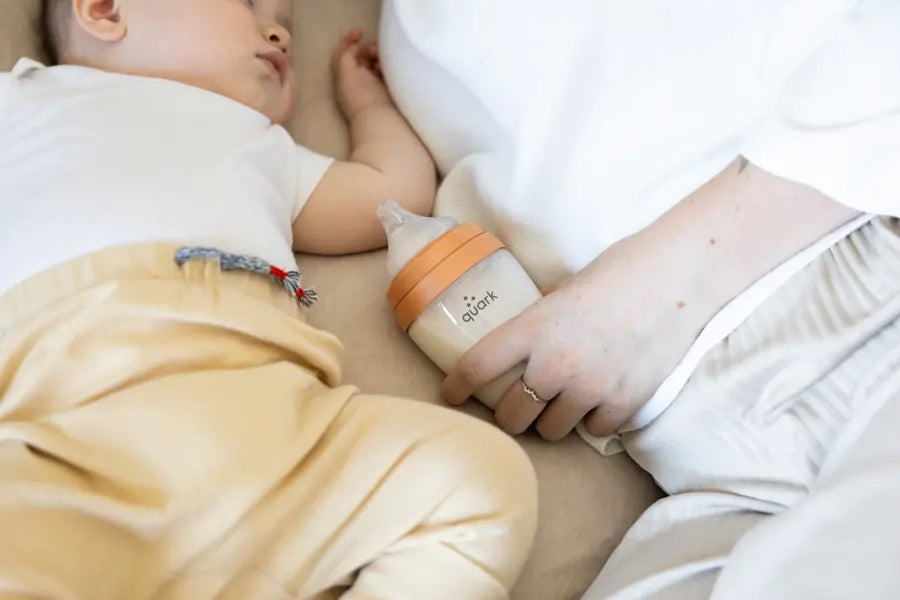
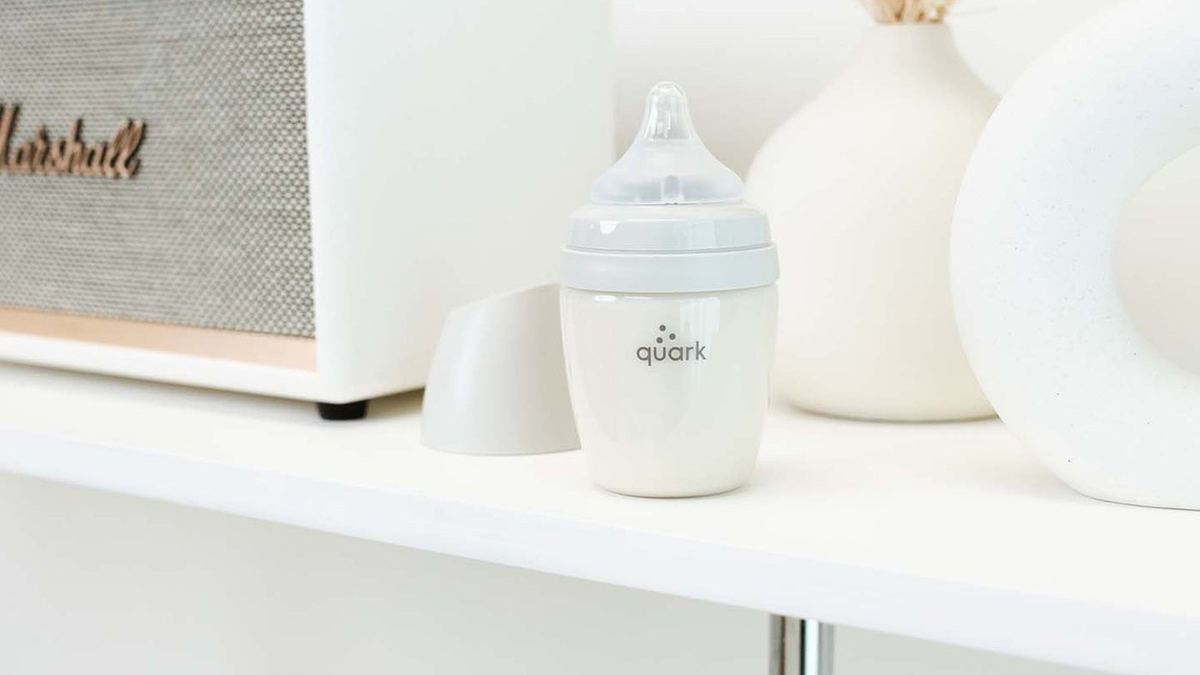
The material is the body of the bottle. The part that does the work of feeding is the nipple, and a good bottle pairs the right body with the right nipple. Quark Baby's RealFeel nipple is breast-shaped and flexes during feeding for a more natural latch, with an internal anti-colic vent and flow stages that step up as your baby grows (Slow from birth, Medium at 3 months, Fast at 6, Flex at 9). The TR-90 body keeps that system clear, tough, and easy to sterilize between feeds.
If you're starting from scratch, the BuubiBottle starter bundle pairs the bottle and nipple so you're not guessing which flow rate or size to begin with. The 5 oz Mini suits newborn-size feeds; the 8 oz Max grows with bigger appetites.
Is "Swiss medical-grade polyamide" just marketing?
Partly. "Medical-grade" is a description, not a single legal standard, so treat the phrase as a starting point, not proof. The proof is in the specifics underneath it: a named material (Grilamid TR-90), a named maker (Ems-Chemie), a USP Class VI biocompatibility rating, an FDA food-contact notification, and BPA-free confirmation. Quark Baby's bottles also carry independent third-party lab testing through SGS. Those are the things you can look up. A label that can't point you to any of them is the one to be skeptical of.
If you remember one thing from all this chemistry: don't buy a bottle on the strength of an adjective. Buy it on the strength of what the maker is willing to name and have tested. The next time a label says "premium" or "medical-grade," that's your cue to ask which material, certified by whom.
Common questions
Is Grilamid TR-90 BPA-free?
Yes. The manufacturer, EMS-GRIVORY, confirms Grilamid TR-90 is completely BPA-free. Bisphenol A is not part of its chemistry, which is a polyamide (a type of nylon), not a polycarbonate, the plastic family historically associated with BPA.
Can I put a TR-90 bottle in a steam sterilizer or dishwasher?
Usually, yes. The food-contact grade is rated by EMS-GRIVORY to withstand industrial dishwashing up to 95°C over the long term, and its glass transition temperature is around 155°C, so a household steam sterilizer or dishwasher hot cycle stays well within range. Always follow the cleaning instructions on your specific bottle.
Is it the same plastic as in eyeglasses?
Yes. Grilamid TR-90 is widely used for sports and safety eyewear frames, where it's valued for being lightweight and nearly unbreakable. EMS-GRIVORY is the world market leader for transparent polyamides. The same impact resistance that survives a dropped pair of glasses is what helps a bottle survive the high-chair drop.
What does "polyamide" mean? Is it just plastic?
It depends on what you mean by "just plastic." Polyamide is the chemical family commonly known as nylon. Grilamid TR-90 specifically is an amorphous, transparent grade (designated PA MACM12) engineered for clarity, heat resistance, and toughness, rather than a generic commodity plastic. Its industrial certifications (USP Class VI, NSF/ANSI 61, FDA food-contact) are what set a food-grade engineering polyamide apart from cheap plastic.
Is TR-90 safe for hot liquids like formula or warmed milk?
Usually, yes. It holds an FDA Food Contact Notification (FCN 883) covering all food types across the FDA's full range of temperature conditions, and its heat tolerance far exceeds feeding temperatures. As always, test the temperature of milk on your wrist before feeding, and warm milk gently rather than overheating it.
How can I verify a "medical-grade" bottle claim myself?
It depends on the brand's transparency, which is exactly the point. Ask for the named material and maker, look for an FDA food-contact notification or 21 CFR reference, check for BPA-free confirmation, and look for independent third-party lab testing (Quark Baby uses SGS). If a brand can't name any of these, the "medical-grade" label is doing the talking for them.
The takeaway
"Swiss medical-grade polyamide" decodes to Grilamid TR-90, a transparent, food-contact-certified nylon from Ems-Chemie that proved itself in sunglasses and surgical-grade devices before it ever held milk. It's clear so you can see the feed, tough so it survives the floor, and heat-stable so the sterilizer doesn't wreck it, all backed by certifications you can look up rather than adjectives you have to trust. If you want to see the material in your hand, the BuubiBottle starter bundle is the simplest place to start.
Written by Quark Baby. Material and regulatory claims are sourced to the manufacturer (Ems-Chemie / EMS-GRIVORY) and public FDA and EU food-contact references, listed below.
This article is for general information and is not medical advice. It does not diagnose, treat, or prevent any condition. Always follow your bottle's cleaning and use instructions, test milk temperature before feeding, and replace any feeding item that shows cracks or wear. For questions about your baby's feeding or health, talk to your pediatrician or a qualified healthcare professional.
Sources
- FDA, Inventory of Effective Food Contact Substance (FCS) Notifications — FCN No. 883, EMS-Chemie AG (poly[imino...dodecanediyl], CAS 163800-67-7), effective June 3, 2009. https://hfpappexternal.fda.gov/scripts/fdcc/index.cfm?set=fcn&id=883
- FDA, 21 CFR §177.1500 — Nylon resins (food-contact polymers framework). https://www.ecfr.gov/current/title-21/chapter-I/subchapter-B/part-177/subpart-B/section-177.1500
- EUR-Lex, Commission Regulation (EU) No 10/2011 on plastic materials and articles intended to come into contact with food. https://eur-lex.europa.eu/legal-content/EN/TXT/?uri=CELEX%3A32011R0010
- EMS-GRIVORY, "Grilamid TR — the BPA-free high-performance solution for food contact" (BPA-free; dishwasher resistance to 95°C; food-contact applications). https://www.emsgrivory.com/en/media/news/ems-grivory/detail/grilamid-tr-the-bpa-free-high-performance-solution-for-food-contact/
- EMS-GRIVORY, Markets — Optics (world market leader for transparent polyamides; eyewear applications, impact and break resistance). https://www.emsgrivory.com/en/products-markets/markets/optics/
- Grilamid TR-90, EMS-GRIVORY technical data sheet (glass transition 155°C; elongation at break >50%; USP Class VI; NSF 61; DVGW W270; light transmission). https://silo.tips/download/grilamid-tr-90-ems-grivory-a-unit-of-ems-chemie-ag
- Grilamid TR-90 datasheet (PA MACM12 designation; optical properties; refractive index 1.5–1.6). https://www.processsensing.com/docs/datasheet/Grilamid-TR90.pdf
Medically reviewed by Dr. Yang Last reviewed August 6, 2026.




Leave a comment
All comments are moderated before being published.
This site is protected by hCaptcha and the hCaptcha Privacy Policy and Terms of Service apply.