



Reviewed for general-information accuracy against CDC and AAP developmental-milestone guidance. This guide is for general information and is not medical advice. Every baby develops at their own pace; talk to your pediatrician about your baby's individual development.
In the first twelve weeks a newborn goes from sleeping in one-to-two-hour stretches and seeing about a foot in front of them to holding their head up, unclenching their fists, and smiling at you on purpose. The first real smile usually lands around six weeks. Almost nothing arrives on a specific week, which is why a strict week-by-week chart lets most parents down by week three.
So this guide does two things at once. It gives you the genuine week-to-week detail for the newborn stretch, where a week really does look different from the one before it, and then switches to stages for the rest of the first year, where development spreads out and weekly framing stops meaning anything. Along the way: a quick-reference table for each, honest answers to the questions parents actually type at 2am, and clear signs for when to call your pediatrician.
Newborn week by week: what actually changes, weeks 1 to 12
These are the weeks where a week-by-week view pays for itself. Your baby's nervous system is reorganising fast, reflexes are fading and being replaced by choices, and the change from one fortnight to the next is genuinely visible. Ranges still overlap, so treat the weeks below as the order things tend to happen in, not the date they are due.

| Weeks | What is new | Typical feeding and sleep |
|---|---|---|
| Weeks 1–2 | Rooting and grasp reflexes; turns head to the side; focuses at roughly arm's length; calms to your voice | Breastfed babies commonly feed 10–12 times in 24 hours; bottle-fed every 2–3 hours. Sleep totals 16–17 hours, in 1–2 hour pieces |
| Weeks 3–4 | Longer alert windows; more expressive crying; early cooing sounds join the crying | Feeding pattern holds. Fussing typically increases across this fortnight |
| Weeks 5–6 | The first real social smile, often right around six weeks; sounds other than crying | Daily fussing tends to peak here, at roughly 3 hours a day |
| Weeks 7–8 | Lifts head while on the tummy; tracks you across the room; reflexes give way to voluntary movement | Some babies stretch one night sleep slightly longer, but there is no regular sleep cycle yet |
| Weeks 9–12 | Startle reflex fades; hands unclench; legs straighten out of the curled newborn position; a few babies roll | Fussing eases for most babies through this window |
Jump to your week: 1–2 · 3–4 · 5–6 · 7–8 · 9–12
Weeks 1 to 2: reflexes, feeding, and very short sleep
Your newborn arrives running on reflexes. They can turn their head to the side through the rooting reflex, but as the AAP puts it, infants "don't have much neck control the first few weeks." Vision is deliberately short range: newborns "can only see about a foot in front of them at first," which is almost exactly the distance to your face while you feed them. That is not an accident, and it is the single easiest thing you can do for early development, because looking at your face is the work.
Feeding dominates. The AAP describes breastfed newborns nursing about every 2 hours, "so 10-12 sessions in 24 hours is the norm," and bottle-fed newborns eating "every 2 to 3 hours," with 8 feeds in 24 hours as the recommended minimum. An infant's stomach is roughly the size of an egg, which is why the feeds are small and relentless rather than large and spaced out. Sleep follows the same shape: about 16 to 17 hours a day, but "they may only sleep 1 or 2 hours at a time."
What helps: hold your baby close, talk and sing during feeds, and start short daily tummy-time sessions. Our guide to your newborn's first two weeks goes deeper on the practical side of this fortnight, and the complete guide to bottle-feeding a newborn covers paced feeding and comfort cues.
Weeks 3 to 4: longer alert windows, and more crying
Alert stretches get longer and your baby starts spending real time looking at faces and high-contrast shapes rather than drifting straight back to sleep. Communication starts to differentiate too: crying becomes more expressive, and soft cooing sounds begin to appear alongside it.
This is also the fortnight when crying tends to climb. About one fifth of babies develop colic, and per the AAP it usually begins "between the second and fourth weeks." If your baby seems harder to settle now than they were in week one, that is a documented pattern rather than something you have caused. Our guide on colic and how to soothe a crying baby covers what actually helps.
What helps: respond to cries promptly, protect your own sleep in shifts if you have a partner, and keep the environment calm and predictable. A simple daily newborn routine gives the day shape without imposing a schedule your baby is not ready for.
Weeks 5 to 6: the first real smile, and peak fussing
Around six weeks, the AAP notes, "your baby may flash you her first real smile." Not a reflex, not wind: a smile aimed at you, usually with the whole face involved. Babies this age also start making sounds other than crying and reacting to loud noises.
The same window is usually the hardest. Regular daily fussing "peaks at about 3 hours a day by 6 weeks old." Those two facts landing in the same fortnight is a genuinely strange experience: the most rewarding milestone so far arrives in the middle of the noisiest weeks. Both are normal, and both pass.
What helps: answer coos with your own side of the conversation, offer high-contrast toys, and keep tummy time short and playful. More on this milestone in our guide to baby smile milestones.

Weeks 7 to 8: head control arrives
By around two months, per the AAP, "most babies this age can lift their head up when lying on their tummies," and reflexive movement starts giving way to voluntary motion. Your baby will track you across a room, hold your gaze for longer, and move both arms and legs with more intent.
Sleep may stretch a little at night, but do not read too much into it. The AAP is direct on this point: "babies do not have regular sleep cycles until about 4 months of age." A good night at seven weeks does not promise another one at eight.
What helps: daily tummy time, floor play within arm's reach, and narrating what you are both doing. If night feeds are the part wearing you down, our realistic guide to baby sleep sets expectations that match the evidence.
Weeks 9 to 12: reflexes fade and hands open up
By the third month the newborn reflexes are visibly retreating. The startle reflex "is probably gone by now," hands "will no longer be balled up in fists all the time," and legs are "straightening out from their pulled-up newborn position." Grasping becomes deliberate rather than reflexive, and some babies begin rolling over.
Crying is usually easing too. Colicky crying "generally stops by 3 to 4 months," though the AAP notes it can last until six months in some babies.
What helps: put easy-to-grasp rattles within reach, give plenty of unrestricted floor time, and keep naming what your baby is looking at. Language is being built long before the first word.
How long the newborn stage lasts
Clinically, the newborn period is the first 28 days after birth, which is the window the WHO uses when it reports on newborn health. In everyday use, most parents and most pediatric resources stretch "newborn" to cover roughly the first two to three months, until the reflexes have faded and your baby is holding their head up and smiling on purpose. Both definitions are in circulation, which is why one article will tell you the newborn stage ends at four weeks and the next will say three months. Neither is wrong; they are measuring different things.
How to read milestones (so you don't worry needlessly)
Milestones are a guide, not a deadline. The CDC "Learn the Signs. Act Early." checklists (updated with the AAP in 2022) list what most babies can do by a given age, and the World Health Organization documents wide normal windows for big motor skills. Independent walking, for example, can normally appear anywhere from about 8 to 18 months. Premature babies are usually tracked by their corrected age. The goal is not hitting each item on an exact week; it is steady forward progress, with your pediatrician as your partner at every well-child visit.
One number is worth remembering: the CDC defines a milestone as something most children (75% or more) can do by a certain age. It was never a pass-or-fail test, and it was never a median.
First-year milestones at a glance

This quick-reference table summarises typical milestones by stage. Ranges overlap on purpose: your baby may reach some earlier and some later.
| Stage | Social & emotional | Language | Cognitive | Movement / physical |
|---|---|---|---|---|
| Newborn (0–1 mo) | Calms to your voice; looks at your face | Cries; begins cooing "ahh" sounds | Focuses ~8–14 in; tracks briefly | Turns head; reflexive grasp; lifts head a little on tummy |
| ~2 months | First real smile; happy to see you | Makes sounds other than crying; reacts to loud sounds | Watches you move; looks at a toy | Holds head up on tummy; moves both arms & legs |
| ~4 months | Smiles to get attention; chuckles | Coos; turns toward your voice | Looks at hands; opens mouth when hungry | Holds head steady; brings hands to mouth; pushes up on elbows |
| ~6 months | Knows familiar people; laughs; mirror play | Takes turns making sounds; blows raspberries; squeals | Reaches for toys; mouths objects to explore | Rolls tummy-to-back; props on hands when sitting |
| ~9 months | Shy with strangers; responds to name; peek-a-boo | "Mamama / babababa" sounds; lifts arms to be picked up | Looks for dropped/hidden things; bangs objects | Sits without support; rakes food; passes objects hand-to-hand |
| ~12 months | Plays games like pat-a-cake | Waves bye-bye; says mama/dada; understands "no" | Puts items in a container; finds hidden things | Pulls to stand; cruises; pincer grasp; may take first steps |
Months 3 to 4 (weeks 13 to 16): reaching and coordination
Expression blossoms: laughing, babbling, and experimenting with sounds. Hand-eye coordination improves as your baby reaches for and grasps dangling, rattling toys. By about four months, most babies hold their head steady without support, push up on their elbows during tummy time, bring hands to the mouth, and coo to get and keep your attention.
What helps: offer play-gym toys at arm's reach, and keep up tummy time to build the upper-body strength that rolling and sitting will need.
Months 4 to 5 (weeks 17 to 24): rolling and raspberries
Strength and curiosity surge. Many babies start rolling (often tummy-to-back first), push up on straight arms, and socially they laugh, blow raspberries, take turns making sounds, and recognise familiar people. Everything goes in the mouth now. Mouthing is how babies explore texture and shape, so safe, clean toys matter.
What helps: give floor time and room to roll, narrate your day to feed language, and keep mouthable toys clean. Around this window you may also notice readiness signs for solids; here is how to spot them in our signs your baby is ready for solid foods guide.
Months 6 to 7 (weeks 25 to 32): sitting up
The six-month mark is a major one. Per the CDC, by six months most babies roll from tummy to back, push up with straight arms, lean on their hands to support themselves when sitting, reach to grab a toy, put things in the mouth to explore, and close their lips to show they don't want more food. Many are starting solids around now, sitting with support, and clearly enjoying back-and-forth conversation.
What helps: practise supported sitting, offer first foods responsively, and respect those "all done" cues. Our starting-solids guide covers safe first foods.
Months 8 to 9 (weeks 33 to 40): exploring and object permanence

Babies become busy explorers: sitting without support, passing objects hand-to-hand, raking up finger foods, and often beginning to scoot or crawl. Big cognitive gains arrive too, including looking for dropped or hidden objects (the start of object permanence) and babbling "mamama" or "babababa." Stranger awareness and separation reactions are normal and healthy. Note that 9 months is the AAP-recommended age for a general developmental screening at a well-child visit.
What helps: play peek-a-boo and hide-and-find games, offer safe self-feeding practice, and baby-proof for a newly mobile explorer.
Months 10 to 11 (weeks 41 to 48): pulling up and problem-solving
Now you will see pulling to stand, cruising along furniture, more intentional gestures, and early problem-solving: finding hidden objects, fitting things into containers, and anticipating familiar routines. Communication grows more two-way, with gestures and sound combinations that clearly mean something.
What helps: create safe surfaces to pull up on, offer stacking cups and containers, and keep daily routines predictable so your baby can anticipate what comes next.
Month 12 (weeks 49 to 52): standing, maybe walking
By the first birthday, many babies pull to stand, cruise, use a pincer grasp, wave bye-bye, say a word or two (mama or dada), understand "no," and play games like pat-a-cake. Some take their first independent steps around now. Plenty of perfectly healthy babies walk later, anywhere up to around 18 months, so a one-year-old who is still cruising is not behind. The AAP notes that most babies do not take their first real steps "until about a year old," and the range around that is wide.
What helps: give safe space to cruise and stand, read together every day, and celebrate communication attempts.
How to support your baby's development at home
You do not need special gear. Responsive, everyday interaction does the heavy lifting. A few high-value habits:
- Talk, sing, and narrate all day. This builds language long before first words.
- Daily tummy time from the newborn stage, to build the strength behind rolling, sitting, and crawling.
- Floor play and safe exploration over screens or containers. Movement drives motor and cognitive growth.
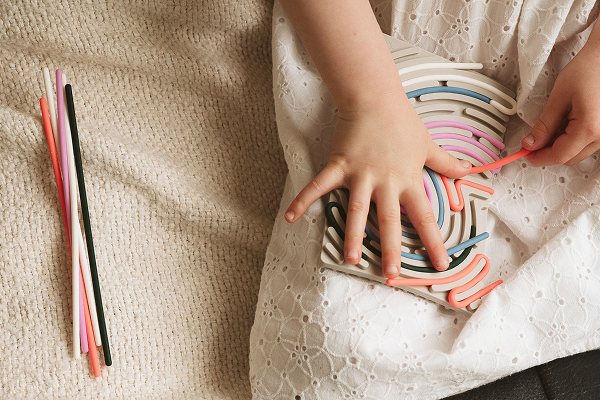
- Open-ended toys matched to the stage: high-contrast cards early, then rattles, stacking cups, and cause-and-effect play. QB's Playmaze and the ideas in our developmental toys for 6 months to 1 year guide are easy places to start.
- Predictable feeding and sleep rhythms, which give your baby the regulated, rested state where learning happens best.

When to talk to your pediatrician
Milestone ranges are wide, but reach out to your pediatrician if your baby misses several milestones for their age, loses a skill they once had, or if anything about their development worries you. Do not wait for the next scheduled visit if you are concerned. Early action and developmental screening (recommended by the AAP around 9, 18, and 30 months) are the most reliable way to support healthy development. For premature babies, your provider will track progress using corrected age.
Frequently asked questions
Sources
- AAP / HealthyChildren.org, Movement: Birth to 3 Months (vision range, neck control, head lifting at two months, first real smile around six weeks, startle reflex and fists at three months, first steps around a year)
- AAP / HealthyChildren.org, How Often and How Much Should Your Baby Eat? (10–12 breastfeeds in 24 hours, bottle feeds every 2–3 hours with a minimum of 8, stomach the size of an egg)
- AAP / HealthyChildren.org, Getting Your Baby to Sleep (16–17 hours of sleep a day, 1–2 hour stretches, no regular sleep cycles until about 4 months)
- AAP / HealthyChildren.org, Colic (colic in about one fifth of babies, usually starting between the second and fourth weeks; fussing peaking at about 3 hours a day by 6 weeks; colicky crying generally stopping by 3 to 4 months)
- CDC, Learn the Signs. Act Early. developmental milestones (the 75% definition and the age-by-age checklists, updated with the AAP in 2022)
- WHO, Newborn health (the newborn period as the first 28 days after birth)
- WHO, Child Growth Standards (normal windows for gross motor milestones, including independent walking)
Medically reviewed by Dr. Yang. Last reviewed September 25, 2026.



Leave a comment
All comments are moderated before being published.
This site is protected by hCaptcha and the hCaptcha Privacy Policy and Terms of Service apply.