





This article is for general information and is not medical advice. Premature babies, babies with jaundice, and babies who are not yet back to their birth weight need a feeding plan set by their own pediatrician. Check any change to your baby's feeding routine with your healthcare provider.
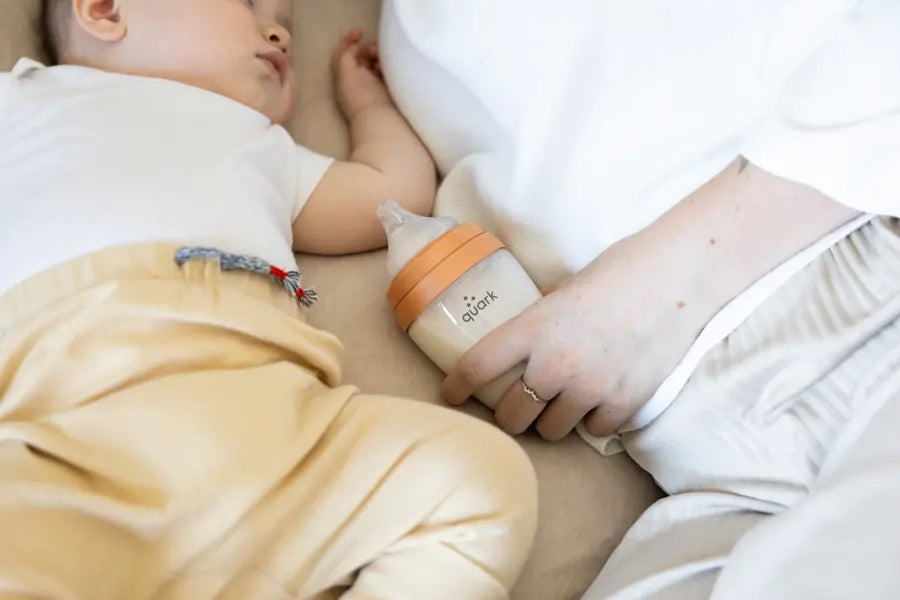
It is 2am, the baby has been asleep for three and a half hours, and the house is finally quiet. Every instinct says leave them be. In the first weeks, though, the answer to "should I wake my newborn to feed?" is usually yes, and there is a specific number behind it: the American Academy of Pediatrics says that if your newborn sleeps longer than 4 hours at night, you should wake them and encourage a feed.
This guide gives you that rule and the reasons for it, who needs a stricter schedule, how to tell when your baby no longer needs waking, and how to wake a sleepy baby without a battle. It ends with the questions parents actually type into a phone in the middle of the night.
Should you wake a newborn to feed?
Yes, in the early weeks. Newborns have small stomachs and need frequent, around-the-clock feeds to gain weight. The AAP lists a newborn who "frequently misses nursing sessions or sleeps through the night" as a warning sign of a feeding problem, and advises waking a newborn who sleeps longer than 4 hours at night. Nemours KidsHealth gives the same limit for breastfed newborns: they should not go more than about 4 hours without feeding, even overnight.
Time the gap from the start of one feed to the start of the next, not from when the last feed ended. If a feed began at 10pm, the 4-hour mark is 2am, even if that feed ran until 10:40.

How long can a newborn go without eating?
The honest answer is shorter than most parents hope, and it depends a little on whether your baby is breastfed or bottle-fed: breastfed newborns tend to feed more often.
| Situation | Typical gap between feeds | Feeds in 24 hours | Longest stretch before waking |
|---|---|---|---|
| Breastfed newborn | About every 2 hours (1.5 to 3) | 10 to 12 is the norm; at least 8 | About 4 hours, including at night |
| Bottle-fed newborn | Every 2 to 3 hours | At least 8 | About 4 hours, including at night |
| Bottle-fed, end of first month | About every 3 to 4 hours | Fewer, larger feeds | Ask your pediatrician |
| Premature, jaundiced, or not back to birth weight | As your pediatrician directs | As directed | Follow your pediatrician's plan exactly |
Figures from the AAP and Nemours KidsHealth; see Sources below. These are general guides for healthy, full-term babies. Your pediatrician's plan for your baby always comes first.
Which babies need a stricter feeding schedule?
For most healthy, full-term babies, the AAP says parents can look to the baby rather than the clock. The exceptions are the babies for whom a long sleep is a real risk:
- Premature babies. The AAP notes that babies born even a little early can be sleepy and may not take in enough in the early weeks. For premature babies or those with certain medical conditions, scheduled feedings advised by your pediatrician are best.
- Babies with jaundice. Jaundice is more common in breastfed newborns who are not getting enough milk. The AAP advises breastfeeding at least 8 to 12 times a day in the first few days to help keep the bilirubin level down, and calling your baby's doctor if your baby is hard to wake, fussy, or not feeding well.
- Babies still below birth weight. The AAP treats a baby who is still under their birth weight at two weeks as a sign they may not be getting enough milk. If your baby is having trouble gaining weight, the AAP's advice is not to wait too long between feeds, even if it means waking your baby.
If your baby slept through a feed once: it happens, and on its own it is not a reason to panic. Offer a feed as soon as they stir, keep an eye on wet diapers over the next day, and mention it at your next check-up. If it keeps happening, or your baby is hard to wake or not feeding well, call your pediatrician the same day.
When can you stop waking your baby to feed?
When your pediatrician confirms your baby is growing well, not on a date on the calendar. The first checkpoint is usually birth weight: the AAP expects a breastfed baby to be back above it by two weeks of age, and your pediatrician will track growth on a chart at each visit. Once your baby is healthy, full-term, and gaining steadily, the AAP's general advice is to feed on demand, following hunger cues rather than the clock.
That covers the questions parents ask about a 1-month-old or a 3-month-old. By then most healthy babies who are gaining well have moved to feeding on cue, and a longer night stretch is something to enjoy rather than fix. The decision to stop night waking is still one to make with your pediatrician, because they are the one watching the growth chart.
Waking a newborn feels like undoing your own hard work. In the first weeks, it is the work.
Should you set an alarm to feed your newborn at night?
In the first weeks, yes, it is a practical way to keep to the 4-hour limit. Set it for 4 hours after the start of the last feed. Many babies will wake on their own before the alarm; the alarm is there for the nights they do not. Once your pediatrician is happy with your baby's weight and tells you it is fine to let them sleep, turn it off.

How do you wake a sleepy baby for a feed?
Gently, and in stages. What tends to work:
- Try when your baby is in lighter sleep: eyelids fluttering, small movements, face changing expression.
- Unswaddle them and change their diaper. Being undressed a little and handled usually brings a baby up enough to feed.
- Hold them skin to skin. The NHS notes skin-to-skin contact helps a baby attach to the breast using their natural crawling and latching reflexes.
- Talk to them, dim bright lights, and offer the breast or bottle as soon as their mouth starts to move.
- If they drift off mid-feed, pause, burp, and try again.
If your baby is very hard to wake, or will not stay awake long enough to feed, do not wait it out. The AAP lists "hard to wake" among the reasons to call your baby's doctor.
How do you know your baby is getting enough?
Diapers and weight tell you more than the clock does. According to the AAP:
- In the first few days, 2 to 3 wet diapers a day. After the first 4 to 5 days, at least 5 to 6.
- For breastfed babies, 6 or more wet diapers a day with pale urine by 5 to 7 days old, and at least 3 to 4 yellow, loose stools a day.
- Feeding at least 8 to 12 times every 24 hours for a breastfed newborn.
- Seeming satisfied for 1 to 3 hours between feeds, and steady progress on the growth chart at check-ups.
After 7 days, fewer than 6 wet diapers and 4 stools a day, dark yellow urine, or stool that is still dark are signs the AAP says to take to your pediatrician.

What about safe sleep after a night feed?
When the feed is done, put your baby back down on their back, in their own sleep space in your room. The AAP advises sharing a room with your baby, but never a bed. The AAP's safe-sleep guidance is to place your baby on their back for all naps and at night, on a firm, flat surface such as a crib or bassinet with no incline, with nothing else in it but a fitted sheet. It is easy to fall asleep holding a baby at 3am, so settle them back into their own space before you get comfortable.
Making the 3am feed a little easier
Night feeds go faster when the milk is ready and you are not squinting at a thermometer in the dark. The BuubiBottle Portable Milk Warmer PRO lets you set the temperature to a single degree, in °F or °C, and remembers your last setting, so the 2am bottle is warmed the same way as the 10pm one. It has an illuminated real-time temperature display you can read in a dark nursery, warms a full 17 ounces, and runs all day on a charge.
For the bottle itself, see our baby bottles. If you are sharing nights with a partner, how dads can take the night feeds covers how to split them.

Related reading
- Is my baby getting enough? A parent's guide to breastfeeding
- How to bottle-feed a newborn
- Surviving second night syndrome
- Newborn week by week: development in the first year
- Healthy sleep in the newborn stage
Common questions
The first weeks of night feeds are hard, and they do end. Once your baby is back to birth weight and gaining, most of the clock-watching goes with it. If you are still unsure whether your baby needs waking, a quick call to your pediatrician is always the right question to ask.
Sources
- American Academy of Pediatrics (HealthyChildren.org): 11 Warning Signs of Breastfeeding Problems (last updated 3/25/2024)
- American Academy of Pediatrics (HealthyChildren.org): How Often and How Much Should Your Baby Eat? (last updated 4/2/2024)
- American Academy of Pediatrics (HealthyChildren.org): How to Tell if Your Breastfed Baby is Getting Enough Milk (last updated 1/13/2025)
- American Academy of Pediatrics (HealthyChildren.org): Jaundice in Newborns (last updated 8/8/2024)
- American Academy of Pediatrics (HealthyChildren.org): A Parent's Guide to Safe Sleep (last updated 9/11/2026)
- Nemours KidsHealth: Breastfeeding FAQs: How Much and How Often
- Nemours KidsHealth: Formula Feeding FAQs: How Much and How Often
- NHS: Breastfeeding: the first few days
Medically reviewed by Dr. Yang. Last reviewed September 27, 2026.



Leave a comment
All comments are moderated before being published.
This site is protected by hCaptcha and the hCaptcha Privacy Policy and Terms of Service apply.