

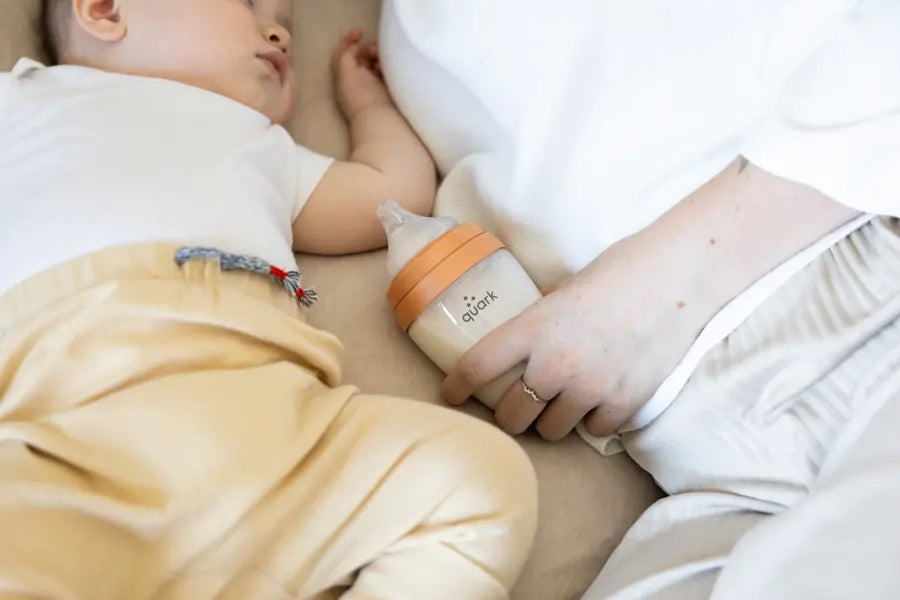





The last few weeks of leave have a particular texture. You are still holding the baby, and you are already somewhere else: running the drop-off in your head, wondering whether anyone else can settle them, doing arithmetic about milk at two in the morning. Nobody warns you that the dread arrives before the day does.
Most guides to this moment are written about feelings. Feelings are real, and they are not the part that goes wrong. What goes wrong is logistics: a bottle the baby will not take from anyone but you, a manager who has never scheduled a pumping break, a bag packed at 6:40am with the one thing missing that the daycare will not accept a substitute for. This is a four-week plan for the logistics, with the emotional part treated as what it is, which is a load you carry rather than a problem you solve.

What actually breaks on the first day back
Ask ten parents what went wrong on day one and you will hear the same four answers. The baby would not take the bottle from the caregiver. The pumping break got scheduled over by a meeting nobody thought to move. The milk that left the house cold arrived at the centre and sat there until a feed the baby was already too upset to want. And the morning ran eleven minutes late, which sounds trivial until you learn that eleven minutes is the difference between a calm handover and handing a crying baby to a stranger.
None of those are character failures. They are all things you can rehearse. The four-week structure below exists because each of them needs a different amount of lead time, and stacking them into the final weekend is how they all fail at once.
Four weeks out: childcare, and the question nobody thinks to ask
If childcare is not settled by now, that is the whole of this week. Licensing, ratios and waitlists get asked about in every guide, so we will not repeat them. The question that gets missed is the one about food: what will this centre or this person actually do with what I send?
Ask it concretely. Will they warm a bottle, and how. Will they accept frozen milk, or does it need to arrive thawed. What do they do with a bottle the baby only half finished. Do they want everything labelled a particular way, and do they mean the bottle, the cap, and the bag. Centres vary enormously on this and almost none of them volunteer it. Our daycare bottle prep guide works through labelling, storage and warming in detail, and it is worth reading before the conversation rather than after, because it tells you which answers should make you ask a follow-up.
If a grandparent or a nanny is doing the days instead, the same interview applies, minus the policy and plus the honesty. Packing a first-foods kit for daycare or grandparents covers what to send when the person feeding your baby has done this before, for a different baby, in a different decade.
Three weeks out: the bottle has to work for someone who isn't you
This is the step that most often gets left too late, and it is the one with the least give in it. A breastfed baby taking a bottle is not one skill. It is two: accepting the bottle at all, and accepting it from a person who does not smell like the alternative.

So run the practice the way the real thing will run. Your partner, your mother, the nanny: whoever will be doing it should be the one holding the bottle, ideally with you out of the room and preferably out of the house. Babies are not fooled by a parent hiding behind a door.
Nipple choice matters more here than brand loyalty does, and a baby who has only ever fed at the breast will often reject a fast flow before they reject the bottle itself. How to pick the right bottle for your breastfed baby goes through what to try and in what order. Our own BuubiBottle Max is an 8 oz anti-colic bottle built for exactly this handover, though the honest answer is that the bottle your baby accepts is the right one, and it may take three before you find it.
Give this three weeks, not three days. If it goes smoothly you have banked time. If it does not, you have room to try something else without the return date sitting on top of it.
Two weeks out: your pumping breaks are an entitlement, not a favour
Here is the thing almost no article about returning to work will tell you, including the ones written by lactation organisations: in both the United States and federally regulated Canadian workplaces, the break to express milk is written into law. You are not asking for a concession. You are asking your employer to do a thing they are already required to do.
In the US, the FLSA provisions expanded by the PUMP Act, which took effect on 29 December 2022, require employers to provide break time and, in the Department of Labor's words, "a place, other than a bathroom, that is shielded from view and free from intrusion from coworkers and the public." On pay, the Department is specific: an employee taking that break "must be completely relieved from duty; or must be paid for the break time." There is one significant carve-out, and it is worth knowing before you walk into the conversation: "Employers with fewer than 50 employees are not subject to the FLSA break time and space requirements if compliance with the provision would impose an undue hardship."
In Canada, federal labour standards are shorter and blunter. For federally regulated workplaces: "If you are an employee who is nursing, you are entitled to any break that is necessary for you to nurse or express milk. These breaks are unpaid." Everyone else in Canada falls under provincial employment standards, which differ, so check your own province rather than assuming the federal wording applies to you.
| United States (FLSA, as amended by the PUMP Act) | Canada (federally regulated workplaces) | |
|---|---|---|
| How long after the birth | Up to one year after the child's birth | Not stated on the federal labour standards page |
| Where | A place other than a bathroom, shielded from view, free from intrusion | Not stated on that page |
| Paid or unpaid | Relieved from duty, or paid for the break time | Unpaid |
| Employer exemption | Under 50 employees, where compliance would be an undue hardship | Not stated on that page |
| General break rule alongside it | Not specified in this provision | Unpaid break of at least 30 minutes every 5 consecutive hours of work |
Two weeks out is also when the schedule stops being theoretical. Work out how many sessions fit into your actual day, in your actual calendar, with your actual commute, and then put them in as blocked appointments before someone else books the time. Our pumping schedule guide for working parents has the timing patterns; pumping at work covers the practical side of doing it in a building designed for something else. If you are building a freezer supply first, hands-on pumping and exclusive pumping go deeper, and choosing a pump is worth reading if the one you have has been fine at home and you now need it to be portable.
One week out: run the whole day, once, for real
Not the routine. The day. Alarm at the real time, out of the door at the real time, drop-off with the real bag, then drive or ride the real commute and come home. Most guides suggest practising the morning. The morning is the easy half.
What the full run tells you that a partial one cannot: whether the pick-up window collides with your last meeting, whether the bag is too heavy to carry with a car seat, whether the person doing drop-off on Thursdays knows where anything lives. Write down every point where you improvised. Those are the eleven minutes.

Do it on a Wednesday if you can, and consider making your first real day back a Wednesday too. A three-day first week is a different animal from a five-day one.
The night-before pack
The morning bag is not one bag. Treating it as one is why things go missing. Split it by who opens it and when, and pack it the night before while you can still think.
| Bag | Who opens it | Contents |
|---|---|---|
| Daycare bag | The caregiver, without you there | Labelled bottles, cold pack, spare clothes, comfort item, the day's sheet |
| Pump bag | You, at work, in a hurry | Pump, spare parts set, storage bags, cooler and ice packs, wipes, charger |
| Car or commute kit | You, on the move | A way to warm a feed, water, a spare bottle, a spare set of nipples |
The spare parts set is the one people skip and then buy twice. Our diaper bag packing guide has the fuller checklist if you want to build from a list rather than from memory.
Warming at the other end
Most centres will handle warming in the room, on their terms, which is why we have kept the storage and warming detail in the daycare guide rather than repeating it here. The gap that catches people out is not the classroom. It is everything either side of it: the car on the way there, the twenty minutes in the car park after pick-up when the baby decides they are hungry now, the late meeting that turns into a feed in the office.
A vacuum flask of hot water and a bottle works, and it is cheap. It is also imprecise, and imprecision at 5:40pm in a car park with a screaming baby is its own kind of expensive. The BuubiBottle Portable Milk Warmer PRO holds 17 ounces in a vacuum-insulated stainless steel vessel, heats 360 degrees around the bottle rather than from one side, shows the real-time temperature on an illuminated display, and lets you set a target to a single degree in Fahrenheit or Celsius and remembers it. The vessel twists free of the electronic base so the part that touches milk can be washed properly, and the opening is wide enough for most bottles and milk bags. On a charge it runs the day, and reaches 80 percent in about 90 minutes on a 30W USB-C supply.
Whether you need one is a real question rather than a rhetorical one, and we have answered it honestly elsewhere: do you need a bottle warmer sets out when the answer is no, and portable bottle warmer versus thermos compares the two approaches on travel days. If the underlying question is why milk temperature matters to a baby in the first place, the temperature guide covers it.
Day one, and the month that follows
Expect to be worse at your job for a while. Everyone is, and the people who tell you otherwise had a different setup at home. Ease the workload deliberately in week one rather than discovering the ceiling by hitting it. Put a hard stop in your calendar and treat it like a meeting with someone senior.
Expect the routine to break again around the time you have stopped bracing for it, usually when the baby's sleep or feeding pattern shifts. That is not a sign the plan failed. It is a sign the plan was built for a baby who has since changed. Balancing work and a new baby covers the longer arc, and if the part that is hardest is not the schedule but how you feel about it, mom guilt is worth ten minutes.
Common questions
Can my employer tell me to pump in the bathroom?
No. The US Department of Labor is explicit that the space must be "a place, other than a bathroom, that is shielded from view and free from intrusion from coworkers and the public." If your workplace has offered you a toilet cubicle, they have offered you something the rule specifically excludes.
Are pumping breaks paid?
Not automatically. The US rule is that the employee "must be completely relieved from duty; or must be paid for the break time", so if your employer wants you working through it, it becomes paid time. In federally regulated Canadian workplaces the federal guidance says plainly that these breaks are unpaid.
Does every employer have to provide a space?
No. In the US, "employers with fewer than 50 employees are not subject to the FLSA break time and space requirements if compliance with the provision would impose an undue hardship." Small employer does not automatically mean exempt, though. The hardship has to be real, and the exemption is theirs to demonstrate.
How long does the entitlement last?
Under the US provisions, up to one year after the child's birth. Canadian federal guidance does not put a time limit in the wording on that page, and provincial rules vary, so check yours.
When should I introduce the bottle before I go back?
It depends on how much runway you have left. If you have three weeks or more, start now and go slowly, with the person who will actually be doing the feeds. If you have days rather than weeks, focus on one thing only, which is getting the baby to accept a bottle from someone other than you, and leave brand and flow experiments for later. Our guide to bottles for breastfed babies is the fastest way through the options.
Do I need a bottle warmer if daycare warms bottles?
It depends on your commute and your evenings, not on the centre. If the baby only ever feeds at home and at daycare, probably not. If there is a car, a long pick-up, a sibling's activity or an office late enough to need a feed in it, that is the gap a portable warmer fills. Our honest answer piece works through both cases.
What if the baby refuses the bottle the week before I go back?
Change one variable at a time and change the person first. A different feeder, a different room, a different time of day, and only then a different nipple or bottle. Refusal in the final week is common and it is not a verdict on the plan. If you are running out of days, tell the caregiver: they have almost certainly settled a bottle refuser before, and centres are often better at it than parents are, precisely because they are not the alternative.
Sources
- US Department of Labor, Wage and Hour Division. "Fact Sheet #73: FLSA Protections for Employees to Pump Breast Milk at Work." U.S. Department of Labor — FLSA break time for nursing mothers (Fact Sheet 73). Retrieved 7 September 2026.
- US Department of Labor, Wage and Hour Division. "FLSA Protections to Pump at Work." U.S. Department of Labor — PUMP at Work. PUMP Act effective 29 December 2022. Retrieved 7 September 2026.
- Government of Canada. "Breaks and rest period, Federally regulated workplaces." Government of Canada — Federal labour standards: hours of work and breaks. Retrieved 7 September 2026.
Written by the Quark Editorial Team. Medically reviewed by Dr. Yang on September 7, 2026.
Always consult your pediatrician about your baby’s health. This article is general information about returning to work and is not a substitute for advice from your own paediatric provider, lactation consultant or employment lawyer. Employment rules differ by country, province and state, and the summaries above reflect the cited government pages as retrieved on the date shown.




Leave a comment
All comments are moderated before being published.
This site is protected by hCaptcha and the hCaptcha Privacy Policy and Terms of Service apply.