


This article is for general information and is not medical advice. Talk to your pediatrician before flying with a newborn, or if your baby has had an ear infection or ear surgery recently.
Checked against the American Academy of Pediatrics, the FAA, and the TSA.
The flight is booked, or nearly. You are doing the maths on a lap seat versus a second ticket, wondering whether the milk will get through security, and quietly dreading the moment the plane starts to climb and your baby starts to cry. Most of that dread comes from not knowing what the rules are. They are clearer than you think.
Here is where we land: if you can afford it, buy your baby a seat and bring an FAA-approved car seat. Book the window, not the aisle. Feed during takeoff and descent. Pack milk and formula separately and tell the security officer about them. Everything else on this page is detail on those four decisions.
How old does a baby need to be to fly?
The American Academy of Pediatrics (AAP) says it is generally safe to fly once a newborn is at least 7 days old, and that ideally you would wait until your baby is 2 to 3 months old. The reason is infection rather than the flight itself: crowded airports and cabins raise a newborn's chance of catching a cold, flu or something worse. If your baby was born early or has a health condition, ask your pediatrician before you book.
Airlines set their own minimum ages, and they differ, so check your carrier's policy before you buy the ticket rather than at the gate.
Lap baby or their own seat?
The FAA does not require a ticket for a child under 2, so holding your baby on your lap is allowed. The AAP's answer to "should my baby sit on my lap?" is still no. Turbulence is the leading cause of children's injuries on airplanes, and the AAP points to studies showing parents cannot always keep hold of a child when the plane drops or shudders. The FAA puts it plainly: the safest place on an airplane for a child under 2 is an approved car seat or device suited to the child's weight.
The table sticks to what each option is and what the AAP and FAA say about it. Our pick is highlighted.
| Own seat + approved car seat (our pick) | CARES harness | Lap infant | Airline bassinet | |
|---|---|---|---|---|
| Needs a ticketed seat | Yes | Yes | No (under 2) | No; booked through the airline |
| Who it fits | Per the car seat's own rear-facing and forward-facing limits | 22 to 44 lb and up to 40 in; not for infants | Under 2 | Most airlines: under 6 months or 20 lb, not yet sitting up |
| Takeoff, landing, turbulence | Baby stays buckled in | Approved for all phases of flight | Held by a parent | Baby comes out; car seat or lap instead |
| Label or rule to check | "This restraint is certified for use in motor vehicles and aircraft" | FAA-certified for aircraft only, not cars | Airline may ask for proof of age | Reserve when you book; limited per flight |
If a second ticket is out of reach, there is a middle path the AAP suggests: fly on days and at times when planes are emptier, and ask the airline whether you can use an empty seat for your car seat. If you are not using the car seat on board, you can usually check it at the gate at no extra cost, which spares it the baggage belt. Check your airline's policy first.
Car seats on the plane: what the FAA requires
Not every car seat is approved for aircraft. Look for the label that reads "This restraint is certified for use in motor vehicles and aircraft." Booster seats, baby carriers and backless restraints cannot be used during taxi, takeoff or landing, so a baby in a carrier has to come out and be held or buckled in.
Use the seat the same way you would in the car. The FAA points to NHTSA's advice: keep your child rear-facing until they reach the top height or weight limit the car seat maker allows. The old "rear-facing under 20 pounds" rule of thumb you may still see quoted is out of date. The CARES harness is the other FAA-approved option, but it is made for toddlers between 22 and 44 pounds, not babies.
Car seats generally must go in a window seat, cannot go in an exit row, and must not block anyone's way out in an emergency. Board when families are invited: installing a car seat with an airplane seat belt takes longer than you expect.
Which seat on the plane is best?
The window. Some popular travel guides tell parents to pick the aisle for easy walks. The AAP disagrees, and so do we. In an aisle seat, hot drinks get passed over your baby, carts clip little arms and legs, and bags can fall from the overhead bins while people are boarding. A window or middle seat keeps your child out of all three, and a rear-facing car seat has to go by the window anyway.
A bulkhead row gives you more room for the bag and for feeding, and it is where airline bassinets clip on. Avoid exit rows: the airline expects passengers there to help others in an emergency, and your first job would be carrying your baby. To sit together, the U.S. Department of Transportation keeps a family seating dashboard showing which airlines commit to seating a child under 13 next to an accompanying adult at no extra charge.
Ear pain: feed at takeoff and landing
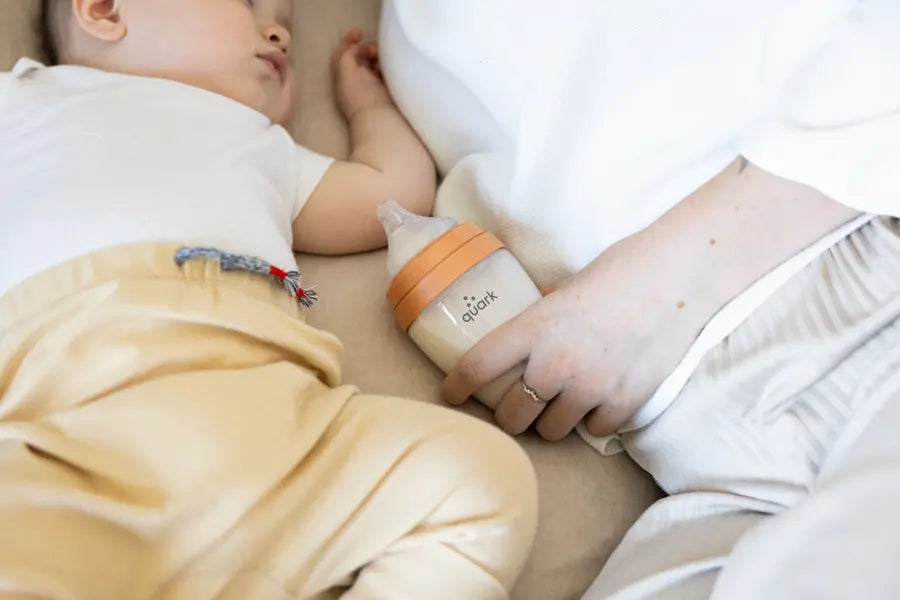
Air pressure changes during takeoff and landing are what make babies uncomfortable, and swallowing helps. The AAP's tip is to have your baby feed from the breast or a bottle, or suck on a pacifier, during takeoff and landing. Landing pressure changes start during the descent, well before the wheels touch down, so save a feed for when the crew announces the descent rather than the last few minutes. Our guide to pacifiers for breastfed babies covers the trade-offs if you have not used one yet.
Two medical points come straight from the AAP. If your baby had ear surgery or an ear infection in the 2 weeks before the trip, ask their doctor whether it is OK to fly. And do not give diphenhydramine (Benadryl) to make your baby sleepy on the flight unless your pediatrician has said it is OK: it can have serious side effects, and some children become more alert, not less. If your baby has a cold or ear infection, ask your pediatrician whether an infant pain reliever is appropriate, and follow the dosage instructions exactly.
Cabin noise peaks during takeoff. The AAP suggests soft earplugs or noise-canceling headphones sized for babies to reduce the load on their hearing.
Getting milk and formula through security
Breast milk, formula, toddler drinks and baby food are allowed in your carry-on in quantities over 3.4 oz (100 ml), under what the TSA calls the reasonable quantities rule. Ice packs, freezer packs and gel packs are allowed too, with or without milk. Three habits make the checkpoint quicker:
- Pack it separately. Keep milk, formula and the water you will mix it with in their own bag, apart from your 3-1-1 liquids, and tell the officer you have them before screening starts.
- Decide about the X-ray in advance. The TSA says its X-ray machines are not harmful to food, and the AAP agrees it should not cause a health problem for your baby. If you would still rather the milk is not X-rayed or opened, say so to the officer; expect extra screening instead.
- Carry the warmer empty. A portable warmer that warms by immersion goes through security dry. Fill it on the other side.
If you are flying with frozen or chilled breast milk, our breast milk storage guide covers how long it keeps and how to thaw it. For the full packing list, see our travel feeding kit checklist.

Warming a bottle at 35,000 feet
Babies do not need warm milk. Room-temperature or even cold milk is fine nutritionally, as we explain in our baby milk temperature guide. But a baby who only takes a warm bottle will not change their mind because you are in seat 23A, and the descent is the worst time to find that out.
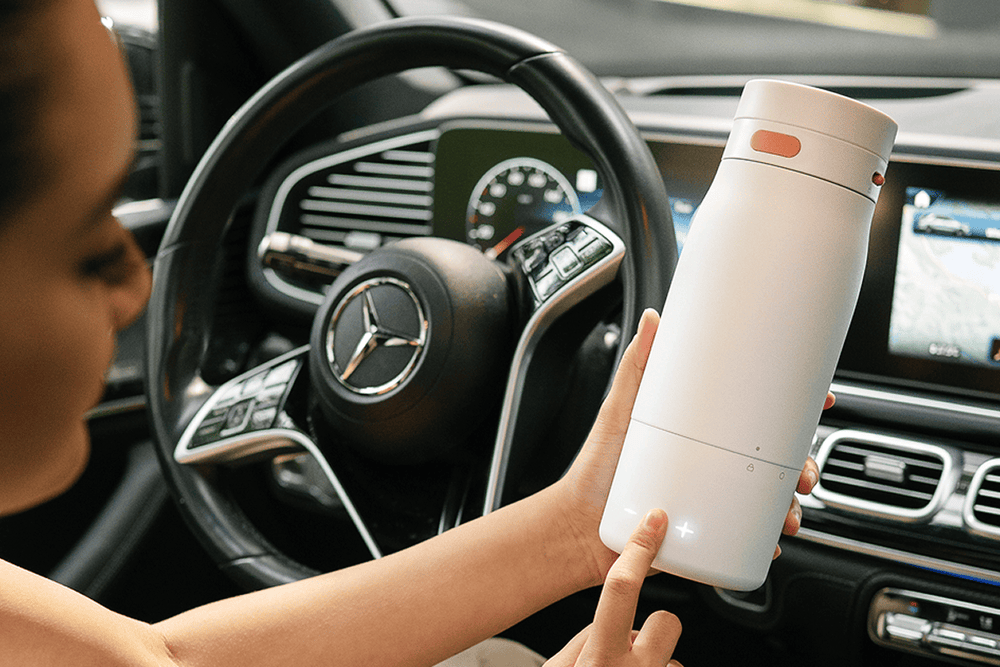
That is the job we built the BuubiBottle Portable Milk Warmer PRO for. It is cordless and silent, you set the temperature to a single degree in Fahrenheit or Celsius, and the wide stainless steel vessel fits most bottles and milk storage bags for warming in water. A Formula Preparation Mode heats water to 158°F (70°C) for mixing powdered formula. It runs all day on a charge and gets back to 80% in about 90 minutes over 30W USB-C, which covers a long travel day and a layover. Keep it in your carry-on, not your checked bag.

If you plan to top it up from a power bank, note the FAA rule: spare lithium batteries and power banks must travel in carry-on baggage only, and if your cabin bag is taken at the gate, the power bank has to come out and stay with you. For a side-by-side of our two warmers, see Portable Milk Warmer vs PRO; for choosing any travel warmer, see how to choose a bottle warmer for car rides and flights.


Smaller bottles suit a plane. A 5 oz BuubiBottle Mini holds less, so there is less milk to warm and less to spill on a tray table. Whatever you use, test the milk on your wrist before you feed: a warmer that holds a set temperature still needs a quick check.

BuubiBottle Portable Milk Warmer PRO
Our pick for flying: cordless and silent, holds the temperature you set to a single degree, with a Formula Preparation Mode.
Shop BuubiBottle Portable Milk Warmer PRO
BuubiBottle Smart warmer
The entry option: our original cordless Smart warmer, for breast milk or formula.
Shop BuubiBottle Smart warmer
BuubiBottle Mini
Starter bottle sized for newborns, with a breast-shaped RealFeel nipple for slow, paced feeds.
Shop BuubiBottle Mini
BuubiBottle Starter Set
Both bottle sizes, Mini and Max, plus 8 vented RealFeel nipples in four flow rates, for trying sizes and flows as feeding changes.
Shop BuubiBottle Starter SetSleep on long flights
Buckled into a car seat is still the safest place for a sleeping baby. On long-haul flights there are other options, each with its own rules:
- Airline bassinets clip to the bulkhead wall. Most airlines limit them to babies under 6 months or 20 lb who cannot yet sit up, and your baby must come out for takeoff, landing and turbulence.
- Sky couch or lie-flat seats are for after the first birthday. The AAP says babies under 12 months are safest in their own space, so sharing a flat seat with a parent does not suit a young baby.
- Inflatable seat extenders need their own ticketed seat, and not every airline allows them. Check before you buy one.
Safe sleep rules still apply in the air. If your baby falls asleep on your lap, stay awake and check that their face is uncovered and their breathing is easy. In a bassinet, the surface should be firm and flat, with no blankets, pillows or soft toys. If you can, book a flight that lines up with your baby's usual sleep; our realistic guide to baby sleep may help you plan around it.
Diapers, layers and the people around you
Change your baby right before boarding, and pack more changing supplies than the flight needs, because delays happen. Ask a flight attendant whether the plane has a changing table; if you end up using the closed toilet seat, keep a hand on your baby the whole time. Dress your baby in layers, since cabins swing between warm and cold while you sit on the runway, and pack a spare outfit or two for you and the baby.
Your baby may cry anyway. The AAP's advice is to ignore the side-eye: for every passenger glaring, others have flown with children and are on your side. Ask for help at every step, from gate check-in to a tight connection. Our five strategies for a first flight with a baby go deeper on the day itself.
Passports and ID
Within the United States, a baby travelling with an adult does not need ID at the TSA checkpoint, and REAL ID rules do not apply to anyone under 18. The airline may still ask for proof of age, such as a birth certificate or passport, when you book a lap-infant or child fare. For international flights, your baby needs their own valid passport. In the US that means applying in person with your baby and Form DS-11, a birth certificate, and two printed photos taken in the last 6 months showing only your baby. Our guide to travelling internationally with a baby covers the rest of the planning.
Common questions
Can a newborn fly?
Yes, from about a week old. The AAP says flying is generally safe once a newborn is at least 7 days old, and ideally you would wait until 2 to 3 months to lower the risk of infection. Airline age limits vary, and babies born early or with health conditions should be cleared by their pediatrician first.
Do I have to buy a seat for my baby?
No, but it is safer. The FAA does not require a ticket under age 2. Both the FAA and the AAP say the safest place for a child under 2 is their own seat in an approved car seat or restraint, because turbulence is the leading cause of children's injuries on planes.
Can I bring breast milk or formula through security?
Yes. The TSA allows breast milk, formula and baby food in carry-ons in quantities over 3.4 oz (100 ml). Pack them separately from your other liquids and tell the officer. Ice packs and gel packs are allowed too.
Is the X-ray safe for breast milk?
Yes. The TSA says its X-ray machines are not harmful to food, and the AAP says screening should not cause a health problem for your baby. You can still ask the officer not to X-ray or open the milk; expect extra screening if you do.
How do I stop my baby's ears hurting on a plane?
Have your baby feed from the breast or a bottle, or suck on a pacifier, during takeoff and during the descent. Swallowing helps with the pressure change. If your baby had an ear infection or ear surgery in the 2 weeks before the flight, check with their doctor before you travel.
Can I use a portable bottle warmer on a plane?
It depends on the airline, so ask. Carry it in your cabin bag, empty through security, and fill it afterwards. Any spare power bank you bring for it must also stay in your carry-on under FAA rules.
Sources
- American Academy of Pediatrics (HealthyChildren.org): Flying With Baby: Parent FAQs & Tips for Safer, Easier Air Travel (last updated 3 March 2026)
- Federal Aviation Administration: Child Safety: Keep Your Little One Safe When You Fly (PDF)
- Federal Aviation Administration: PackSafe: Lithium Batteries
- Transportation Security Administration: Traveling With Children
- U.S. Department of Transportation: Airline Family Seating Dashboard
- Quark Baby: BuubiBottle Portable Milk Warmer PRO product page
Medically reviewed by Dr. Yang. Last reviewed November 19, 2026.
Disclaimer: This article is for educational purposes only and is not a substitute for professional medical advice, diagnosis, or treatment. Always seek the advice of your pediatrician or other qualified health provider with any questions regarding your baby's health or travel.


Leave a comment
All comments are moderated before being published.
This site is protected by hCaptcha and the hCaptcha Privacy Policy and Terms of Service apply.