

Health + Safety
The organic seal is a farming standard, not a contaminant test. Once you know which problem it solves, the baby-food aisle gets a lot easier to shop.
By the Quark Editorial Team · Last updated 24 August 2026 · 9 min read

You are standing in the baby-food aisle holding two pouches of sweet potato purée. Same brand, same weight, roughly the same beige colour through the little window. One has a green seal on it and costs about a dollar more. Your baby is starting solids in four days and you have already read three articles that told you organic is "worth it" without ever saying what, exactly, you were buying.
Here is the short version of the answer, and it is more useful than "yes, buy organic." The seal is a farming and handling standard. It is enforced on the field, the barn and the processing line, not on the finished jar. That makes it very good at one thing (pesticide residues) and silent on another thing parents are often more worried about (heavy metals like lead). Those two worries have different causes and different fixes, and merging them is how families end up spending more money on the wrong lever.
What the organic seal actually certifies
In the United States, the rule is written down in plain regulatory text. Under 7 CFR 205.105, to be sold or labeled as "100 percent organic," "organic," or "made with organic (specified ingredients)," a product must be produced and handled without the use of:
- synthetic substances and ingredients, except those specifically allowed on the National List;
- nonsynthetic substances that the rule prohibits;
- certain nonagricultural and nonorganic agricultural substances in processed products;
- "excluded methods" (the regulation's term for genetic engineering), except for approved vaccines;
- ionizing radiation, as described in FDA regulation 21 CFR 179.26; and
- sewage sludge.
Read that list again and notice what is not on it. There is no maximum lead level. No cadmium threshold. No arsenic ceiling. The regulation governs inputs and methods, and it does that job seriously, but it never promises a number on the finished purée.
Canada works the same way through a different door. The Canadian Food Inspection Agency's Canada Organic Regime allows the "organic" claim and the Canada Organic logo only on products with 95% or more organic content, certified against the national standards CAN/CGSB-32.310 (general principles and management standards) and CAN/CGSB-32.311 (permitted substances lists). Any label claiming 70% or more organic ingredients has to name the certification body that certified it, which is a genuinely useful detail: if you cannot find a certifier's name on a Canadian package making a serious organic claim, that is a reasonable thing to be sceptical about.
The part the seal does not cover: metals come out of the ground
This is the piece that surprises most parents, and the FDA states it directly. In its January 2025 guidance on lead in processed baby food, the agency writes that "potential sources of lead in food include contaminated soil, contaminated water, atmospheric deposition from industrial activities and old lead-containing equipment used to process food," and that agricultural crops such as root vegetables "can take up lead from contaminated soil, water, and air."
A carrot grown without synthetic pesticides is still a carrot grown in soil. If that soil carries a legacy of leaded gasoline, old paint or nearby industry, the carrot draws some of it up regardless of how the farm is certified. Organic certification has no mechanism to change that, because it was never designed to.
Lead in baby food is a soil story, not a farming-method story. Certification governs what gets sprayed onto a crop. It does not govern what the crop pulls up from underneath it.
What regulators do instead is set targets on the finished food. The FDA launched Closer to Zero in 2021 to push exposure to toxic elements in food eaten by babies and young children "as low as possible while maintaining access to nutritious foods." In January 2025 it issued final guidance with these action levels for lead:
If you only skim one thing here: purées sit at 10 ppb, root vegetables and dry cereals at 20 ppb, and none of it is a legal limit.
| Food category (packaged, for children under 2) | FDA action level for lead |
|---|---|
| Fruits, vegetables (excluding single-ingredient root vegetables), mixtures, yogurts, custards and puddings, single-ingredient meats | 10 ppb |
| Single-ingredient root vegetables | 20 ppb |
| Dry infant cereals | 20 ppb |
Source: FDA, Guidance for Industry: Action Levels for Lead in Processed Food Intended for Babies and Young Children, January 2025. The document is headed "Contains Nonbinding Recommendations"; the levels sit under 21 CFR 109.6(d) and inform whether FDA considers enforcement action, rather than setting a legal maximum.
The detail worth carrying home: dry infant cereals are set at double the purée level. That is not a warning to avoid cereal. FDA sets action levels against an achievability assessment, so a higher number reflects what that category can currently reach in practice, not a judgment that cereal is twice as risky.
So does organic actually have fewer pesticides? Yes, and here is the honest size of it
On this question the seal delivers. The American Academy of Pediatrics reviewed the evidence in its clinical report Organic Foods: Health and Environmental Advantages and Disadvantages (Forman J, Silverstein J, Committee on Nutrition and Council on Environmental Health; Pediatrics, November 2012) and concluded that "organic diets have been convincingly demonstrated to expose consumers to fewer pesticides associated with human disease."
The same AAP clinical report (Pediatrics 2012;130(5):e1406–15) is equally clear about the limits. Current evidence, the academy writes, "does not support any meaningful nutritional benefits or deficits from eating organic compared with conventionally grown foods," and there are "no well-powered human studies that directly demonstrate health benefits or disease protection as a result of consuming an organic diet." It also found no evidence of harm from an organic diet. Two true things at once: measurably fewer pesticide residues, and no demonstrated health outcome attached to that reduction yet.
It helps to know what the baseline actually is. The Canadian Food Inspection Agency's Children's Food Project bought 298 samples of infant and toddler food in the Ottawa and Gatineau areas in August and September 2019 and tested all of them for pesticide residues. The overall compliance rate was 99.7%. Metals were tested on 251 of those samples. The agency's stated conclusion: "All data was reviewed by HC and no health risk was identified to Canadian infants and toddlers in any of the foods tested."
So the choice is not between a safe option and a dangerous one. It is a choice between a compliant baseline and a lower-residue version of the same compliant baseline, at a price premium the AAP notes organic foods "regularly command."
If you are already worried about the jar in your cupboard
Action levels are manufacturing targets, not a safety cliff for a jar you already opened. They tell a company what FDA expects it to achieve across production. Health Canada reviewed the CFIA sampling above and identified no health risk in any of the foods tested. If your baby has an exposure history you are worried about, that is a blood-lead conversation with your paediatrician, not a pantry-purge decision.
Which one should you actually buy?
Our view, plainly: buy conventional produce in variety before you buy organic in narrow rotation. If your grocery budget stretches to organic across the board, it is a reasonable thing to spend money on and the pesticide reduction is real. If it does not stretch, spending the difference on a wider range of fruits, vegetables, grains and proteins does more for your baby than buying the same three organic purées over and over. That is not us hedging. It is the direction the AAP itself points: the academy tells parents "the most important thing for children is to eat a wide variety of produce, whether it's conventional or organic."
Best for: organic suits families who want lower pesticide exposure and can absorb the premium without cutting produce volume. Conventional suits families who would otherwise buy fewer fruits and vegetables, which is the trade that actually costs a baby something.
| Certified organic | Conventional | |
|---|---|---|
| Synthetic pesticides permitted in growing | No (except National List) | Yes, within legal residue limits |
| Typical pesticide residue level | Lower (AAP 2012) | Higher, 99.7% compliant in CFIA 2019 sampling |
| Heavy metal limit set by the seal | None | None |
| Subject to FDA lead action levels | Yes | Yes |
| Genetic engineering permitted | No | Yes |
| Demonstrated nutritional advantage | None found (AAP 2012) | None found (AAP 2012) |
| Price | Premium | Baseline |
Four things that lower exposure more than the seal does
1. Rotate what goes in the bowl. Variety is the lever both AAP and FDA keep returning to, because a single food eaten daily concentrates whatever that food happens to carry. If your baby has been on sweet potato for two weeks, the next step is not organic sweet potato. It is a different vegetable. Our guide to baby food combinations by age is built around rotation for exactly this reason.
2. Wash and peel, especially root vegetables. AAP's advice to parents is direct: "Wash and scrub fruits and veggies under running water. This can help reduce any traces of pesticides that remain on the surface." FDA makes the parallel point for metals, noting that manufacturers may be able to reduce lead levels "by using practices such as thoroughly peeling root vegetables and thoroughly washing fruits and vegetables, particularly leafy vegetables." The same two actions work in your kitchen.
3. Do not let the price gap shrink the produce. A baby eating six conventional vegetables is ahead of a baby eating two organic ones. If you are still deciding how to start, our signs your baby is ready for solids piece covers first foods, and baby-led weaning covers the other route.
4. Know which foods you would actually avoid. Some of the real first-year risks have nothing to do with farming methods: honey before twelve months, choking hazards, added salt. We list them in foods to avoid with your baby.
If you make it yourself, be precise about what that fixes

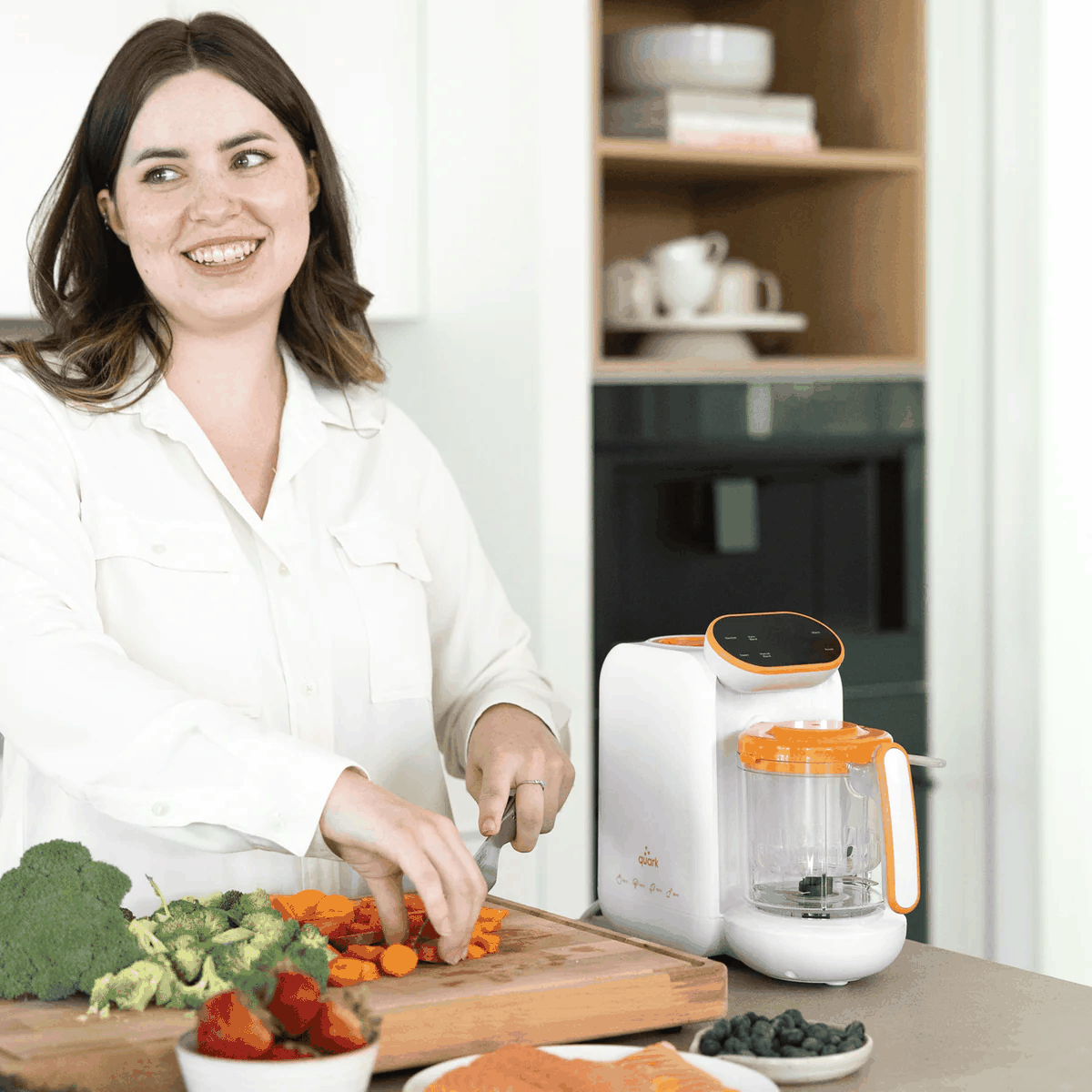
Homemade purée gives you real control over ingredients, salt, sugar, texture and freshness. It does not remove metals that a plant took up from the soil. Same carrot, same field, different kitchen. Anyone selling you a food processor on a heavy-metals argument is selling you something the machine cannot do.
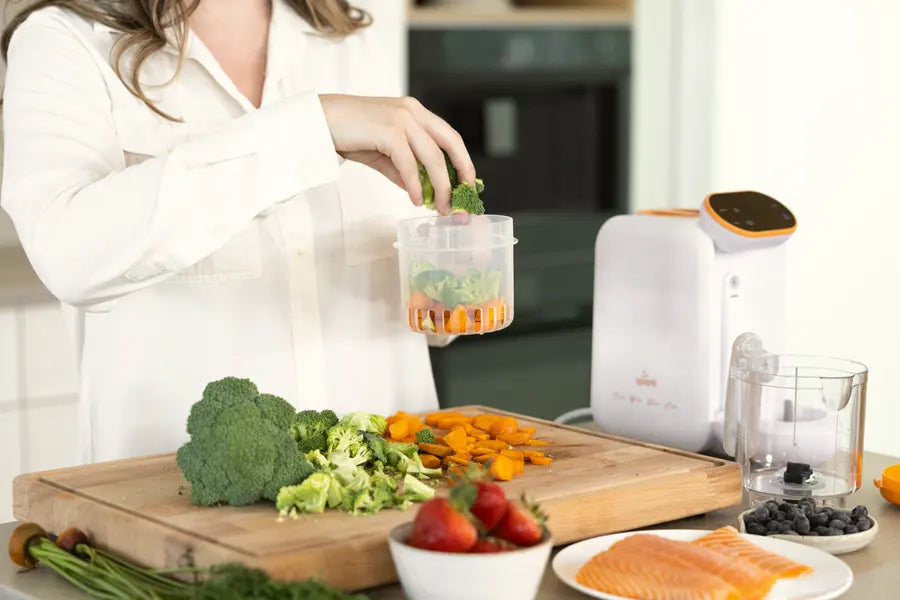
What homemade genuinely changes is narrower and still worth having: you choose the produce, you do the peeling and washing that both AAP and FDA describe, you decide how often the menu rotates, and you control what the food sits in afterwards. If you want the practical version, start with how to start making homemade baby food and ten easy homemade recipes. If you are weighing the time cost honestly, baby food maker versus store-bought purées lays out where each one wins, and what to actually cook in one covers the range.
The container question is the one place we can answer from our own testing rather than by citing someone else. In an SGS-CSTC report dated 4 February 2024 (report number QDHL2401001434CW), commissioned on our BuubiBottle Mini+Max feeding range, six soluble heavy metals (antimony, arsenic, barium, cadmium, chromium and selenium) were tested across nine separate parts by ICP-OES referencing ASTM F963-17 Clause 8.3, and all results came back not detected against detection limits of 2.5 to 10 mg/kg. Total lead and total mercury were also not detected, below detection limits of 0.002% and 0.0001% respectively. Two honest caveats, because they matter: "not detected" means below those stated detection limits rather than absolute zero, and the report covers the models and parts submitted for that test in early 2024, not our whole catalogue and not the food you put inside.
For storage, the boring advice is the durable one: portion, chill fast, label with a date. Our summer storage guide covers the timings. The Chiill silicone freezer tray portions a batch into single servings with a lid that actually seals, and the Storii cooling containers clip in an ice pack for the trip to daycare. If you want steaming, blending, warming and sterilising in one appliance instead of four, that is what the Quook 5-in-1 baby food maker is for.
Common questions
Is organic baby food safer than conventional?
It depends on which risk you mean. For pesticide residues, organic is measurably lower and the AAP says so directly. For heavy metals, the seal makes no difference at all, because those come from soil and water rather than from spraying. For microbial safety, neither label tells you anything; handling and storage do.
Does organic baby food contain less lead?
No, not because of the organic certification. Lead enters crops from contaminated soil, water and air, and organic standards do not regulate it. Both organic and conventional packaged baby foods fall under the same FDA action levels: 10 ppb for purées and mixtures, 20 ppb for single-ingredient root vegetables and dry infant cereals.
Does washing produce actually remove pesticides?
Yes, partly. AAP tells parents to "wash and scrub fruits and veggies under running water," which reduces residues sitting on the surface. It will not remove what the plant absorbed internally, and it is not a substitute for buying from a compliant supply chain. It costs thirty seconds and it is worth doing on everything.
Is homemade baby food lower in heavy metals than store-bought?
No, not automatically. You are cooking the same crops from the same soil. What homemade does change is your ability to peel, wash and rotate ingredients yourself, plus full control over salt, sugar and added ingredients.
If I can only afford organic for a few items, what should they be?
Spend it where your baby eats the most volume and the most repetition, because that is where residue exposure concentrates. Then stop optimising and spend the rest on range. A wider rotation of conventional produce beats a narrow rotation of organic, and that is the AAP's own framing rather than ours.
What does "95% organic" mean on a Canadian package?
Under the Canada Organic Regime, only products with 95% or more certified organic content may be labelled or advertised as "organic" or carry the Canada Organic logo. Anything claiming 70% or more organic ingredients must also print the name of its certification body on the label, which gives you something checkable rather than a vibe.
Are organic purées more nutritious?
The AAP's 2012 clinical report found that current evidence "does not support any meaningful nutritional benefits or deficits from eating organic compared with conventionally grown foods." Nutrition is a reason to widen the menu, not a reason to pay the premium.
Where this leaves you in the aisle
Pick up the organic pouch if the extra dollar is comfortable. It buys a real, documented reduction in pesticide residues, and that is a legitimate thing to want for a seven-month-old. Just do not expect it to answer the heavy-metals question, because that answer lives in soil chemistry and food-safety regulation, not on the front of the package. The move that helps your baby most is the unglamorous one: more different foods, washed properly, rotated often, stored well. That is available at every price point in the store.
Sources
- Electronic Code of Federal Regulations, 7 CFR § 205.105 — Allowed and prohibited substances, methods, and ingredients in organic production and handling. Accessed 20 August 2026.
- U.S. Food and Drug Administration, Guidance for Industry: Action Levels for Lead in Processed Food Intended for Babies and Young Children, January 2025 (nonbinding recommendations).
- Forman J, Silverstein J; Committee on Nutrition; Council on Environmental Health; American Academy of Pediatrics. Organic foods: health and environmental advantages and disadvantages. Pediatrics. 2012 Nov;130(5):e1406–15. doi:10.1542/peds.2012-2579.
- American Academy of Pediatrics, HealthyChildren.org, Protecting Children from Pesticides: Information for Parents. Last updated 5 March 2020.
- Canadian Food Inspection Agency, Children's Food Project — Annual Report 2019 (298 samples, August–September 2019).
- Canadian Food Inspection Agency, Regulating organic products in Canada (Canada Organic Regime; CAN/CGSB-32.310 and CAN/CGSB-32.311).
- SGS-CSTC Standards Technical Services (Qingdao) Co., Ltd., report no. QDHL2401001434CW, dated 4 February 2024, commissioned by Quark Baby LTD on the BuubiBottle Mini+Max range.
Medical disclaimer: This article is general information for parents and is not medical advice. It does not replace guidance from your paediatrician, family doctor or a registered dietitian who knows your child. If you have a specific concern about your baby's diet, growth or a possible contaminant exposure, speak with your child's healthcare provider.


Leave a comment
All comments are moderated before being published.
This site is protected by hCaptcha and the hCaptcha Privacy Policy and Terms of Service apply.