


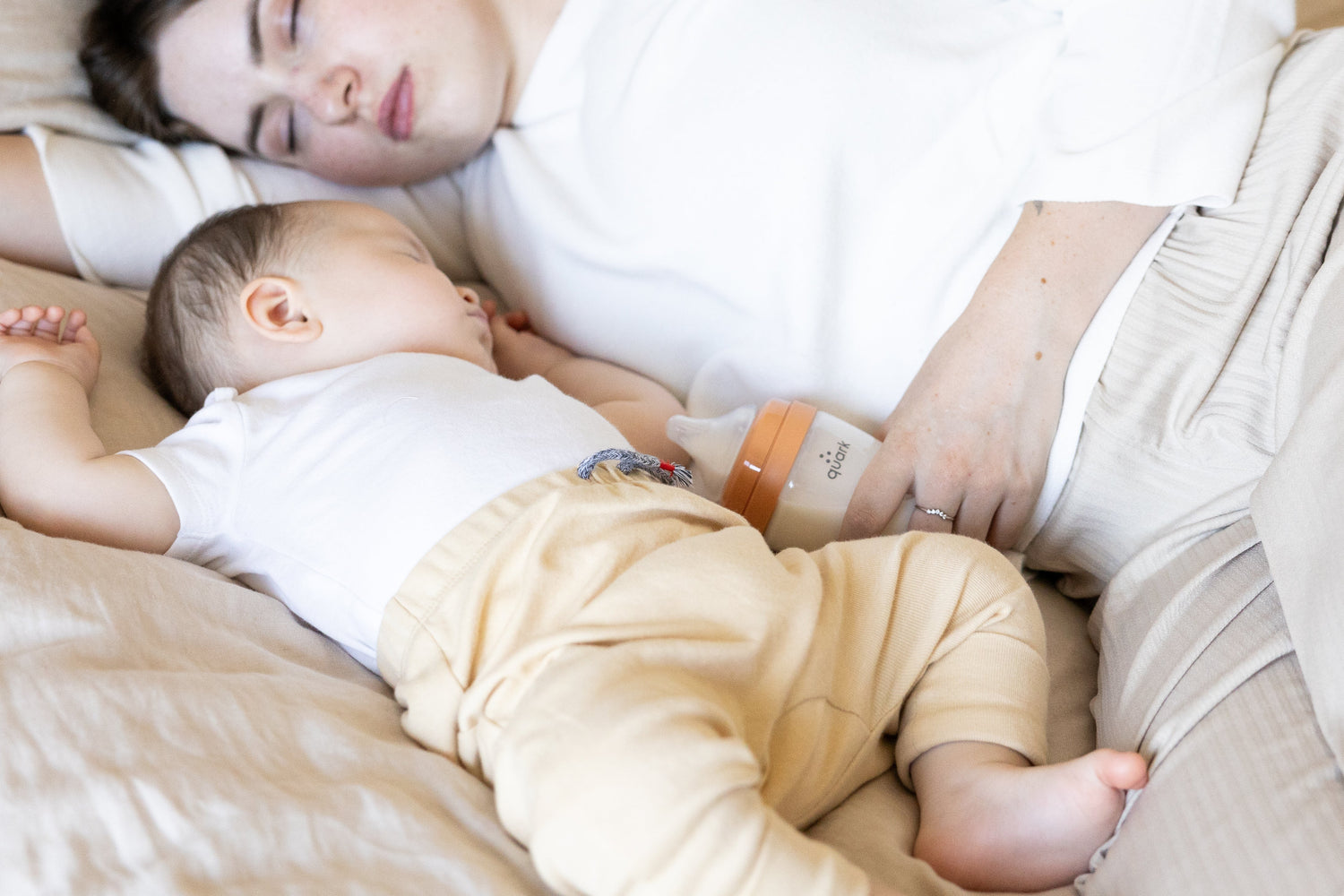
Quick answer: Night feeding is normal and necessary in the early months — newborns have tiny stomachs and need to eat around the clock. Most babies gradually need fewer night feeds as they grow, and many full-term, healthy babies start consolidating longer night stretches somewhere between 3 and 6 months. There is no single "right" age to night wean; the gentlest approach is to follow your baby's growth and cues and confirm timing with your pediatrician before dropping feeds.
Medically reviewed by Dr. Yang · June 12, 2026.
By Justin Gurinskas, Co-Founder, Quark Baby. Information reviewed against American Academy of Pediatrics (AAP), Canadian Paediatric Society (CPS), and La Leche League guidance.
This article is for general information and is not medical advice. Every baby is different. Premature, jaundiced, or underweight babies, and babies with any medical concern, need a feeding and sleep plan set by their own pediatrician. Always confirm your baby's feeding plan with your healthcare provider before making changes.
What is night feeding, and why does it matter early on?
Night feeding simply means feeding your baby during the overnight hours. In the newborn weeks it is not optional — it is how your baby gets enough nutrition to grow and, if you are breastfeeding, how your body learns to build a full milk supply. Newborns have stomachs about the size of a ping-pong ball, so they typically need to feed every 2 to 3 hours, day and night. La Leche League notes that frequent feeding, including overnight, is normal and helps protect supply.
Because night waking is so common, it helps to reset expectations: a baby who still wakes to feed is usually doing exactly what their body is built to do. The goal of this guide is not to stop night feeds as fast as possible, but to help you recognize when fewer night feeds become appropriate, and to make the transition gentle for both of you.
Typical night feeding patterns by age
These are general patterns, not a schedule to enforce. Your baby's growth, weight, and your pediatrician's guidance always come first. Use the table below as a rough map of what many families experience.
| Age | Typical night feeds | What's usually going on | Night weaning? |
|---|---|---|---|
| Newborn (0–6 weeks) | 2–4+ overnight | Tiny stomach, frequent feeds protect weight gain & milk supply | No — feed on demand around the clock |
| ~2–4 months | 1–3 overnight | Stomach capacity grows; some babies start longer stretches | Not usually — follow your baby's cues |
| ~4–6 months | 0–2 overnight | Many full-term babies can consolidate a longer night stretch | Possible for some — ask your pediatrician first |
| 6+ months | 0–1 overnight | Solids often starting; night feeds may be habit as much as hunger | Often appropriate — go gradually, with guidance |
The AAP notes that many full-term babies start consolidating sleep between about 2 and 4 months, and that most formula-fed babies no longer need a middle-of-the-night feed somewhere between 2 and 4 months of age or once they pass roughly 12 pounds. Breastfed babies often feed more frequently at night for longer, which is normal. Premature or underweight babies follow their own timeline set by their pediatrician.
Why babies wake at night
Not every night waking is hunger. Babies wake for many reasons: a genuinely empty stomach, comfort and closeness, a developmental leap, teething, illness, or simply surfacing between sleep cycles and needing help to resettle. Distinguishing hunger from habit is the key question behind most night-weaning decisions.
Signs the waking is likely hunger: your baby feeds eagerly and takes a full feed, then settles. Signs it may be habit or comfort: your baby takes only a few sips before drifting off, or is easily soothed back to sleep without feeding. If you are unsure, or if your baby has been losing or not gaining weight, treat the wakings as hunger and talk to your pediatrician before cutting feeds.
Signs your baby may be ready to reduce night feeds
Readiness is about your baby, not the calendar. Many families look for a cluster of these signs before gently reducing night feeds — and confirm with their pediatrician first:
- Your baby is back to and past their birth weight and gaining steadily.
- They are taking full, robust feeds during the day.
- Night wakings are getting shorter or your baby takes only a little before resettling.
- Your pediatrician has confirmed your baby no longer needs the overnight calories.
- For older babies, solids are well established and daytime intake is solid.
If your baby is sick, teething, or going through a developmental leap, it is kinder to pause night weaning and pick it back up when things settle.
Gentle strategies for reducing night feeds
The calmest transitions are gradual. La Leche League's guidance on weaning is to go slowly, drop one feed at a time, and remember that the nighttime feed is usually the last to go. Pick the approach that fits your baby's temperament and your own energy, and give each change several nights before judging it.
Drop one feed at a time
Rather than cutting all night feeds at once, eliminate the one your baby seems to need least, hold steady for several nights, then reassess. This protects milk supply for breastfeeding parents and is gentler on your baby.
Gradually shorten the feed
For breastfeeding, shorten the time at the breast by a minute or two every few nights. For bottle-feeding, reduce the volume in small steps. The feed slowly becomes small enough that your baby stops asking for it.
Stretch the interval
When your baby wakes, try a non-feeding comfort first — a gentle pat, re-swaddle, or a few minutes of soothing — to push the next feed slightly later. Over time the gaps lengthen on their own.
Offer comfort instead of milk
For wakings that look like habit rather than hunger, a parent's calm presence, a soft shush, or a clean diaper can resettle your baby without a feed. If they truly need to eat, feed them.
Try a dream feed
A dream feed is a feed you offer your baby while they are still drowsy, often before you go to bed, to "top them up" so they may stretch longer before the next waking. It works for some babies and not others; treat it as an experiment, not a rule.
A sample gentle night-weaning approach
This is one example of how a gradual transition might unfold for an older baby whose pediatrician has confirmed they no longer need overnight calories. It is illustrative, not a prescription — your baby may move faster or slower.
- Nights 1–4: Shorten the first night feed slightly and offer comfort first at any second waking.
- Nights 5–8: Drop the smallest night feed entirely, resettling with comfort instead.
- Nights 9–12: Shorten the remaining feed and stretch the interval before it.
- Nights 13+: Replace the last feed with comfort once your baby consistently takes very little. Pause and back off any time your baby is sick, teething, or clearly hungry.
Frequent night feeds are far less exhausting when cleanup is fast. An easy-to-clean, anti-colic bottle like the BuubiBottle Mini newborn bottle is designed to reduce the air-swallowing that causes gas and fussiness, so a half-asleep feed is less likely to end in a wide-awake baby. For families warming milk overnight, planning ahead with the Quook all-in-one warmer and sterilizer can shorten the time between a hungry cry and a ready bottle.
Keeping night feeds safe
Safe sleep matters most at the exact moments night feeds happen — when a baby is drowsy and being moved. A few non-negotiables, drawn from the AAP and the Canadian Paediatric Society:
- Back to sleep, every sleep. After a night feed, place your baby on their back, on a firm, flat, non-inclined surface, in their own crib or bassinet, with no loose bedding, pillows, or soft toys.
- Never prop the bottle. Propping a bottle so a baby feeds unattended is a choking and ear-infection risk and is never safe — always hold your baby for the feed.
- If you feed while bed-sharing, return your baby to their own sleep surface afterward. The CPS advises putting your baby back in their crib, cradle, or bassinet after each nighttime feed.
- Stay alert. If you are very tired, feeding in a chair or sofa risks falling asleep with your baby in an unsafe position; a firm seat and good lighting help you stay awake.
If you have any concern about your baby's breathing, weight, or feeding, contact your pediatrician — these safety practices support, but never replace, your healthcare provider's advice.
Taking care of yourself
Broken sleep is hard, and exhaustion is real. Share night duties with a partner where you can, sleep when your baby sleeps, and keep night feeds calm and dim so everyone resettles faster. If you feel persistently low, anxious, or unable to cope, that is worth raising with your own doctor — your wellbeing is part of your baby's wellbeing.
When to talk to your pediatrician
Reach out to your healthcare provider if your baby is not gaining weight, has fewer wet diapers than expected, seems hard to wake for feeds, is unusually sleepy or floppy, or if night feeds suddenly increase after a period of longer sleep. Always confirm the timing of any night weaning with your pediatrician, especially for premature, small, or medically complex babies.
Where to go next
Sorting out night feeds often leads straight into the next questions: should you ever wake a sleeping baby, and what to do when feeding gets fussy. Our guide to whether to wake your baby for feeding time covers the newborn-stage exceptions, and our complete guide to baby feeding problems walks through gas, reflux, and fussy feeds. For gear that makes feeds easier, browse our bottles collection or the everyday Feedi silicone dining set for when solids begin.
Frequently asked questions
When can my baby safely stop night feeds?
There is no fixed age. Many full-term, healthy babies start needing fewer night feeds between about 4 and 6 months, and the AAP notes most formula-fed babies no longer require a middle-of-the-night feed somewhere between 2 and 4 months or once they pass roughly 12 pounds. Breastfed babies often feed at night for longer, which is normal. Always confirm timing with your pediatrician before dropping feeds, especially for premature or small babies.
How do I know if my baby is waking from hunger or just habit?
If your baby feeds eagerly and takes a full feed before settling, the waking is likely hunger. If they take only a few sips and drift off, or resettle easily without feeding, it may be comfort or habit. When you are unsure, or if your baby isn't gaining weight, treat it as hunger and check with your pediatrician before cutting feeds.
What is the gentlest way to night wean?
Go gradually. Drop one feed at a time, or slowly shorten the feed by a minute or a small volume every few nights, and offer comfort first for wakings that look like habit. La Leche League notes the nighttime feed is usually the last to go, so be patient and pause any time your baby is sick or teething.
How many night feeds are normal at 6 months?
It varies widely. By 6 months many babies are down to zero to one overnight feed, especially once solids are established, but plenty still wake to feed and that can be perfectly normal. Use your baby's growth and your pediatrician's guidance rather than a fixed number.
Is it safe to night wean while still breastfeeding during the day?
Yes, for many families. It is common to wean only the night feeds while continuing to breastfeed during the day. Go gradually to protect your milk supply and avoid engorgement, dropping one feed at a time, and check with your healthcare provider or a lactation consultant if you have supply concerns.
Can I prop the bottle so my baby feeds back to sleep?
No. Propping a bottle so your baby feeds unattended is a choking hazard and raises the risk of ear infections, and it is never safe. Always hold your baby for the feed, then place them back on their back in their own crib or bassinet to sleep.
How do I keep night feeds safe?
Follow safe-sleep basics from the AAP and Canadian Paediatric Society: after every feed, place your baby on their back, on a firm flat surface, alone in their crib or bassinet, with no loose bedding. Never prop the bottle. If you feed while bed-sharing, return your baby to their own sleep surface afterward.
What is a dream feed and does it help?
A dream feed is a feed you offer while your baby is still drowsy, often before you go to bed, to top them up so they may sleep a longer stretch. It helps some babies stretch longer and does nothing for others, so treat it as an experiment rather than a guaranteed fix.
My baby still wakes to feed at 9 months — is something wrong?
Usually not. Some babies genuinely still need or want a night feed at 9 months, and others wake from habit, teething, or developmental leaps. If your baby is growing well, it is not a problem; if you want to reduce the feeds, do it gradually. Talk to your pediatrician if wakings suddenly increase or your baby seems unwell.
Sources
- American Academy of Pediatrics (HealthyChildren.org) — Sleeping Through the Night
- American Academy of Pediatrics (HealthyChildren.org) — Amount and Schedule of Baby Formula Feedings
- American Academy of Pediatrics (HealthyChildren.org) — How to Keep Your Sleeping Baby Safe (Safe Sleep Policy)
- Canadian Paediatric Society (Caring for Kids) — Safe sleep for babies
- La Leche League International — Weaning: How to Stop Breastfeeding
- La Leche League International — Newborn Breastfeeding Frequency (FAQs)




Leave a comment
All comments are moderated before being published.
This site is protected by hCaptcha and the hCaptcha Privacy Policy and Terms of Service apply.