


Starting solids
Baby-led weaning means skipping purées and letting your baby feed themselves soft finger foods from the start. Most babies are ready at around six months, not before, and the first week is far less eventful than the internet suggests.
Medically reviewed by Dr. Yang · Last reviewed September 1, 2026
The short version. Wait until your baby can sit upright with little support, holds their head steady, reaches for food and no longer pushes it back out with their tongue. Offer one soft food, cut into a finger-length strip, at one meal a day. Sit with them. Expect almost nothing to be swallowed for the first week or two. That is not failure. That is the whole method working as designed.

What baby-led weaning actually is
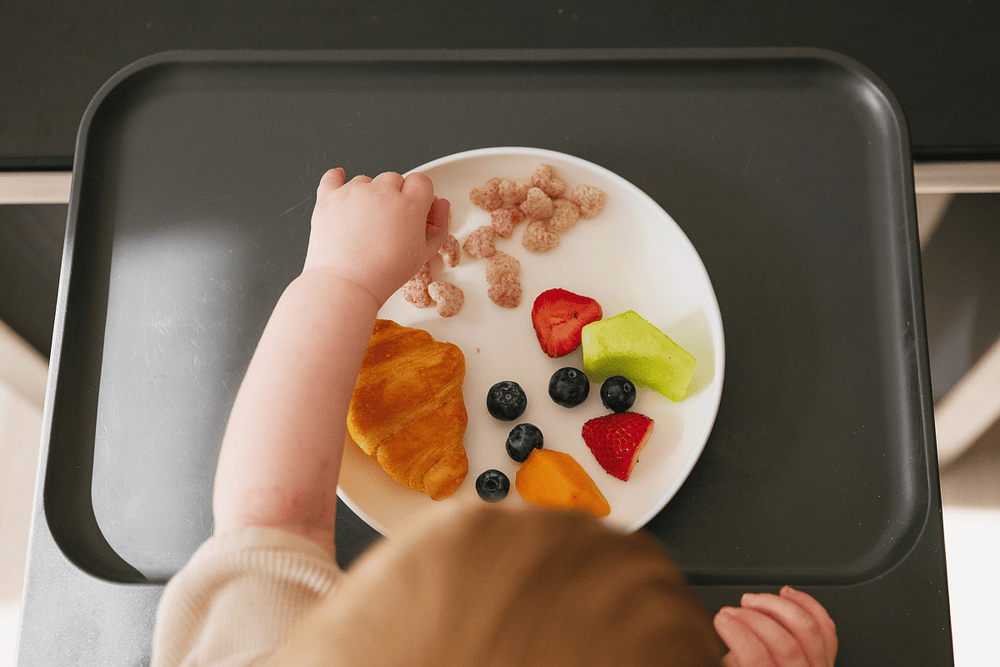
Baby-led weaning is one thing: your baby feeds themselves, with their hands, from the first day of solids. There is no purée stage and no spoon-feeding stage before it. Food goes on the tray in a shape they can hold, and they decide what reaches their mouth.
That single difference is what everything else follows from. Because your baby controls the pace, they stop when they are full rather than when the bowl is empty. Because the food keeps its texture, they learn to move it around their mouth and chew before they swallow. And because you are not operating a spoon, you get to eat your own dinner.
It is worth being clear about what it is not. It is not a rule that purées are forbidden. Plenty of families do both, and our guide to baby-led weaning versus spoon-feeding walks through the trade-offs honestly. It is also not a shortcut. It is messier, slower at the start, and it asks you to sit through a lot of food landing on the floor.
When to start, and why not at four months
Around six months, and not earlier. The World Health Organization recommends exclusive breastfeeding for the first six months, with other foods introduced from six months alongside continued breastfeeding. The American Academy of Pediatrics gives the same window for starting solids.
People search for "baby-led weaning at four months" often enough that it deserves a direct answer: no. The reason is not nutritional, it is mechanical. Baby-led weaning depends on your baby sitting upright, controlling their head, and moving food around their own mouth. A four-month-old generally cannot do those three things, and self-feeding without them is exactly the situation that turns a gag into something worse. If you have been advised to start solids earlier for a medical reason, spoon-fed purées are the safer route until the sitting and head control arrive.
Six months is a guide, not a starting gun. Some babies are ready at five and a half months; plenty are not ready until seven or eight. Babies born prematurely are usually assessed from their corrected age. What you are waiting for is the four signs below, not a date on the calendar. Our piece on signs your baby is ready for solid foods goes through them with photos, and five signs your baby is ready covers what to put on the tray first.
The four readiness signs
All four, not three of four:
| Sign | What it looks like | Why it matters |
|---|---|---|
| Sits upright | Stays upright in a highchair with little or no propping | An upright airway is the single biggest safety factor |
| Steady head and neck | Head does not bob or loll when they turn to look at something | They need to be able to turn away from food they do not want |
| Reaches and grabs | Takes food off the tray and aims it at their mouth | This is the "led" part: no reaching, no self-feeding |
| Tongue-thrust gone | Food stays in rather than being pushed straight back out | The reflex that protects young babies also blocks solids |
Interest in your dinner is not on this list. Almost every five-month-old stares at food. That is curiosity, not readiness.
The first week, day by day
This is the part almost no guide writes down, and it is the part parents actually search for. The honest version: the first week is about getting food into hands, not into stomachs.
Days one to three. One food, one meal a day, at a time when your baby is alert but not ravenous, because a hungry baby has no patience for learning. Mid-morning works for most families. Cut a single soft food into a strip about the length of an adult finger, so a good part of it sticks out of a closed fist. Put two or three pieces on the tray. Sit down opposite them and eat something yourself. Twenty minutes, then done.
Days four to seven. Same meal, same time, add a second food alongside the first so there is a choice. Most of it will be squeezed, dropped, or worn. Some will get chewed and spat out. A little may go down. All of that is normal and none of it needs fixing.
Milk does not change this week. Breast milk or formula is still where essentially all the nutrition comes from until closer to nine months, so keep feeds exactly as they were and offer solids between them rather than instead of them.
What a day looks like as you go
There is no fixed schedule, but the shape is fairly consistent across families:
| Age | Solid meals a day | What changes |
|---|---|---|
| 6–7 months | 1 | Practice. Milk unchanged. Strips they can hold in a fist. |
| 7–9 months | 2 | More gets swallowed. Pincer grip starts, so smaller pieces work. |
| 9–12 months | 3, plus a snack | Solids start displacing some milk. Cup practice with water at meals. |
Around nine months most babies develop a pincer grasp (thumb and forefinger), and you can move from finger-length strips to pea-sized pieces. Until then, strips are safer, because a piece small enough to be inhaled is also a piece too small to be picked up deliberately.
First foods, and how to cut them
The test for a first food is simple: it should squash between your thumb and forefinger with gentle pressure. If it needs force, it is not ready for a baby who has no molars.
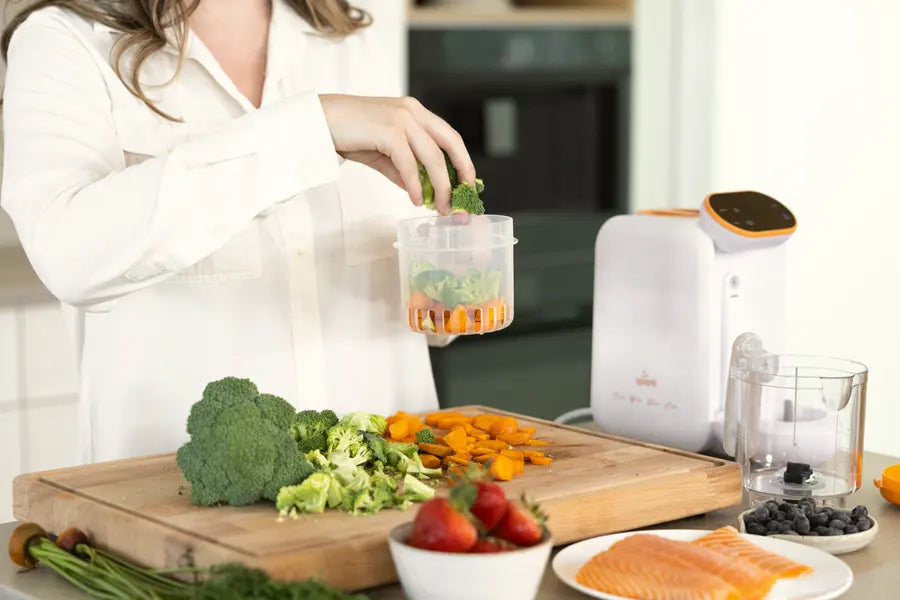
- Steamed until soft: broccoli florets with a stalk to hold, carrot sticks, sweet potato wedges, green beans
- Soft raw: ripe banana with a strip of peel left on as a handle, ripe avocado, ripe pear
- Cooked and cut into strips: omelette, well-cooked pasta shapes, toast fingers with a thin spread
- Protein: soft-cooked chicken strips, flaked fish checked carefully for bones, lentils pressed into patties
Iron is the one nutrient worth being deliberate about from six months, because the stores babies are born with start running down around then. Meat, fish, egg, beans and iron-fortified cereals all count. If you are cooking for the whole family anyway, our baby food combinations guide and easy homemade baby food recipes are built around the same ingredients. For fruit specifically, the seven best fruits for babies covers which ones need cooking and which do not.
Batch-cooking helps more than any gadget. Cook once, portion, freeze. Our guide to baby food storage has the fridge and freezer times, and storing homemade baby food in summer covers the warm-weather margin. If you want to make your own from scratch, how to start making homemade baby food is the practical version.
Gagging is not choking
This is the section that matters most, and it is the one most guides skip.
Gagging is loud, red-faced, noisy and normal. It is a reflex that pushes food forward when it goes too far back, and in a six-month-old it triggers very easily, and that is protective rather than dangerous. Your baby will retch, their eyes will water, they will push the food out, and then they will usually carry on. New babies gag a lot. It settles as they learn.
Choking is silent. No noise, no cough, no crying. That silence is the signal, because it means air is not moving. It is the opposite of what the gagging looks like.
The practical consequence: if your baby is making noise, let them work it out and keep your own face calm. If they go quiet and cannot cough, that is when you act. Every parent starting solids should know infant choking first aid before the first meal, not after. The American Academy of Pediatrics guidance on choking prevention is the place to start, and an in-person infant first-aid course is better still.
Three rules that remove most of the risk before it starts: baby sits fully upright, never reclined or in a car seat; someone stays at the table for the whole meal; and no one, including older siblings, puts food into the baby's mouth for them.
Foods to leave off the tray
- Round and firm: whole grapes, cherry tomatoes, blueberries. Quarter them lengthways, not across.
- Hard and crunchy: raw carrot, raw apple, nuts, popcorn, hard crusts. No molars means no grinding.
- Sticky: nut butter straight from the spoon, large sticky lumps. Spread thinly instead.
- Honey, in any form, before twelve months.
- Salt and added sugar. Season your own portion after you have set the baby's aside.
Allergens: early and one at a time
The advice here reversed within the last decade, so it is worth saying plainly: the common allergens are now introduced early rather than delayed. Peanut, egg, dairy, wheat, soy, sesame, fish and shellfish all belong in the first months of solids, not held back until the toddler years.
The method is unglamorous. Introduce one new allergen at a time, in the morning rather than at bedtime, on a day when you are not going anywhere. Give a small amount, wait, and if nothing happens over the next couple of days, keep it in the rotation, because regular exposure is the part that matters. Then move to the next one.
Two caveats worth knowing. Whole nuts are a choking hazard regardless of allergy, so peanut goes in as a thin smear of smooth butter mixed into something soft. And if your baby has severe eczema or an existing food allergy, talk to your paediatrician before starting rather than after. That is the group where timing is handled individually. We cover the detail in reducing food allergy risk through early introduction and protecting kids against food allergies.
What tends to go wrong
Quitting in week two. Almost nothing gets eaten for the first fortnight and it feels like it is not working. It is working; swallowing is the last skill to arrive, not the first.
Cutting food too small too early. Before the pincer grip, small pieces are both harder to pick up and easier to inhale. Strips are the safer shape.
Helping. Putting food into their mouth removes the control that makes the method safe. Load a spoon and hand it over if you like, but let them do the last few inches.
Dropping milk feeds too fast. Milk stays primary well past six months. Solids are added around it, not swapped for it.
Fixing the mess. Wiping a face mid-meal ends more meals than any food ever will. A floor mat and a long-sleeved bib cost less than the patience you will otherwise spend.
Common questions
Can you start baby-led weaning at 4 months?
No. Self-feeding needs upright sitting, steady head control and the ability to move food around the mouth, and those generally are not there at four months. Both the WHO and the American Academy of Pediatrics put the start of solids at around six months. If solids are needed earlier for a medical reason, spoon-fed purées are the safer route until the sitting and head control arrive.
How much should my baby actually eat in the first week?
Almost nothing, and that is fine. The first week is practice at holding, mouthing and chewing. Breast milk or formula supplies essentially all the nutrition until closer to nine months, so keep milk feeds unchanged and treat solids as a separate activity rather than a replacement.
Is baby-led weaning safe, given the choking risk?
It depends on setup, not on the method. The evidence does not show baby-led weaning causing more choking than spoon-feeding when the basics are followed: baby fully upright, an adult present for the whole meal, soft foods in strips, and nobody putting food into the baby's mouth. What genuinely raises risk is a reclined baby, an unattended tray, or hard round foods, and those are risks under any feeding method. Learn infant choking first aid before you start.
What is the difference between gagging and choking?
Noise. Gagging is loud, red-faced and normal, and it happens often in the early weeks. Choking is silent, because air is not moving. If your baby is coughing or retching, let them work it out. If they go quiet and cannot cough, act immediately.
Can I do baby-led weaning and purées at the same time?
Yes. Many families do. Purists argue that mixing them muddles the self-regulation, but there is no rule against a spoon-fed yoghurt alongside a tray of strips. Our guide to combination feeding covers how families actually run it.
Do I need special equipment?
No. A highchair that holds your baby fully upright, a surface you can wipe, and food cut into the right shape is the whole list. A fruit feeder is useful for a different job: cold soft fruit for sore gums, where a whole piece would be a hazard. We compare the types in silicone versus mesh feeders. It is not a substitute for hands.
When do babies actually start swallowing much?
Usually somewhere between seven and nine months, once chewing becomes efficient. If your baby is nine or ten months old and still swallowing very little, or is losing interest rather than gaining it, raise it with your paediatrician. That is a reasonable thing to check rather than wait out.
Sources
1. World Health Organization, Breastfeeding — exclusive breastfeeding for the first six months, with complementary foods from six months. who.int
2. American Academy of Pediatrics, HealthyChildren.org — Starting Solid Foods. healthychildren.org
3. American Academy of Pediatrics, HealthyChildren.org — Choking Prevention. healthychildren.org
4. Canadian Paediatric Society, Caring for Kids — Feeding your baby in the first year. caringforkids.cps.ca
Links checked 2026-09-01.
Written by the Quark Editorial Team. This article is general information and is not medical advice. Always consult your paediatrician about your baby's feeding, particularly if your baby was born prematurely, has severe eczema, or has a known food allergy. Learn infant choking first aid before starting solids.



Leave a comment
All comments are moderated before being published.
This site is protected by hCaptcha and the hCaptcha Privacy Policy and Terms of Service apply.