



Somewhere around four months, the advice starts arriving from every direction. A grandparent says a little cereal will help them sleep. A jar says "from 4 months". Your baby stares at your fork. And you wonder whether you are already late.
You almost certainly are not. Our view, after reading what the American Academy of Pediatrics (AAP), the NHS and the World Health Organization (WHO) actually say: watch two things, the calendar and your baby, and start when both agree. Below: the age guidance, the three signs that count, the three that fool almost everyone (including an earlier version of this article), and the first week.
When to start solids: around 6 months
The three big health bodies agree:
- The AAP recommends only breast milk for approximately 6 months, then continued breastfeeding alongside first foods.
- The NHS says to wait until your baby is around 6 months old, "even if labels say it's suitable from 4 months."
- The WHO recommends starting complementary foods at 6 months, alongside breast milk.
Why wait? The NHS explains that milk covers your baby's needs until around then, and that by 6 months most babies are better at chewing and swallowing. Some go straight to mashed and finger foods without needing smooth purées at all.
"Around" matters. If your baby was born early, the NHS advises asking your health visitor or doctor when to begin rather than counting from the birth date.

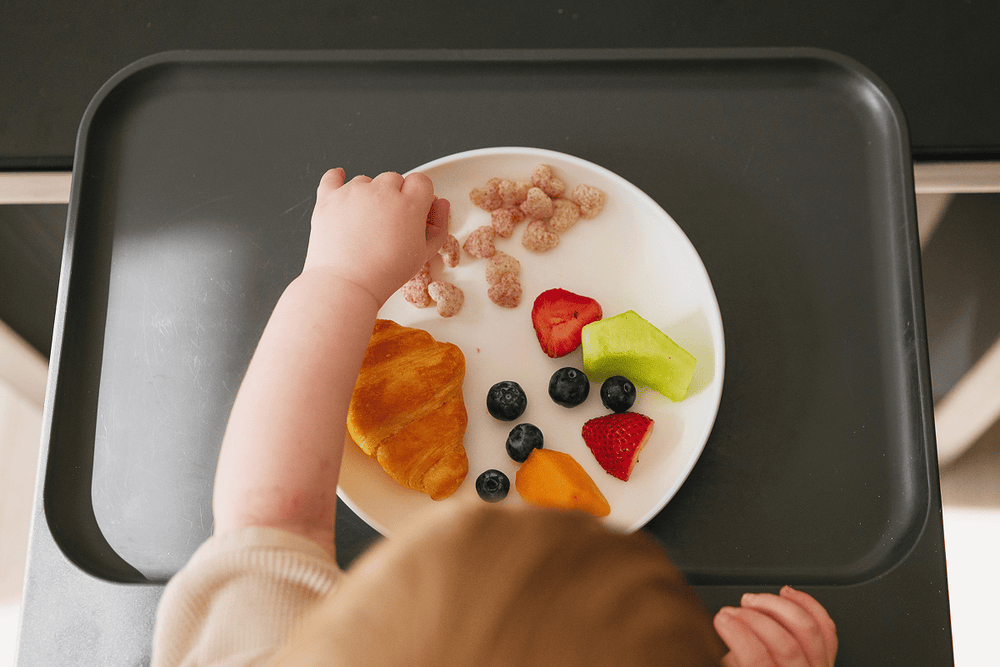
Sitting upright with a steady head and bringing something to her own mouth: two of the three signs in one picture.
The 3 signs your baby is ready for solids
The NHS describes three clear signs that, when they appear together from around 6 months, show your baby is ready. The AAP's checklist asks very similar questions. One sign on its own is not enough.
1. Sits up and holds their head steady
The AAP puts it as being able to sit in a high chair or feeding seat with good head control. Upright posture is also what lets your baby swallow properly, which is why the NHS asks for an upright, strapped-in seat at every meal.
2. Looks at food, picks it up and puts it in their mouth
This is eye, hand and mouth coordination: your baby can look at a piece of food, grab it and get it to their mouth on purpose. The AAP adds the signs you will notice at the table, like watching you eat, reaching for your plate and opening their mouth when a spoon comes their way.
3. Swallows food instead of pushing it back out
Young babies push food out with the tongue. If most of the spoonful slides back down the chin, the AAP says your baby may not yet be able to move food to the back of the mouth, which is normal; you can thin it, or wait a week or two and try again.
The AAP also mentions size: many babies who have doubled their birth weight (typically at about 4 months) and weigh about 13 pounds or more may be ready. We read that as one input next to the three signs above, not a starting signal on its own.
Signs that fool parents (and fooled us)
The NHS lists three behaviours that are often mistaken for readiness:
- chewing their fists
- wanting extra milk feeds
- waking up in the night more than usual
All three are normal baby behaviour, and none of them is necessarily a sign of hunger or of being ready for food. The NHS adds that starting solids will not make your baby any more likely to sleep through the night, and that a little extra milk often helps until they are ready.
An honest note: an earlier version of this article listed a bigger appetite and longer milk feeds as a readiness sign. That was wrong, and we have removed it. If your 4 month old suddenly wants more milk, the answer is usually more milk, not cereal.
The calendar tells you when to start watching. Your baby tells you when to start.
Ready or not yet: a quick check
If you only skim one thing: the first three rows need to be true at the same time, at around 6 months.
| What you notice | Readiness sign? | Source |
|---|---|---|
| Sits up with a steady head | Yes | NHS, AAP |
| Picks up food and gets it to the mouth | Yes | NHS |
| Swallows food instead of pushing it out | Yes | NHS, AAP |
| Watches you eat, opens mouth for a spoon | Supporting sign | AAP |
| Has doubled birth weight, about 13 lb or more | Supporting sign | AAP |
| Chews fists | No | NHS |
| Wants extra milk feeds | No | NHS |
| Wakes more at night | No | NHS |
What if my baby is 4 or 5 months old?
If your baby seems keen at 4 or 5 months, talk to your pediatrician before starting rather than going by a jar label. Both the AAP and the NHS point to around 6 months for most babies, and premature babies need individual advice.
The one group where earlier planning genuinely matters is allergy risk. The AAP says there is no evidence that holding back soft versions of eggs, dairy, soy, peanut products or fish beyond 4 to 6 months prevents food allergy, and that babies with severe eczema and/or egg allergy should be tested for peanut allergy. If that sounds like your baby, ask your doctor how and when to introduce peanut. Our guide to early allergen introduction goes into more detail.
Don't wait too long, either
Starting late has its own cost. The WHO notes that around 6 months a baby's need for energy and nutrients starts to exceed what breast milk provides, and that if complementary foods are not introduced around then, growth may falter. Iron is the nutrient to plan for: the AAP advises including foods that provide iron and zinc, such as baby food made with meat or iron-fortified baby cereal.
Milk still does most of the work at first: the AAP says your baby will get most of their nutrition from breast milk, formula or both early on, so solids add to milk feeds rather than replacing them. If you are worried your baby is eating or gaining too much or too little, that is a question for your child's doctor.

Early meals are mostly practice. Expect more tasting and exploring than eating.
How to start solids: the first week
These steps follow the AAP's Starting Solid Foods guidance and the NHS weaning pages.
- Pick a calm moment. Not starving, not overtired. The AAP suggests a little breast milk or formula first, then food, then more milk, so hunger does not turn into frustration.
- Start tiny. Half a spoonful or less, building to a teaspoon or two. Most will end up on the bib.
- Seat them safely. Upright in a high chair with the harness fastened. The NHS says to always stay with your baby while they eat, in case they start to choke.
- One new food at a time. The AAP suggests one single-ingredient new food every 3 to 5 days, watching for any reaction.
- Follow their cues. If your baby turns away, closes their mouth or cries, stop. The AAP is clear: do not make them eat.
- Keep it soft. Purée, mash, or soft finger-sized pieces. The AAP's list of foods to avoid before age 1 includes whole grapes, nuts and seeds, popcorn, chunks of peanut butter, raw vegetables, hard fruit chunks such as apple, and hot dogs.
Spoon purées or baby-led weaning? Both are fine if the food is safe and your baby is ready; the NHS notes that babies starting around 6 months may not need smooth purées at all. Compare the two in baby-led weaning vs spoon-feeding, or jump into how to start baby-led weaning. If you are making your own purées, our guide to homemade baby food covers the basics, and baby food storage covers what to do with the leftovers. For a full list of what to skip, see foods to avoid for babies.
Drinks change too. The AAP says babies under 12 months should not be given juice, and that it is OK to offer a little water once solids start. The NHS suggests an open or free-flow cup for those sips, and says cows' milk should not be a main drink until 12 months.
If the first tries go badly, that's normal. Gagging is common at the start: the NHS describes it as your baby learning how much food they can manage, and it is different from choking. If your baby refuses the spoon, the AAP suggests going back to milk only for a while and trying again. Stools will change colour and smell once solids start; if they are very loose, watery or full of mucus, the AAP suggests slowing down, and talking to your doctor if it continues.
What you need (less than you think)
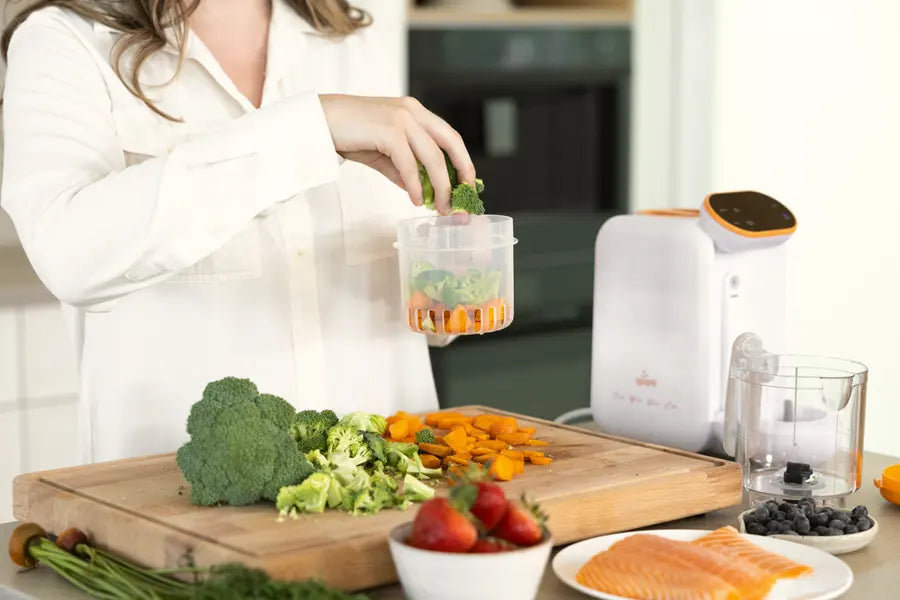
A safe high chair, a soft spoon and a bowl that stays put cover most of the first month. Our Feedi silicone dining set has a suction-base bowl, a compartment plate, a soft spoon and fork and a bib, and the suction helps when your baby's favourite game becomes pushing the bowl off the tray. If you plan to make purées in batches, the Quook baby food maker steams and blends in one appliance. A fruit feeder is optional; read whether a fruit feeder is worth it before buying one, and our first-foods setup for keeping the mess manageable.

Sitting with the family at meals lets your baby watch, reach and copy, long before the first spoonful.
A calmer way to think about it
Starting solids is a slow shift over months, not a single day you can get wrong. Watch for the three signs, start small around 6 months, keep milk feeds going, and let your baby set the pace. Once you are underway, our baby food combinations by age and best fruits for babies give you ideas for the weeks ahead.
Frequently asked questions
Sources
- American Academy of Pediatrics (HealthyChildren.org): When Can Babies Start Solid Foods? Readiness & Feeding Tips (last updated 23 June 2026)
- NHS: Your baby's first solid foods
- NHS Best Start in Life: How to start weaning
- World Health Organization: Complementary feeding
Medically reviewed by Dr. Yang. Last reviewed October 15, 2026.
Disclaimer: This article is for educational purposes only and is not a substitute for professional medical advice, diagnosis, or treatment. Always seek the advice of your pediatrician or other qualified health provider with any questions about your baby's feeding or health.


Leave a comment
All comments are moderated before being published.
This site is protected by hCaptcha and the hCaptcha Privacy Policy and Terms of Service apply.