

Short answer: a fruit feeder is genuinely useful for a narrow window — roughly from the start of solids until your baby can manage soft finger foods on their own — and it is the wrong purchase after that. Most of what parents actually worry about (can the baby bite through it? what is in the silicone that sits in their mouth?) is answerable with laboratory data rather than opinion. This article gives you our own product's third-party test report, including the report number, the detection limits, and an honest account of what that report does not cover.

What problem does a fruit feeder actually solve?
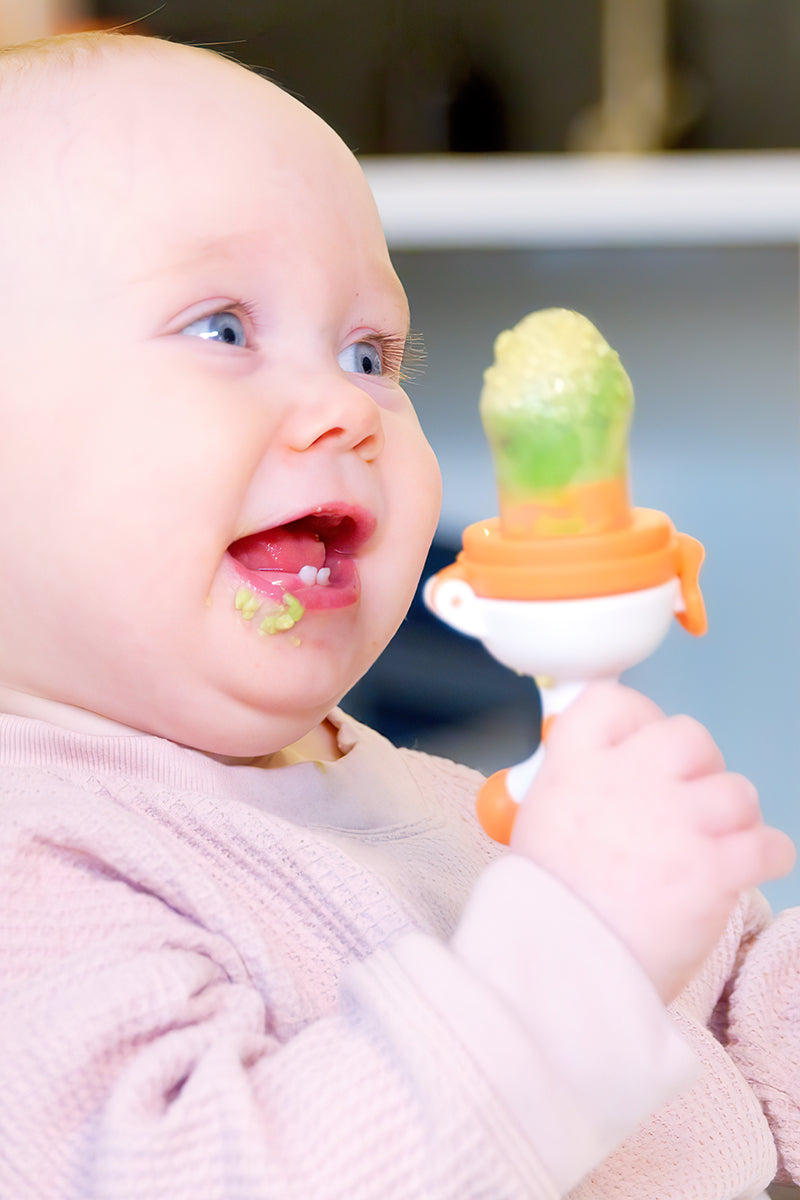
A fruit feeder solves one specific, temporary problem: your baby wants to taste solid food before they can safely chew and swallow pieces of it. The mesh or silicone pouch holds a piece of fruit so your baby gets the flavour, the juice and the chewing sensation, while the pouch keeps a swallowable lump from breaking off.
That problem has a beginning and an end, and both matter for whether you should buy one.
The beginning is the start of solids. Most babies are ready at around six months, once they can sit up with support, hold their head steady, and have lost the tongue-thrust reflex that pushes food back out. Age alone is not the signal — the American Academy of Pediatrics frames readiness in terms of those developmental markers, not the calendar. Our tested models are graded 6m+.
The end arrives sooner than most parents expect. Once your child can pick up a piece of soft ripe peach and manage it themselves, the feeder is no longer protecting them from anything. At that point it is a container you have to wash.
What are parents actually afraid of?
When people search for whether a fruit feeder is good or bad, two fears sit underneath the question: can my baby bite through it and get a piece loose, and what is in the material that spends twenty minutes a day inside my baby's mouth.
Both are testable. Neither is answered by the phrase "BPA-free" printed on a box, because that claim is unverifiable as written — it carries no laboratory, no method, and no detection limit. Below is what an independent laboratory actually measured on our feeder.
What did the laboratory test, and what did it find?
Dongguan NTEK Testing Technology Co., Ltd. tested the Fruuti Baby Fruit Feeder, models QK-6331-3 and QK-6331-4, age-graded 6m+, submitted by Quark Baby LTD of Vancouver, BC. Report number DGT221116031BE01, testing period 16 November to 14 December 2022, report issued 14 December 2022, destination market USA.

Bite and mechanical safety
This is the test that answers the fear parents actually have. Report DGT221116031BE01 records a pass across the full mechanical-safety battery: sharp points, sharp edges, small parts, impact, bite, torque, tension and compression — tested to US CPSC 16 CFR 1500.48, 1500.49, 1501, 1500.51b, 1500.52c and 1500.53e–g.
The bite test is the relevant one for this product category, and it is the result competitor pages almost never publish. If a brand tells you their feeder is safe but will not tell you whether it was bite-tested and under which method, that is a meaningful gap.
Heavy metals
Eight soluble heavy metals (antimony, arsenic, barium, cadmium, chromium, lead, mercury, selenium) were not detected in the transparent silicone nipple component, measured by ICP-MS referencing ASTM F963-17 Section 8.3. The limit of detection was 5 mg/kg, against regulatory limits of 60, 25, 1000, 75, 60, 90, 60 and 500 mg/kg respectively.
"Not detected" is not the same as "zero." It means no amount above 5 mg/kg was found. This distinction matters more than it sounds: any brand that states a flat zero without giving you a detection limit is describing something a laboratory cannot actually measure. The detection limit is the honest part of the sentence.
Lead
Total lead in the accessible substrate was not detected, below a 2 mg/kg detection limit, against a 100 mg/kg regulatory limit. Method: ICP-OES referencing CPSC-CH-E1002-08.03, under the US Consumer Product Safety Improvement Act 2008, Title I, Section 101.
Phthalates
Eight phthalates (DBP, BBP, DEHP, DIBP, DPENP, DnHP, DCHP, DINP) were not detected, with detection limits of 0.003–0.01% against a 0.1% limit, by GC-MS referencing CPSC-CH-C1001-09.4 under 16 CFR Part 1307. Six were then re-tested separately against California Proposition 65 requirements, and were likewise not detected.
Flammability
Result: DNI, did not ignite within five seconds, against a limit of ≤0.1 in./s, tested to US CPSC 16 CFR 1500.44 and ASTM F963-17 Annex A5.
What this report does not tell you
A test report is only as useful as its stated boundaries, so here are ours plainly:
- Report DGT221116031BE01 covers the samples submitted by Quark Baby LTD to NTEK, in those two model numbers. It is not a statement about fruit feeders as a category, and it says nothing about any other brand's product.
- The chemical testing was performed on the silicone mouth component — the part that goes in your baby's mouth — not on every component of the product.
- NTEK issued the report on 14 December 2022. It is a report on tested samples, not a certificate for the batch currently on a shelf, and we are not presenting it as one.
- It tells you nothing about whether a fruit feeder is developmentally appropriate for your baby. That is a conversation with your paediatrician, not a laboratory question.
- A passed bite test describes an undamaged sample. It does not describe a pouch that has been chewed daily for four months. That is what the inspection habit below is for.
How do you use one without creating a new risk?
- Sit alongside, the same as any first solid food. A feeder makes the piece smaller; your presence is what makes it work.
- Inspect the pouch before and after every use. Look for splitting, thinning, or separation where the pouch meets the ring. Replace it on any damage. This is the failure mode that actually matters in month four — not the material, which was tested, but the wear, which was not.
- Keep your baby upright — the same posture you would use for any first solid food (not in a reclined or car seat).
- Frozen for teething, ripe for taste. Frozen fruit soothes gums; ripe fruit introduces flavour. They are different jobs.
- Wash it immediately after use. Pulp left in a pouch is the real hygiene problem with this product category, and it is far easier to prevent than to fix.
- Retire it at the end of the window. When your child manages soft finger foods confidently, stop using it rather than stretching its life.

When is a fruit feeder the wrong buy?
We would rather lose the sale than have you buy something that sits in a drawer. Skip it in these situations:
- Your baby already handles soft finger foods confidently. You have passed the window. Buying one now adds a washing-up job and no new capability.
- You want it to free up your hands. A feeder makes the piece smaller — it does not put an adult in the room. Like any first solid food, it works with you sitting alongside.
- You want it for purées. A spoon is faster and less messy. A feeder works best with whole pieces — frozen banana, melon, peach, mango — not with something already smooth.
- You are buying it as a teether first and a feeder second. A plain chilled teether is cheaper and easier to clean. The feeder makes sense when food is the point.
Silicone or mesh: which should you choose?
This is the decision most parents are actually making, and the honest answer depends on which annoyance you would rather live with.
Mesh transfers flavour and juice more readily, and many babies take to it faster. The cost is cleaning: pulp works into the weave, and the mesh stains and holds odour. In our experience the families who quietly abandon a fruit feeder are overwhelmingly the ones who bought mesh, and cleaning is almost always the reason.
Silicone is far easier to clean, does not trap pulp in a weave, and survives the dishwasher. The trade-off is slightly slower flavour transfer, which most babies stop noticing within a few uses.
If you want a longer side-by-side, we wrote one: silicone fruit feeders vs mesh feeders.
What should you put in it?
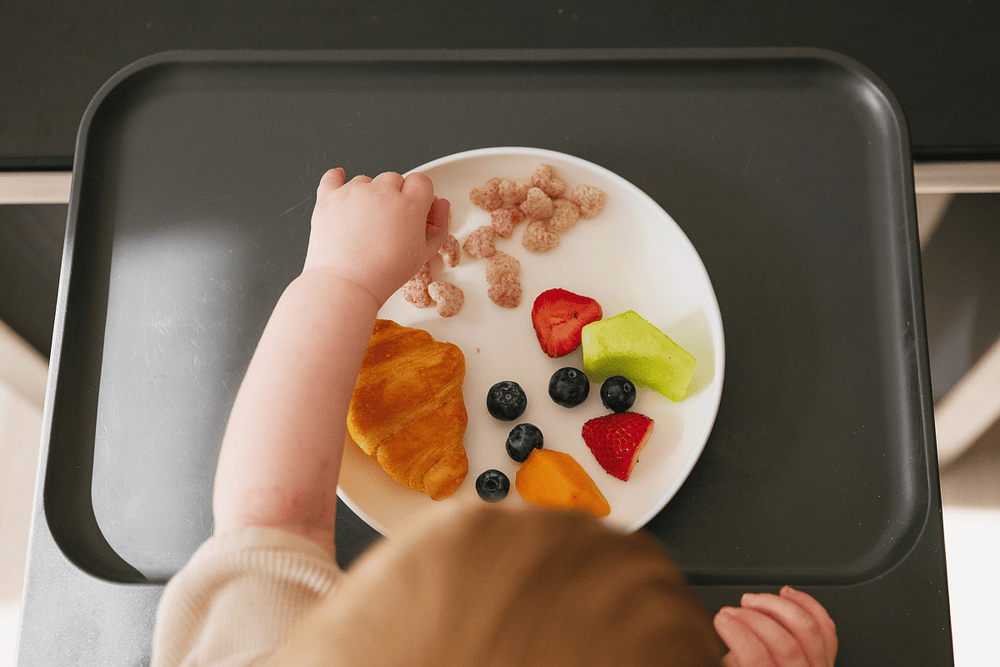
Ripe, soft, and cold covers almost every good case. Frozen banana and frozen melon are the two that do double duty on sore gums. Peach, mango, pear and watermelon all work well once ripe. Avoid anything fibrous or stringy, and avoid pieces small enough to pass through the opening.
We have a fuller list with ages here: the best foods to put in a baby fruit feeder. If mess is your main worry, this one is more practical: how to use Fruuti without the sticky mess.
Common questions
At what age can a baby use a fruit feeder?
Generally from around six months, at the same point solids are introduced, and only once your baby can
sit up with support and hold their head steady. The models covered by report DGT221116031BE01 are
age-graded 6m+.
Can a baby bite through a silicone fruit feeder?
On the models tested in report DGT221116031BE01, the bite test was passed under US CPSC 16 CFR 1500.53.
That result covers the sample submitted in 2022 — not a pouch that has been damaged or worn through
months of use, which is why inspecting before each use matters more than the original certificate.
Is silicone or mesh better?
It depends on which annoyance you would rather live with. Silicone for cleaning and durability; mesh for flavour transfer. Families who abandon a feeder usually
abandon a mesh one, and cleaning is usually why.
Does "BPA-free" mean it is safe?
No, not by itself. "BPA-free" is a claim about one substance, and as printed on packaging it carries no
laboratory, no method and no detection limit. Ask instead which laboratory tested it, under which
method, and to what detection limit. For this product those answers are NTEK, GC-MS referencing
CPSC-CH-C1001-09.4, and 0.003–0.01% — all in report DGT221116031BE01.
Is a fruit feeder worth buying at all?
Yes, for a few months. It gives your baby real food safely at a stage when very little else does.
As a long-term feeding tool, no. If your baby is already eating soft finger foods, keep your money.
If you decide a feeder fits your situation, Fruuti has a twist-to-lock silicone pouch and comes apart completely for washing, which is where most feeders fail.
Sources
- Dongguan NTEK Testing Technology Co., Ltd., test report DGT221116031BE01, issued 14 December 2022; Fruuti Baby Fruit Feeder, models QK-6331-3 and QK-6331-4.
- American Academy of Pediatrics: HealthyChildren.org, infant feeding and nutrition guidance.
- US Consumer Product Safety Commission: 16 CFR Part 1500, hazardous substances and test methods.
- US Consumer Product Safety Commission: 16 CFR Part 1307, prohibition of children's toys containing specified phthalates.
- ASTM International: ASTM F963-17, Standard Consumer Safety Specification for Toy Safety.
- California Office of Environmental Health Hazard Assessment: Proposition 65.
- US Consumer Product Safety Improvement Act of 2008, Title I, Section 101 (lead limits).
Medically reviewed by Dr. Yang · 2 August 2026
This article is general product education, based on NTEK test report DGT221116031BE01 (issued 14 December 2022) commissioned on our own products. It is not medical advice and does not replace guidance from your paediatrician, particularly on when your child is ready for solids.


Leave a comment
All comments are moderated before being published.
This site is protected by hCaptcha and the hCaptcha Privacy Policy and Terms of Service apply.