




Your baby has just discovered that food exists, and every spoonful seems to come with a new question. Is this enough? Should there be meat in it yet? Is peanut butter allowed? Protein is usually where the worry lands, because it sounds like the thing that builds a growing body.
Here is the reassuring part. A baby from 6 to 11 months needs about 11 grams of protein a day, and a few small, soft servings of meat, fish, eggs, beans or tofu get there easily alongside breast milk or formula. The bigger job of those foods is the iron and zinc that come with them. Below: how much your baby needs, which foods have the most (with numbers from the USDA), and how to serve each one safely.
How much protein does a baby need?
About 11 grams a day from 6 through 11 months, and 13 grams a day from 12 through 23 months. Those are the Recommended Dietary Allowances in Table A1-1 of the Dietary Guidelines for Americans, 2020-2025, the U.S. government's nutrition guidance. The total counts everything your baby takes in, milk included.
The same guidelines flag one group in particular: "Older infants who are fed primarily human milk also underconsume zinc and protein from complementary foods." If your baby is mostly breastfed, the solids you add from about 6 months carry more of the load. That is a reason to put a protein food on the tray early, not a reason to wean.
Under 6 months, breast milk or formula covers it. No extra protein food is needed. The AAP recommends "providing your baby only breast milk for approximately 6 months after birth," and the CDC says "Introducing foods before 4 months is not recommended."
What 11 grams looks like. Using the USDA figures in the table below, 1 oz (28 g) of cooked ground beef has about 7.3 g of protein and 1 oz of mashed lentils about 2.6 g. Your baby will not eat 1 oz at a time at first, and does not need to: breast milk or formula still supplies part of the total. A few spoonfuls of meat or fish purée at one meal and some egg or lentils at another is the right shape of a day.
Babies on mostly formula start from a different place, so ask your pediatrician if you are unsure how your baby's milk and solids add up. Our guide to signs your baby is ready for solid foods covers when to begin.
Protein foods also bring iron and zinc
The foods that supply protein are also the ones that supply iron and zinc, two nutrients babies can run short of after 6 months. The Dietary Guidelines describe protein foods ("meats, poultry, eggs, seafood, nuts, seeds, and soy products") as "important sources of iron, zinc, protein, choline, and long chain polyunsaturated fatty acids." The AAP puts it more simply: "Be sure to include foods that provide iron and zinc, such as baby food made with meat or iron-fortified cereals."
The type of iron matters too. The CDC explains that "Heme iron is commonly found in animal products. The body absorbs it more easily than non-heme iron." Plant sources such as beans, lentils and tofu carry non-heme iron. For zinc, the CDC notes it is "especially important for babies who are fed only breast milk," and that "Children 7 to 24 months need 3 milligrams of zinc each day."
So when you choose a protein food, you are really choosing an iron and zinc food. The Canadian Paediatric Society's advice is concrete: "Offer iron-rich foods at least twice per day."

Which baby food has the most protein?
Gram for gram, cooked meat, poultry and fish have the most, then firm tofu, then eggs, then beans and lentils. Plain yogurt has the least of the common choices. Our pick for first protein foods is meat and fish, because they bring heme iron as well. Lentils are the surprise: they carry more iron per 100 g than beef in this table, but it is the non-heme kind, so serve them with a vitamin C food.
The figures below come from USDA FoodData Central (SR Legacy). They describe the food as cooked, not as a full serving for a baby, who will eat far less than 100 g at a time.
| Food (USDA entry) | Protein per 100 g | Protein per 1 oz (28 g)* | Iron per 100 g | Iron type |
|---|---|---|---|---|
| Chicken breast, roasted | 31.0 g | 8.8 g | 1.0 mg | Heme |
| Ground beef, 85% lean, cooked (our first pick) | 25.9 g | 7.3 g | 2.6 mg | Heme |
| Atlantic salmon, farmed, cooked | 22.1 g | 6.3 g | 0.3 mg | Heme |
| Peanut butter, smooth, no salt | 22.2 g | Served thinned, in small amounts | 1.7 mg | Non-heme |
| Tofu, firm (calcium sulfate) | 17.3 g | 4.9 g | 2.7 mg | Non-heme |
| Egg, whole, hard-boiled | 12.6 g | 3.6 g | 1.2 mg | Heme (CDC lists eggs) |
| Lentils, boiled, no salt | 9.0 g | 2.6 g | 3.3 mg | Non-heme |
| Black beans, boiled, no salt | 8.9 g | 2.5 g | 2.1 mg | Non-heme |
| Greek yogurt, plain, whole milk | 9.0 g | 2.6 g | 0 mg | None |
| Yogurt, plain, whole milk | 3.5 g | 1.0 g | 0.1 mg | None |
*Our calculation from the USDA per-100 g value. Iron type follows the CDC's heme and non-heme lists. USDA FoodData Central IDs: 171477, 174032, 175168, 172470, 172475, 173424, 172421, 173735, 171304, 171284 (retrieved November 9, 2026).
The CDC's own list of first proteins reads like a shopping list: "soft, small pieces of beef, lamb, chicken, fish, turkey, eggs, or tofu." For a plant-based baby, the Dietary Guidelines note that "The vegetable subgroup of beans, peas, and lentils also provides a good source of protein and dietary fiber." The CDC adds that "Getting your baby enough iron from non-heme iron sources alone will require careful planning," so talk to your pediatrician if your baby eats no meat or fish.
How to serve each protein safely
The CDC's rule of thumb is short: "It is important to provide foods that match your child's eating skills." In practice, that means:
- Meat and poultry: cook until very soft, then purée, mince or shred. The AAP lists "well-cooked, finely chopped chicken" as a finger food, and warns against "chunks of meat or cheese" under 1 year. Skip processed meats: the CDC names "Processed meats (for example, lunch meats, sausages, hot dogs, ham)" among foods high in salt.
- Fish: remove every bone and flake it soft. The FDA says you can introduce fish "in your baby's diet once they are about 6 months of age." The CDC says to "Avoid feeding fish high in mercury to young children," which means skipping king mackerel, marlin, orange roughy, shark, swordfish, Gulf of Mexico tilefish and bigeye tuna.
- Eggs: fully cooked, scrambled or mashed. The AAP gives "about 1/3 of a well-cooked egg" as one example portion once your baby is eating eggs regularly.
- Peanut and nut butters: never by the spoonful or in globs. The AAP lists "chunks of peanut butter" as a choking hazard, and says "Dissolving peanut butter in breast milk or formula and feeding it by spoon is another good option." Thinning it into cereal, puréed fruit or yogurt works too.
- Beans, lentils and tofu: cook until soft and mash, or cut soft tofu into strips your baby can hold.
- Yogurt and cheese: the Dietary Guidelines say "families can introduce yogurt and cheese, including soy-based yogurt, before 12 months." Choose plain: the CDC says "Infants and young children should not have added sugars."
Whatever you serve, the AAP's test applies: "To prevent choking, make sure anything you give your baby is soft, easy to swallow, and cut into small pieces." See our list of foods to avoid with your baby for the full picture.

Egg, peanut and fish: the allergen question
You do not need to hold them back. The AAP says "there is no evidence that delayed introduction of allergenic foods like egg, peanut, dairy and sesame prevents allergies." The Dietary Guidelines go further for one food: "Introducing peanut-containing foods in the first year reduces the risk that an infant will develop a food allergy to peanuts."
Introduce one new allergen at a time, and the AAP's advice is "Start with small tastes." If your baby has severe eczema or has already reacted to a food such as egg, talk to your pediatrician first: the AAP considers those babies at high risk for peanut allergy. Our guide to early allergen introduction walks through it step by step.
Protein textures from 6 months to toddlerhood
Start smooth and move on as your baby does. The CDC says "You can introduce thicker and more lumpy foods as your child's ability to eat develops," and warns that "It can take time for your child to adjust to new food textures. Your child might cough, gag, or spit up."
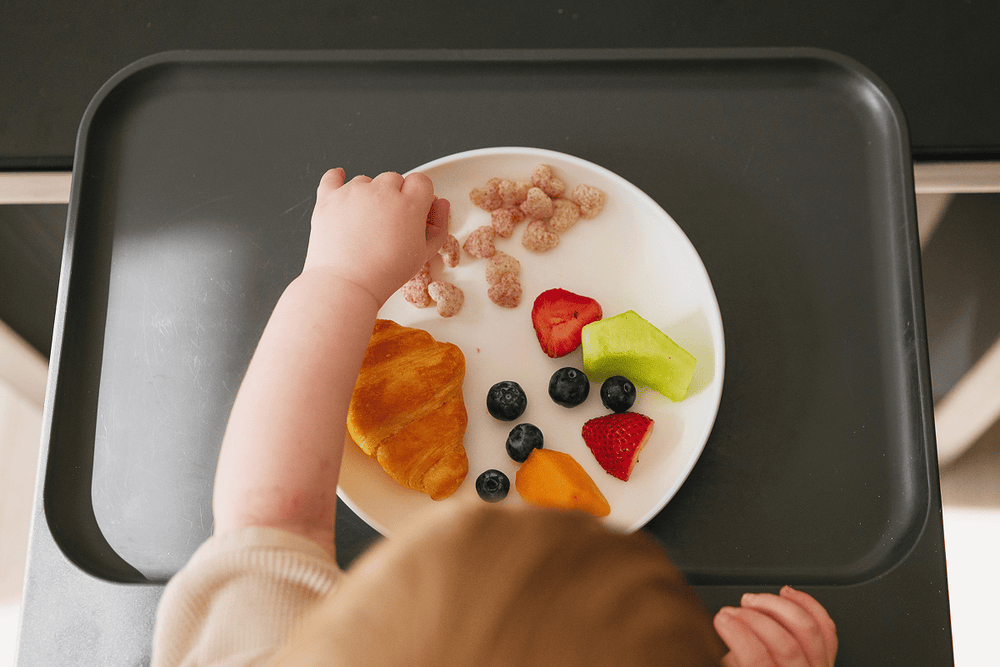
- Around 6 months: puréed meat, poultry or fish thinned with breast milk or formula, mashed lentils, scrambled egg.
- As skills grow (often 8 to 10 months): shredded chicken, soft fish flakes, tofu strips, small soft pieces your baby can pick up. If you are following baby-led weaning, our beginner's guide to baby-led weaning covers shapes and sizes.
- From 12 months: family meals cut small, with protein at most meals. The 13 g daily allowance applies through 23 months.
For toddlers, fish has an official serving size: the FDA's advice for children gives "1 ounce at age 1 to 3," and recommends two servings a week from its Best Choices list, which includes salmon, cod, haddock, tilapia and canned light tuna. It gives no serving size for babies under 1.
Easy protein pairings
Pairing a protein with a vegetable or fruit makes a complete small meal, and pairing plant protein with vitamin C helps iron along. The CDC says "Pairing non-heme iron sources with foods high in vitamin C can help your baby absorb needed iron to support development." A few combinations that work:
- Shredded chicken with mashed sweet potato (or try our chicken, potato and carrot purée)
- Salmon flakes with mashed peas, or our strawberry, salmon and leek purée
- Lentils with soft-cooked tomato or red pepper, for the vitamin C
- Scrambled egg with avocado
- Plain yogurt with a little thinned peanut butter and puréed fruit
More ideas in our baby food combinations by age guide.
Making protein foods at home
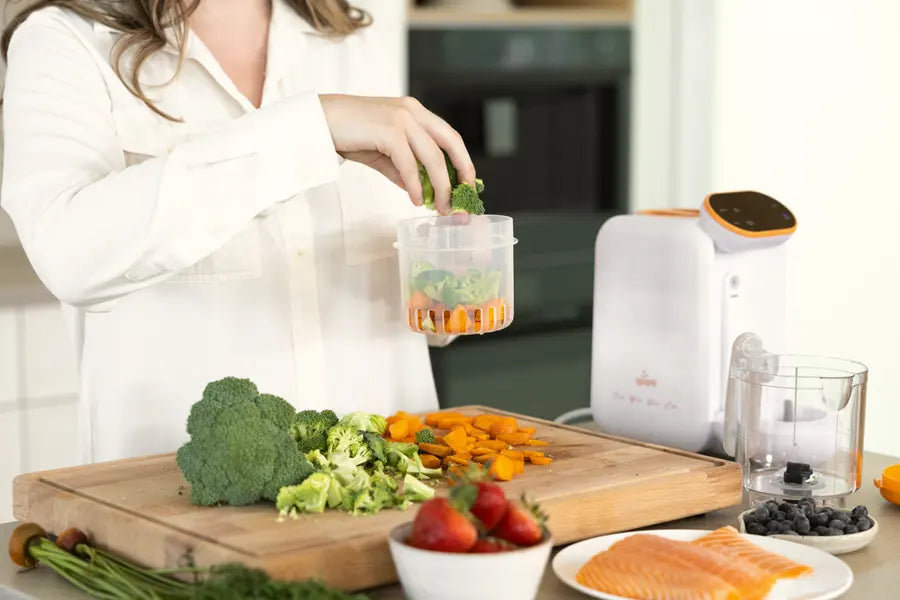
Cooking protein for a baby is mostly about texture: meat has to be soft enough to purée or shred, with no added salt. The AAP says "All fresh foods should be cooked with no added salt or seasoning." Batch cooking helps, because a tablespoon of puréed chicken is hard to make on its own. Our guide to using a baby food maker for meat, vegetables and grains has timings and tips.

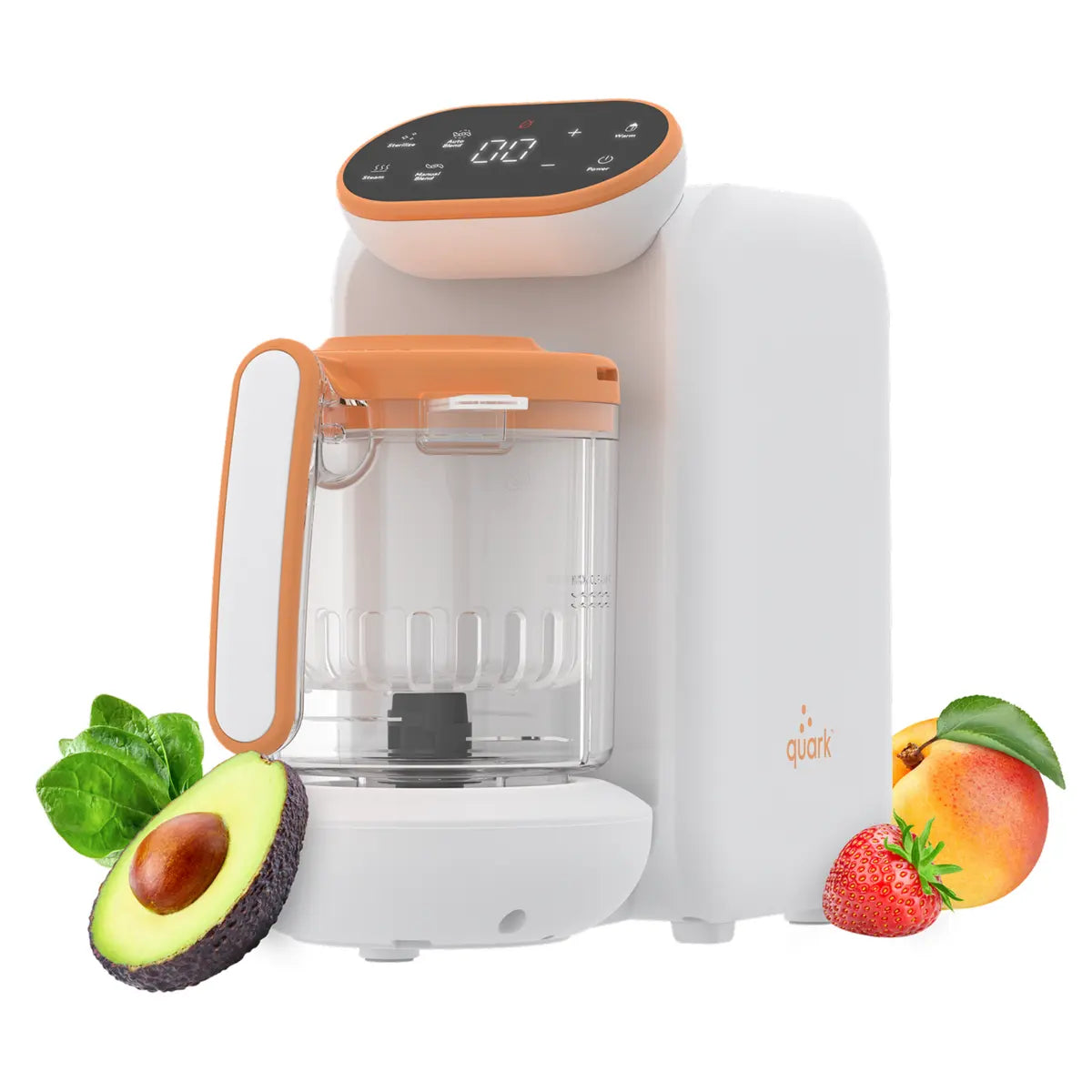
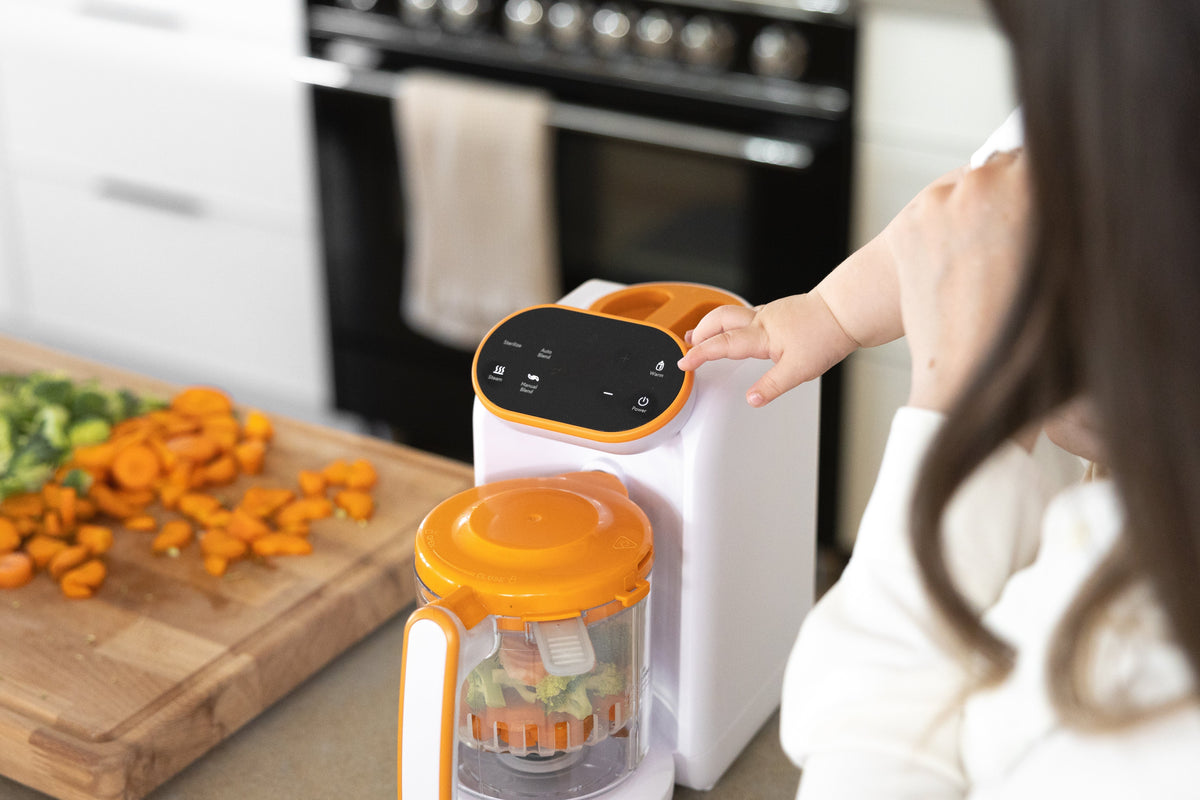
The Quook baby food maker steams and blends in one appliance, so chicken or salmon and a vegetable can steam together and blend to the texture your baby is ready for. Its product page also lists bottle warming, steam sterilizing and a defrost mode. To store the batch, the Chiill freezer tray holds 7 portions of 1.4 oz each under a latching silicone lid, so one portion comes out per meal. For how long cooked purées keep, see baby food storage.

Quook baby food maker
Steam meat, fish and vegetables until soft, then blend in the same jug. Also warms bottles and sterilizes.
Shop Quook
Chiill freezer tray
Freeze a batch of protein purée as single portions: 7 pods of 1.4 oz with a latching lid.
Shop ChiillCommon questions
Can babies get too much protein?
It depends on the source. From ordinary portions of solid food it is not something the guidance we checked warns about. The one case the CDC names is cow's milk as a drink before 12 months: "Cow's milk also has too many proteins and minerals for your baby's kidneys to handle easily." Yogurt and cheese are fine before 1 year; milk as a drink waits until 12 months.
How often should I offer protein foods?
At least twice a day is a good target once solids are going well, because protein foods are your main iron foods, and the Canadian Paediatric Society says to offer iron-rich foods at least twice per day. One serving can be small: a few spoonfuls of meat purée or some scrambled egg.
Do breastfed babies need more protein from food?
Yes, from about 6 months. The Dietary Guidelines say older infants fed mostly breast milk tend to fall short on zinc and protein from solids, so a protein food at most meals helps close the gap.
Can a vegetarian baby get enough protein?
Yes, with planning. Beans, lentils, tofu, eggs, yogurt and thinned nut butters all count. The harder nutrient is iron, so pair plant sources with vitamin C foods and ask your pediatrician whether your baby needs an iron-fortified cereal or a supplement.
What protein foods are good for a 1-year-old?
Most family proteins, cut small and soft: chicken, beef, fish from the low-mercury list, eggs, beans, tofu and plain yogurt or cheese. Aim for the 13 g daily allowance across the day, and keep whole nuts away: the AAP says "Do not feed whole peanuts or tree nuts to babies or young children—they are choking hazards."
Is honey OK in a homemade protein purée?
No. The CDC says "Do not add honey to your baby's food, water, infant formula, or pacifier." That applies under 12 months.
Are protein powders or shakes useful for babies?
No, not as a substitute for food. None of the guidance we checked recommends them for infants, and the foods above deliver protein together with the iron and zinc your baby actually needs. Ask your pediatrician if you are worried about growth.
Sources
- U.S. Department of Agriculture and U.S. Department of Health and Human Services: Dietary Guidelines for Americans, 2020-2025 (December 2020), Chapter 2 and Appendix 1, Table A1-1.
- USDA Agricultural Research Service: FoodData Central, SR Legacy entries listed under the table (retrieved November 9, 2026).
- CDC: Foods and Drinks to Encourage (April 1, 2026); Iron (April 14, 2026); Zinc (April 1, 2024); Foods and Drinks to Avoid or Limit (April 14, 2026); Tastes and Textures (March 13, 2026); When, What, and How to Introduce Solid Foods (April 14, 2026).
- American Academy of Pediatrics, HealthyChildren.org: When Can Babies Start Solid Foods? (updated 6/23/2026); When to Introduce Egg, Peanut Butter and Other Common Food Allergens (updated 6/12/2025).
- U.S. Food and Drug Administration and EPA: Advice about Eating Fish (advice revised October 2021) and its Questions and Answers.
- Canadian Paediatric Society, Caring for Kids: Feeding your baby in the first year.
Medical disclaimer: This article is for general informational purposes and is not a substitute for medical advice. Guidance reflects USDA, CDC, AAP, FDA and Canadian Paediatric Society publications as published when this page was last reviewed. If your baby has a food allergy, severe eczema, trouble swallowing, slow weight gain or was born early, talk to your pediatrician before changing how they eat. Portions of this content draw on AI assistance and are reviewed by a qualified medical reviewer before publication.
Written by the Quark Editorial Team. Medically reviewed by Dr. Yang. Last reviewed November 9, 2026.


Leave a comment
All comments are moderated before being published.
This site is protected by hCaptcha and the hCaptcha Privacy Policy and Terms of Service apply.