


A fruit feeder and a spoon are not competing for the same job. A spoon teaches one kind of feeding skill. A fruit feeder helps with supervised soft-food exploration. The best routine gives each tool a clear lane.

Parents often ask the fruit feeder question as if there has to be one winner: fruit feeder or spoon?
That framing creates the wrong decision. Spoon feeding and fruit feeders solve different problems. A spoon is the simplest way to offer puree, practice opening the mouth, and control portion size. A fruit feeder is useful when the goal is supervised mouthing, tasting, and exploring soft food with a little more containment.
The better question is: what job are you trying to do today?
First, check readiness
Most babies start solids around 6 months, but readiness is developmental. The AAP points to signs such as steady head control, sitting with support, interest in food, and moving food back to swallow. HealthyChildren.org gives the readiness checklist.
Health Canada also frames 6 months as the time to begin complementary foods while breast milk or formula remains central. Health Canada's infant nutrition page gives that broader feeding context.
Neither a spoon nor a feeder makes an unready baby ready. If your baby cannot sit with support or hold their head steady, wait and ask your pediatric provider.
What spoon feeding does well
Spoon feeding is direct. You control the amount on the spoon, the pace, and the texture. That makes it useful when you are introducing a smooth puree, watching how your baby handles a new food, or trying to keep the session short and readable.
It makes portions obvious
With a spoon, you can see how much food was offered and how much your baby actually swallowed. That matters in early solids, when practice matters more than volume.
It supports caregiver pacing
You can pause, wait for your baby to open their mouth, and stop when they turn away. The spoon makes the adult's role clear.
It is easy to keep simple
One bowl, one spoon, one food. For early introductions, simple is a strength.
What a fruit feeder does well
A fruit feeder is better for a different lane: supervised exploration of soft foods that baby can gum, taste, and handle with more containment.
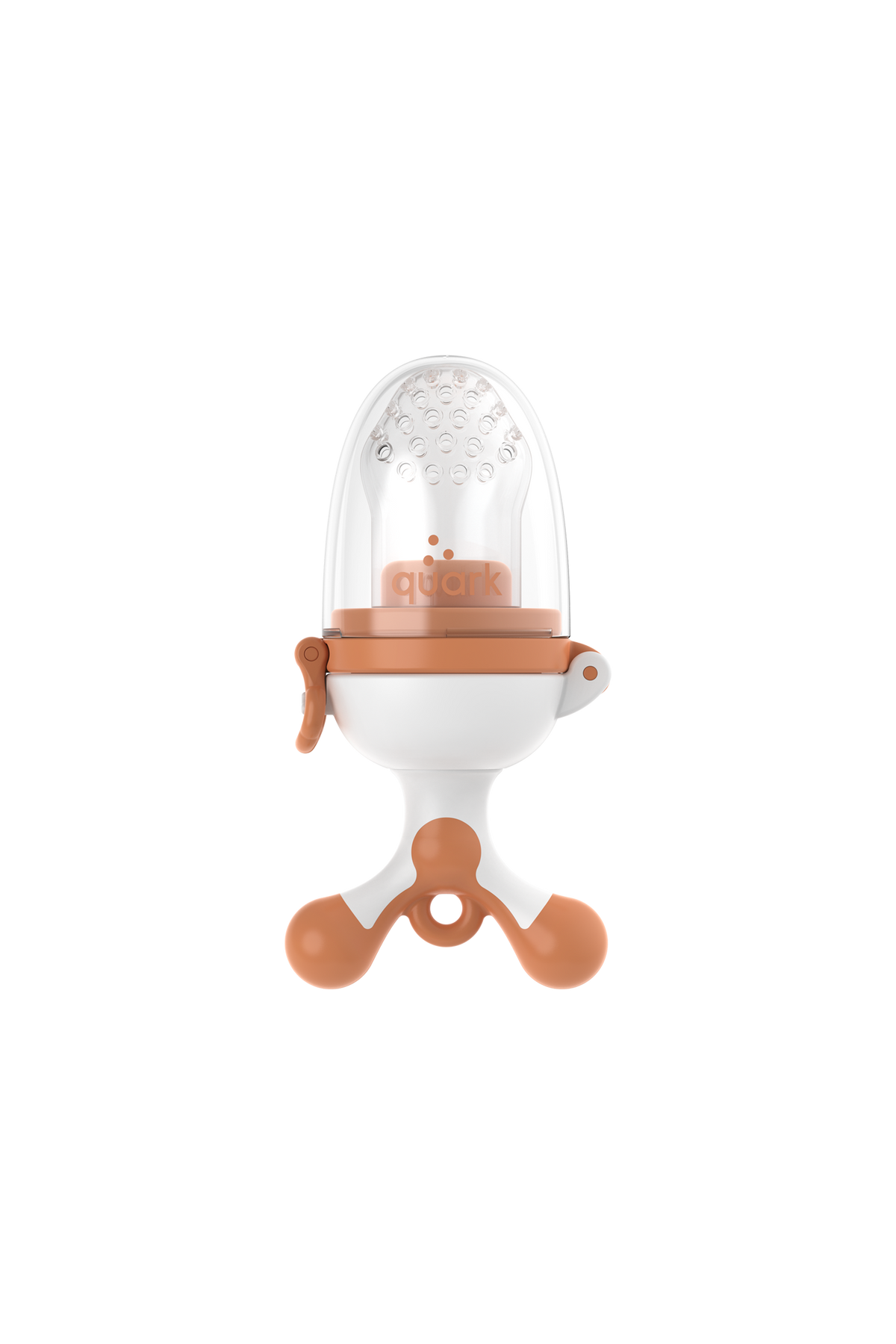
Fruuti Baby Fruit Feeder is a fruit and food feeder with a silicone tip and a twist-to-eject base that pushes soft food forward. The local product source also lists three extra-thick silicone tips and an easy-clean design.
It helps contain slippery soft foods
Ripe banana, avocado, steamed pear, steamed apple, and soft-cooked sweet potato can be hard for a baby to hold. A feeder can make that exploration more controlled while you stay close.
It gives baby more active practice
A spoon is mostly adult-led. A feeder gives baby a little more hand and mouth practice, while still keeping the adult responsible for food choice, posture, and supervision.
It can reduce waste from trapped food
Fruuti's twist-to-eject base is designed to move food through the silicone tip. That can help prevent soft food from sitting at the back of the feeder while baby chews an empty section.
The comparison that matters
| Situation | Better fit | Why |
|---|---|---|
| First smooth puree | Spoon | Clear portion and pace control |
| Familiar soft fruit | Fruuti | More contained exploration |
| Allergy-watch introduction | Spoon | Easier to keep one ingredient and amount clear |
| Teething-day chilled soft food | Fruuti | Useful only if texture stays soft and supervised |
| Caregiver handoff | Either | Pick the method the caregiver can follow safely |
| Learning open textures | Spoon plus age-appropriate finger foods | A feeder is not the whole solids plan |
The practical answer is not to choose one forever. Use a spoon when you want maximum clarity. Use Fruuti when your baby is ready for supervised soft-food exploration and you want a tool built for that job.
Safety rules both tools share
Both tools require the same basics: baby seated upright, adult close by, soft age-appropriate food, and no high-risk choking foods.
Do not use either method with whole grapes, nuts, popcorn, hard raw apple, thick globs of nut butter, hard frozen chunks, or foods that break into firm pieces. The AAP's choking prevention guidance warns against foods that are round, hard, sticky, or require chewing for babies and young children.
How to build a balanced routine
Start with the goal of the meal.
If you are introducing a new puree, use the spoon. If your baby has already tried the food and you want a small taste-and-gum session, use Fruuti. If baby is tired, sick, distracted, or not sitting well, skip the session.
A good first-food routine does not need every tool every day. It needs a clear adult decision before food reaches the highchair.
Common questions
Can Fruuti replace spoon feeding?
No. Fruuti is one tool for supervised soft-food exploration. Spoon practice and texture progression still matter.
Is spoon feeding safer than a fruit feeder?
Not automatically. Safety depends on readiness, food texture, upright posture, and supervision. A spoon gives portion control; a feeder gives containment for certain soft foods.
When should I choose Fruuti over a spoon?
Choose Fruuti for familiar soft foods. It is useful when baby is ready to gum and taste soft food while you stay close.
When should I choose a spoon?
Choose a spoon for new purees or allergy-watch foods. It is easier to keep the amount, ingredient, and pace clear.
Can I use both in the same week?
Yes. Many families use a spoon for purees and Fruuti for soft fruit exploration. Keep each session simple.
Is Fruuti choke-proof?
No. No feeder is choke-proof. Avoid choking-hazard foods and supervise every session.
Sources
- Quark Baby: Fruuti Baby Fruit Feeder product page
- American Academy of Pediatrics / HealthyChildren.org: Starting Solid Foods
- Health Canada: Infant nutrition
- American Academy of Pediatrics / HealthyChildren.org: Choking Prevention
This article is general product and feeding information, not medical advice. For feeding readiness, choking risk, allergies, swallowing, or feeding development, ask your pediatrician or qualified health professional.
Medically reviewed by Dr. Yang This article is general parenting guidance and is not a substitute for advice from your own pediatric provider. If your baby has symptoms that concern you, contact your provider.


Leave a comment
All comments are moderated before being published.
This site is protected by hCaptcha and the hCaptcha Privacy Policy and Terms of Service apply.