


It is 5:40 on a weekday, you are halfway out the door, and the baby is hungry. The pouch in the diaper bag takes four seconds. You have also read somewhere that pouches are "bad", and now you are wondering how many is too many.
We read what the American Academy of Pediatrics (AAP), the CDC, the FDA and two children's health services say about pouches. No health body publishes a daily limit. A pouch on busy days, squeezed onto a spoon, sits comfortably inside the guidance. A pouch most days, sucked straight from the spout, is the pattern worth changing.
How many baby food pouches a day is too many?
There is no official number. None of the pediatric sources we checked gives a daily count. They describe a frequency instead.
KidsHealth, the parent site of the Paediatric Society of New Zealand, puts it this way: "using baby food pouches occasionally doesn't seem to affect weight or iron levels." The same page adds that "if your baby has a pouch most days of the week, they may be getting more sugars," and that pouches "should not be the only solid foods they have." St. Louis Children's Hospital pediatric dietitian Marilyn Tanner-Blasiar is just as direct: "Every now and then, food pouches are fine," and "Just don't use them as a child's main form of nutrition."
Our reading, in numbers: zero to one pouch on a few days a week matches the "occasionally" the guidance describes. One or more every day is the "most days of the week" pattern KidsHealth NZ flags for extra sugar. If most of your baby's solids arrive through a spout, rebalance toward spoon-fed and finger foods. That is our translation of the guidance, not a medical limit.
St. Louis Children's also warns: "Keep an eye on size. Some pouches have more food than a child needs." Watch for hunger and fullness cues rather than finishing the pouch because it is open.
Are baby food pouches healthy?
The food inside is usually fine; the trade-offs come from how often pouches replace other foods. Three issues recur.
Sugar. Many pouches are fruit-led. KidsHealth NZ notes that "pouch foods tend to be sweeter than other commercial baby foods because they contain more fruit," and that babies who have them often "do have around one teaspoon more total sugars a day." It is careful to add: "These sugars are from fruit and are not specifically added to the food." In 2019, UN News reported on two studies of commercial baby foods by the World Health Organization's European office: in three of the four cities studied, "over 30 per cent of the calories in half or more of the products came from sugars," and "Around one-third listed sugar, concentrated fruit juice or other sweetening agents as an ingredient."
Iron. Babies need iron-rich foods once solids begin. The AAP says: "Be sure to include foods that provide iron and zinc, such as baby food made with meat or iron-fortified cereals." KidsHealth NZ observes that commercial pouch, jar and can foods "all tend to be low in iron." A fruit pouch does not cover that.
Fibre and texture. St. Louis Children's notes that "Pureed fruits and vegetables are lower in fiber than whole foods." Smooth purée is right at the very start. The CDC says "You can introduce thicker and more lumpy foods as your baby's ability to eat develops," and KidsHealth NZ suggests that "From around 7 months of age, offer a range of foods with different textures."

Spoon or spout: how you serve it matters most
Squeeze it onto a spoon. It is the most consistent advice in the guidance. KidsHealth NZ: "It's best to squeeze the food onto a spoon to feed to your baby," and "Avoid feeding your baby directly from the pouch nozzle."
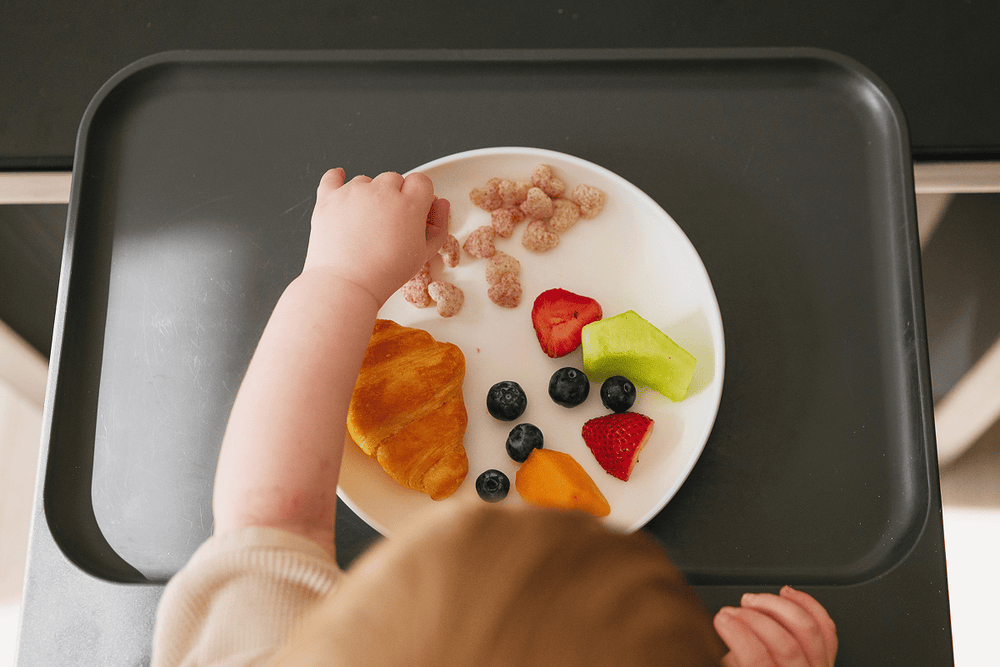
A baby eating from a spoon sees and smells the food and sets the pace. St. Louis Children's adds that "Babies learn motor skills when they touch and hold food," and that "Holding a pouch doesn't teach them hand-eye coordination." Once your baby can sit up and bring things to their mouth, the AAP says "you can give them finger foods to help them learn to feed themselves." Our guide to signs your baby is ready for solid foods covers that milestone.
What about teeth? The honest answer is that nobody knows yet. KidsHealth NZ says: "But it is not yet known if long-term use of baby food pouches is harmful to babies' teeth." The concern is greater for toddlers, who have more teeth and can suck from the nozzle themselves. Spoon-feeding sidesteps the question.
And picky eating? KidsHealth NZ reports that babies "who have baby food pouches frequently are more likely to be fussy eaters," and immediately adds, "But, it isn't yet known what comes first." A fussy eater may simply be offered more pouches, so this is not proof that pouches cause fussiness.

Pouches vs. jars vs. homemade purée vs. finger foods
Pouches win on portability; homemade purée wins on control of ingredients and texture. Our pick for most days is purée you can spoon from a container, plus finger foods as your baby is ready, with pouches kept for the bag. If you are weighing the two styles of starting solids, see baby-led weaning vs. spoon-feeding.
| Format | Texture | Baby sees and smells food | Needs a spoon or bowl | Ingredients chosen by |
|---|---|---|---|---|
| Store-bought pouch, from spout | Smooth | No | No | Manufacturer |
| Store-bought pouch, squeezed onto a spoon | Smooth | Yes | Spoon | Manufacturer |
| Jar | Smooth to lumpy by stage | Yes | Spoon | Manufacturer |
| Homemade purée in a container (our pick) | You choose, smooth to lumpy | Yes | Spoon | You |
| Finger foods | Soft pieces | Yes, and touches it | No, baby self-feeds | You |
What to look for on a pouch label
- Vegetables or a protein near the front of the ingredient list, not fruit alone. Meat-based foods are one of the iron sources the AAP names.
- No added sugar or fruit juice concentrate. These were the sweeteners flagged in the 2019 European studies above. Separately, the AAP says "Babies younger than 12 months should not be given juice."
- An age that matches your baby. The CDC says solids can begin "at about 6 months" and that "Introducing foods before 4 months is not recommended."
- A portion that suits your baby's appetite, and a plan for leftovers. St. Louis Children's: "Throw it away or put it in the fridge if your child didn't eat it all."
About lead: in January 2025 the FDA issued final guidance setting action levels for lead in packaged foods for children less than two years old, explicitly including food "in jars, pouches, tubs, or boxes." The levels are "10 parts per billion (ppb) for fruits, vegetables (excluding single-ingredient root vegetables)," mixtures, yogurts, custards and single-ingredient meats, and "20 ppb for single-ingredient root vegetables." The FDA is clear that this is guidance for manufacturers: "The guidance is not intended to direct consumers in making food choices," and "Parents and caregivers should not throw out processed or packaged baby foods or stop feeding certain foods to babies and young children." These levels apply whether a food is organic or not; our explainer on organic vs. conventional baby food covers what that label controls.
Keeping the convenience, losing the spout
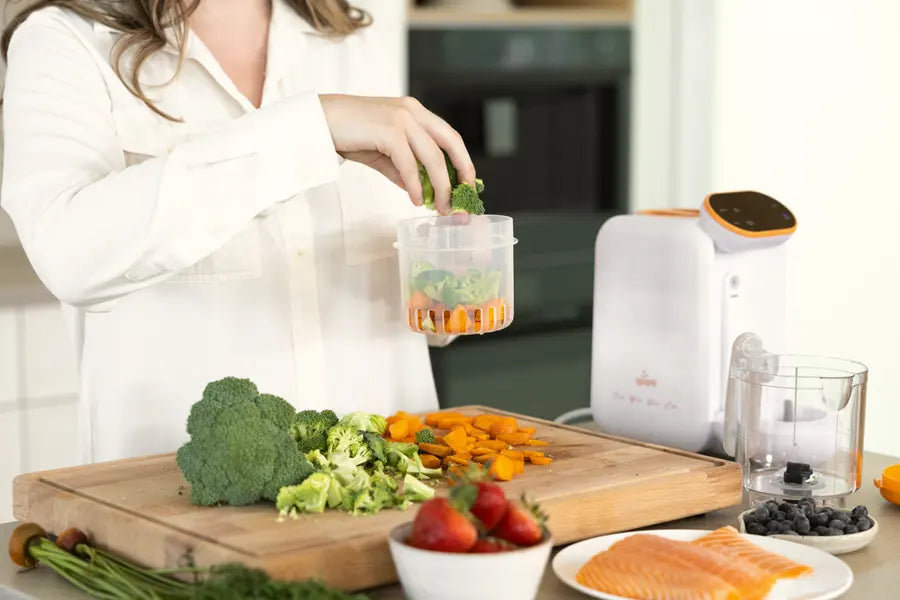
Pouches travel well and need no prep. You can keep both by freezing homemade purée in portions and carrying one out the door in a container. Our guide to baby food makers vs. store-bought purées lays out the time and cost on each side, and these food prep hacks help make a batch session fit into nap time.
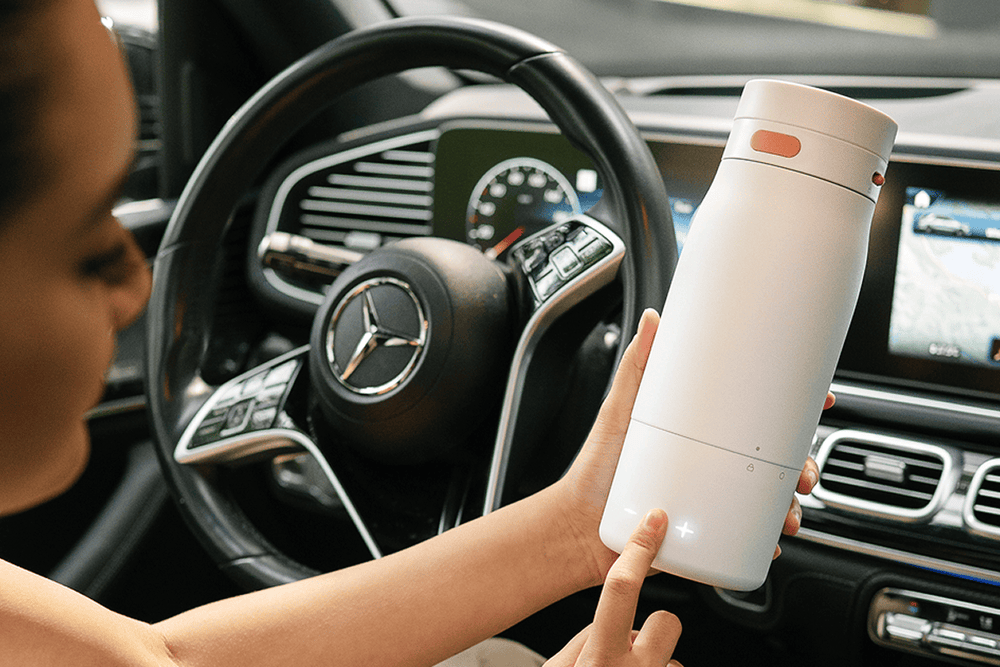
The Chiill freezer tray holds 7 portions of 1.4 oz each with a latching silicone lid, so one portion pops out per meal. To carry it, the Storii container holds 150 ml (5 oz) and has an ice pack that clips into the lid; Quark lists it as keeping food cool for up to 5 hours. It comes as a pack of 3. An independent lab, NTEK, tested Storii models QK-3488-3 and QK-3488-4 in December 2022 (report DGT221214016BE): total lead was below the 2 mg/kg detection limit (not detected). That report covers the container only, not the food you put in it. If you want to cook and blend in one appliance, the Quook baby food maker steams and blends, and it also warms bottles.


Storii cooling containers
150 ml (5 oz) each; the ice pack clips into the lid. Pack of 3.
Shop Storii

Common questions
Are baby food pouches OK every day?
It depends on how much of the day they cover. KidsHealth NZ found occasional use doesn't seem to affect weight or iron, but a pouch most days of the week may mean more sugars. If you use one daily, squeeze it onto a spoon and make sure the rest of the day includes iron-rich foods and different textures.
Can babies doing baby-led weaning have pouches?
Yes, as an occasional extra. Baby-led weaning is built around finger foods your baby picks up, and the AAP supports finger foods once your baby can sit up and bring things to their mouth. A pouch on a travel day does not undo that. Our beginner's guide to baby-led weaning has the details.
Are meat or vegetable pouches better than fruit pouches?
Usually, yes. Fruit-led pouches carry more sugar, according to KidsHealth NZ, and the AAP names baby food made with meat as one source of the iron and zinc babies need.
Can a 4-month-old have pouches?
No, not as a starting point. The CDC says solids can begin at about 6 months and that introducing foods before 4 months is not recommended. Ask your pediatrician before starting early. UN News reported that, in the 2019 European studies, 28 to 60 per cent of products in the four cities were marketed as suitable under 6 months, so the age on the pouch is not a reliable guide.
Are pouches bad for teeth?
It is not yet known. KidsHealth NZ says short-term use around the start of solids does not seem to damage teeth; the long-term effect is the open question. The concern rises once toddlers suck from the nozzle themselves.
Sources
- American Academy of Pediatrics, HealthyChildren.org: When Can Babies Start Solid Foods? (updated 6/23/2026).
- CDC: When, What, and How to Introduce Solid Foods.
- U.S. Food and Drug Administration: Guidance for Industry: Action Levels for Lead in Processed Food Intended for Babies and Young Children (January 2025) and the FDA announcement.
- KidsHealth (Paediatric Society of New Zealand): Commercial baby food pouches (reviewed 9 April 2025).
- St. Louis Children's Hospital: Food pouches make eating on the go easy for kids. But are they a healthy choice?
- UN News: Baby foods high in sugar, inappropriately marketed in Europe, reveal two UN studies (reporting World Health Organization Europe studies, 15 July 2019; we could not retrieve the original release).
- NTEK test report DGT221214016BE (20 December 2022), Storii models QK-3488-3 and QK-3488-4.
Medical disclaimer: This article is for general informational purposes and is not a substitute for medical advice. Guidance reflects AAP, CDC, FDA, KidsHealth NZ, St. Louis Children's Hospital and UN News publications as published when this page was last reviewed. If your baby has trouble swallowing, is not gaining weight, has a food allergy or was born early, talk to your pediatrician before changing how they eat. Portions of this content draw on AI assistance and are reviewed by a qualified medical reviewer before publication.
Written by the Quark Editorial Team. Medically reviewed by Dr. Yang. Last reviewed November 5, 2026.


Leave a comment
All comments are moderated before being published.
This site is protected by hCaptcha and the hCaptcha Privacy Policy and Terms of Service apply.